Forming a senior citizen writing group is one way to explore the value of writing in the lives of older adults. I taught poetry, memoir, and fiction to seniors in their late sixties, seventies, and eighties at Upper Moreland Township School District for six years. Although some of the writers were physically incapacitated in a variety of ways, by the end of the workshop all were actively writing with enthusiastic involvement and participation. They brought their notebooks and pens, and we provided a light snack and coffee or tea.
Several high school students joined us each time to write, share with seniors, and help the seniors by typing their work on district computers in a nearby learning lab. Many seniors were members of the Key Club, a student-led organization that provides its members with opportunities to perform service, build character, and develop leadership. These high school students often wrote side-by-side with seniors during planning and drafting and shared their writing with us. They proved to be a source of motivation and the seniors were our source of inspiration.
The act of writing and the interaction within the group led to a sense of richness and value in the writers’ own lives. Participants often continued writing at home because they wanted to practice and share their work with peers. Initial writing included descriptions, observations, and poetry. Then we moved to our treasured stories – memories of childhood and young adulthood, memories of good times and bad times. This writing led them to want to write more to gain an understanding of their lives and share with others. Finally, the writing selected by the seniors was compiled into an anthology each year and distributed to the seniors. High school volunteers also submitted one piece to add to the collection. The school district graciously paid for publishing costs.
There are few sounds as precious as pure silence in the classroom. While our room usually buzzes with students chattering to one another—reading aloud, sharing important passages, offering analysis—the first 10 minutes of every class period is reserved for independent reading. During this time, silence is preserved; students are immersed in their own worlds, speechlessly anticipating the next plot twist. The steady hum of the projector is all that can be heard.
I must admit that it is not my students, but rather myself, who ultimately loses the quiet game every day. While my students are busy flying around Hogwarts, playing capture the flag at Camp Half-Blood, and raging a rebellion against the Capitol of Panem, I am busy facilitating individual reading conferences. I walk around the room, pull up a stool next to a student, and record their book title and page number on my clipboard. After recording the data, the real fun begins, as we engage in an authentic discussion about their independent reading book. Some of my favorite questions to ask during a conference are:
What’s going on in your book right now?
What has been the most exciting moment in your book so far?
On a scale of 1-10, with 10 being the best, what would you rate this book and why?
How does this book compare to your last one? What makes it better/worse?
Who is your favorite character and why?
What are you planning on reading next?
I also use conferencing time to make book recommendations, expand my own knowledge of YA literature, and generally check in with each student. I value my conferencing time because—in addition to igniting my students’ interest in reading—it allows me to have a differentiated conversation with each student. At the end of each week, I can proudly state that I have had at least one one-on-one conversation with every single one of my 100 students.
The importance of allowing students time to read independently in the classroom has been proven time and time again by teacher-author superstars such as Penny Kittle, Kelly Gallagher, and Nancie Atwell. The 10 minutes of independent reading in my classroom is sacred; every now and then throughout the school year, I have to relinquish this time due to two-hour delays, standardized testing, what have you. The few times where I do this prompts a chorus of sighs and groans and “NO.”
So, when faced with the multiple challenges of distance learning, the barrier that posed the most threat to my classroom environment was the loss of my independent reading conferences. How am I supposed to ignite a love of reading if my students are not setting aside time to read every day?
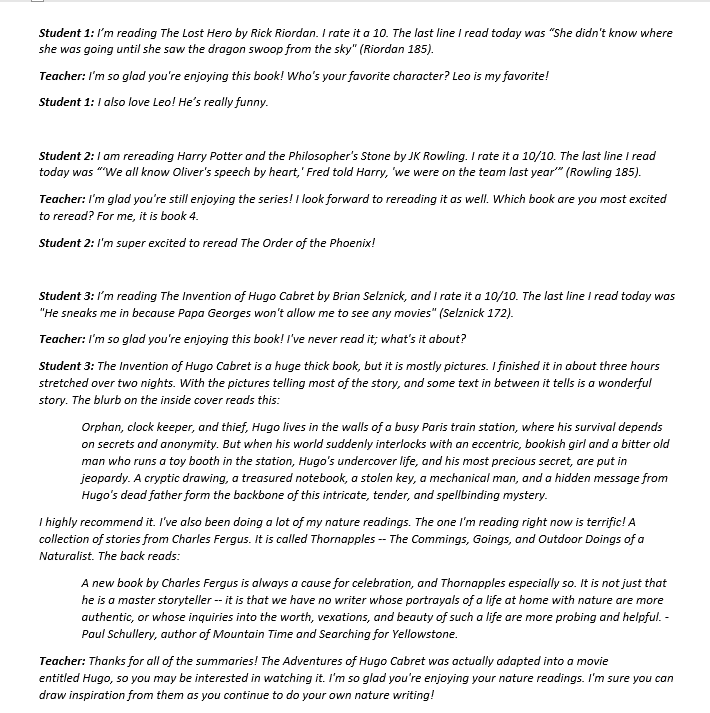
I found my savior in Canvas individual discussion boards. Every week, my students are expected to log on to Canvas and complete the week’s modules in order. The first two modules are labelled “Independent Reading” and “Independent Reading Check-In.” The first module is a timed 10-minute quiz, in which students are asked to pause and read their independent book until the timer runs out. Next, students move on to an individual discussion board between the two of us. These discussion boards function similarly to any online instant messaging platform. Every week, students are asked to post to the individual discussion board by responding to a few questions.
I change the exact directions each week, but students are always asked to share their book title and author and their current page number. This allows us to keep a running log of the student’s reading progress, just as my clipboard does in class. I respond to every student’s post by the end of the week, commenting on what they shared, asking questions about their book, and sometimes offering future book recommendations. Having the book recommendations solidified in the discussion is useful because every time that student needs a new book, we can easily scroll up and find a selection that I have previously curated for them.
Recently, I have been asking students to leave short video/audio messages sharing their book title, author, page number, and the most important moment from the day’s reading. I respond with my own audio message, again attempting to mimic our in-class conferences as closely as possible. It has been heartwarming to hear their voices; it is almost like we are back in the classroom, having a real face-to-face conversation! In their video this week, one student read their favorite poem from Rupi Kaur’s Milk and Honey and then offered their analysis of the poem (without being asked to do so)!
Below are examples of my conversations with students:
While I miss our in-person conferences, Canvas conferences via the individual discussion boards allows me to accomplish the same goal as my in-person conferences. By the end of the week, I have had a one-on-one discussion with every single student.
After reading and reflecting on Lauren Foley’s “Rediscovering Routines” post, I realized that our students are also missing the rhythms and routines of the classroom. By mimicking our in-class routine via Canvas, I am providing my students with some semblance of the structure they are missing. They are asked to pause for 10 minutes and then engage in a one-on-one conference about their reading, just like they would be asked to do in our physical classroom.
Completing our conferences in the Canvas individual discussion boards has also allowed me to better track each student’s progress, as I am no longer solely relying on my clipboard. It has also allowed students to better track their own progress. Moving forward, I plan to continue using this space to have students track their reading, even on the glorious day that we return to the physical classroom. It will also be a space where I recommend books to them, and they can check back at any time to find their personal playlist of books.
These discussion boards are just one way that my future in-person instruction has been enhanced by distance learning. Even though this has been a challenge, teachers and students will emerge from distance learning with a brand-new skill set for the future.
Call for Distance Learning Blog Posts
The PAWLP Blog would like to hear from you! What does distance learning look like for you, your students, and your school district? What digital programs are you using? What lessons have you tried out? What routines and expectations are you establishing?
Blog posts will be featured in our Distance Learning column each Monday. Please email the PAWLP blog if you are interested or would like to find out more information.
Written by Jennifer Archie, Stephanie Collins, and Kelly Metzler
Nicole Mirra’s 2018 book Educating for Empathy seeks to answer driving questions about the role of empathy in our classrooms, specifically English classrooms, on the quest to develop participatory and civically engaged students. Throughout the text, Mirra returns to these questions: “What role (if any) should schools play in fostering empathy for students? What, for that matter, is empathy? And what kinds of educational practices can reverse the empathy deficit and produce compassionate, democratically engaged young adults?” (3).
In order to establish the need for teaching critical civic empathy, Mirra needs first to define how she uses the term “empathy.” She offers readers the standard idea that empathy allows us to see from another’s perspective, but also that one can move “beyond oneself and into the perspective of another person” (4). This process, she suggests, happens naturally in English classrooms, where students can use their imaginations while reading to move into other times, places, and characters’ experiences. In addition, she also implies that this connected process empowers students to become active critics of the world around them, sparking, perhaps, some activism on their part. She calls this process “critical civic empathy,” and she defines it in this way: “1. It begins from an analysis of the social position, power, and privilege of all parties involved. 2. It focuses on the ways that personal experiences matter in the context of public life. 3. It fosters democratic dialogue and civic action committed to equity and justice” (7). From a teacher’s perspective, this seems like an overwhelmingly important but problematically challenging concept, which is one of the main difficulties with this text.
Mirra does offer a series of really inspiring philosophical and pedagogical ideas. In particular, her focus on the “power of text for social transformation” (9) is one that most English teachers would applaud. She waxes poetic with language like “teachers and students must engage together in reflection and action aimed at breaking down structures of oppression that ensnare us all” (10). Almost all of the English teachers we know would approve of this message; we want students to feel texts at such an impactful level, and we try to engage students in this type of dialogue. However, there are also a variety of impediments to taking this discussion into the realm of transformative power, especially as it relates to disempowering social and political structures in the world around us, restrictive curriculum, and test-driven pedagogy to name just a few. Mirra also hammers home the idea that individual empathy is not sufficient; collective empathy needs to be developed in order to effect more change in reworking our power structures and fully empowering all voices to be present in the discourse of civic socialization.
Mirra continues her call to action with her first chapter in which she seeks to explore why reading helps develop empathy, how certain stories get privileged, and how imagining an alternate world view offers students a chance to project a vision of change onto their current society. Mirra cites several studies (Bal & Veltkamp, 2013; Mar & Oatley, 2008) that suggest frequent readers demonstrate higher empathy ratings than nonreaders. Additionally, while discussing the literary canon (and its controversies), she paraphrases Guillory’s 1993 work stating, “…critics argue that the canon inappropriately privileges particular stories as representative of American culture when, in fact, no single American culture exists; as such, its very existence serves to marginalize stories that deviate from those told by people in positions of power” (20). Most English teachers feel this burden; they need to offer more stories that not only reflect the lives of their students, but also stories that challenge and complicate students’ thinking, especially about power and privilege.
As evidence of how to combat this challenge, Mirra uses two teacher leaders to demonstrate ways of pushing back against the status quo. The first teacher she recognizes is a 10th grade ELA teacher, Jerica Coffey, teaching in a public charter high school in East Los Angeles. Ms. Coffey works with her students to develop the idea of a warrior-scholar mentality, explaining that “she developed this concept as a way to communicate to students her commitment to a vision of literacy linked to self- and social empowerment” (24). Students embraced this commitment and recognized their voices, taking actions like writing to their state governor about the juvenile justice system. The second teacher, Ashley Englander, also a 10th grade teacher, works at a traditional public high school in East Los Angeles. Ms. Englander serves as a “bridge-builder” between the smaller community of her students and families and the larger community in which they live. She does this by taking traditionally taught texts, like Night by Elie Wiesel, and moving the conversation beyond oppression and resistance during to Holocaust to these same concepts in their lives and communities today, using a research article to “provoke discussion about the role of schools as institutions of either marginalization or empowerment for students” (29). For teachers fostering ideas of empowerment through literacy, these two teacher leaders could serve as exemplars for what challenging the status quo looks like in a high school setting.
In chapter 2, Mirra stresses the need to develop engaged and thoughtful citizens through the use of structured debate as demonstrated in New York City public middle schools. She presents the idea that making slight changes to the way debate is implemented can “build relational trust and democratic community within classrooms and across schools” and “foster the development of critical civic empathy” (36). Debates possess mutual respect, discourse, and structure, which is seemingly nonexistent in today’s political climate. Our students are constantly exposed to what Mirra refers to as “ferocious verbal sparring” (35) in both formal and informal settings, especially with the presidential election looming. The thought of reimagining the purpose of debate as a trust- and community-building task represents the ability to empathize may seem like a daunting task for today’s educators.
The chapter goes on to present Mirra’s research exploring how students in the Middle School Quality Initiative (MSQI) in New York City responded to debate. Overall, participation in debate “benefited students’ academic literacy and critical-thinking skills…, and also their dispositions toward critical consciousness and civic engagement” (38). Ben Honoroff, a colleague of Mirra’s, was able to use the power of debate to give life to a school struggling with low test scores, declining enrollment, and the negative effects of gentrification. It should be noted that Honoroff was able to unify the school using a curriculum called Word Generation to address a high interest debate topic once a week across the entire school. While this curriculum is composed of vocabulary-rich interdisciplinary units, its implementation seems highly unlikely in the traditional public school setting considering the pressure of state testing and strict adherence to common core standards.
Youth participatory action research (YPAR), the central idea of Chapter 3, is defined as “the practice of encouraging young people to develop their own research questions about topics that are meaningful to them and related to issues or challenges they see reflected in their communities” (53). Mirra argues that YPAR can foster empathy by helping young people see their own thoughts, experiences, and voices as valued. Writing shifts from research to YPAR when “the three Ps” are taken into account: “purpose, practice, and positioning” (55). Purpose allows students to challenge the narrative, practice gives students the ability to create their own schooling experience, and positioning shows students as experts of their experiences. Mirra especially notes the benefit of YPAR with students from minoritized communities. She states that “young people who have grown up listening to dominant narratives about their communities- narratives that often highlight problems and risks—often begin to internalize deficit-oriented views of themselves and their peers” (67). The YPAR process seeks to help minoritized students change the narrative through “counter-storytelling grounded in community cultural wealth” (67), allowing them to do something about problems in their communities and not just place blame.
Chapter 4 focuses on the use of technology in and outside of the classroom and is well worth reading. Mirra claims that technology is damaging empathy by taking away both trust and perspective-taking as students are unable to pick up on non-verbal clues and online activity is impacting self-esteem as others post their fake and elaborate lives on social media. As access to technology increases, classroom disputes that either stem from or are further developed outside of school through social media and internet access routinely disrupt our classrooms.
The second part of this chapter delves into the ways teachers can use technology. Mirra suggests that teachers need to help students “leverage these tools to achieve the kinds of academically oriented, peer-supported, and interest-driven learning outcomes that the tools can facilitate” (84). She adds that this “takes dedicated pedagogy and a mindset change” (84). To support her initial statement that there is a need for more collective empathy, Mirra introduces the idea of Connected Learning vs. the 21st Century Skills, differentiating that the first focuses on a collective advancement whereas the second lends itself to individual advancement. This chapter offers the definitions of each principle within connected learning and suggests ways teachers can incorporate connected learning skills that are meaningful to students and give them a buy-in rather than using technology just to please administration. These principles are useful for all teachers to engage in at every professional level.
Mirra shifts in Chapter 5 to distinguish between Politics with a capital P and politics with a lowercase p with the former being our traditional view of political parties with elections and the latter encompassing the way our ideas about Politics plays a role in our everyday lives. This chapter strikes a chord as it first challenges the teacher to incorporate and facilitate more conversations within the classroom that allow students to become civically engaged in the community. This is a daunting idea to teachers as it is written in some districts’ handbooks that discussions must not lead into the political realm and stay focused on the curriculum. Mirra then shares a survey conducted with high school English teachers about the purposes of teaching reading. The study revealed that teachers identified college preparation as the first purpose whereas civic duty fell in the middle. Where this chapter becomes worth the read is when Mirra describes her beliefs that “teaching is an act of civic engagement” (100), but it is not enough; she believes we need to participate as private citizens as well. She further defends this by reiterating that every choice we make promotes beliefs, values, and actions and thus is political. Mirra argues that fostering civic empathy must start with our own involvement and teachers should reflect on how we are getting civically engaged in the community. This reflection will help teachers better understand the dynamics in the community that impact their students.
In her conclusion, Mirra states that her goal in writing was to “demonstrate how the foundational activities of literary analysis…can be transformed into opportunities for encouraging mutual humanization and community social action” (102). However, this book is clearly geared toward the high school level and above. For elementary teachers, more research would be needed to find ways to bring civic empathy and engagement into practice with younger children. Though inspirational in nature, implementation is problematic at the elementary level due to a lack of models for developmentally appropriate activities. Middle school implementation is possible through the use of thoughtfully selected texts and community collaboration, but the high school level offers the easiest pathways to implementation, especially in larger urban settings, due to Mirra’s presentation of research, examples, and resources in those areas.




 write.share.connect