Moving Beyond the Worksheet: A Writing Workshop Approach to Grammar Instruction
In our writing workshop class, grammar doesn’t live on worksheets—it lives inside stories, poems, conversations, and the students themselves. When we review parts of speech, for example, the goal isn’t just for students to identify them, but to use them intentionally in their own writing. For my English language learners especially, that connection between language rules and meaningful writing is essential.
We start our parts of speech review with nouns. Instead of defining them right away, students first notice nouns in a poetic excerpt from Out of the Dust by Karen Hesse. Together, we look closely at the objects Hesse includes and talk about what those items reveal about the speaker. What matters to her? What kind of life does she live? Students quickly see that nouns do more than name things—they reveal character.
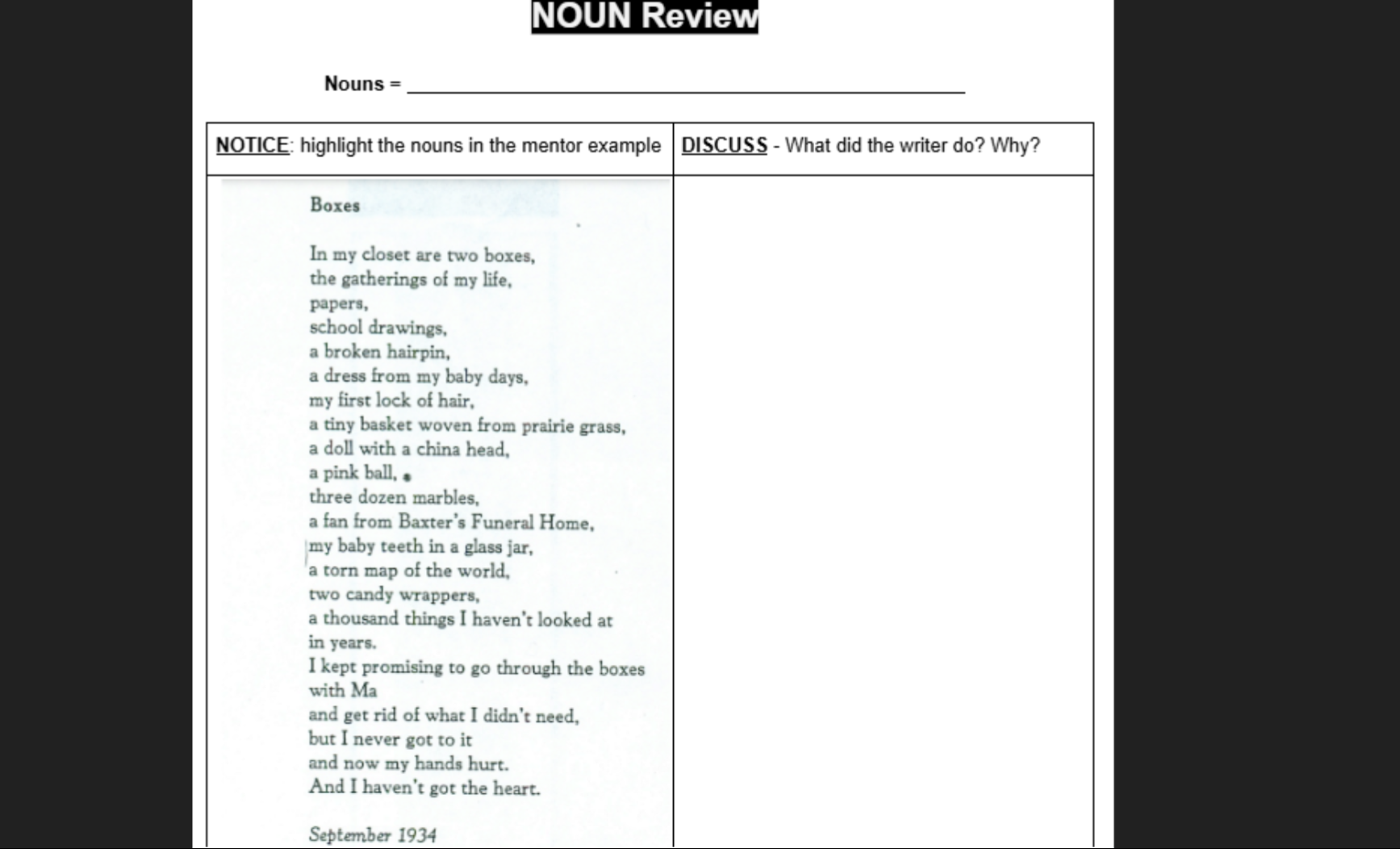
Using those observations, students craft their own personal list poems. They choose specific items from their own lives and begin to see how selecting certain nouns can tell a reader who they are and what’s important to them. This is where the grammar and the writing start to click.
Once we have that foundation, we expand our understanding of nouns by sorting them into types: proper and common, concrete and abstract, singular and plural. Because my students are English language learners, we also pause to notice the language rules that come along with these nouns—capitalizing proper nouns, adding -s to make plurals, and naming the exceptions as we discover them.
To get students moving (and collaborating), we take our learning on the road with a nouns scavenger hunt around the school building. Students work in pairs to complete tasks like introducing themselves to an adult and writing a sentence about who they met, finding the name of our high school and explaining where they are, sitting on something concrete and naming it, or making a facial expression and identifying the emotion they’re showing. It’s active, social, and full of real-world language practice—and it’s always a favorite.
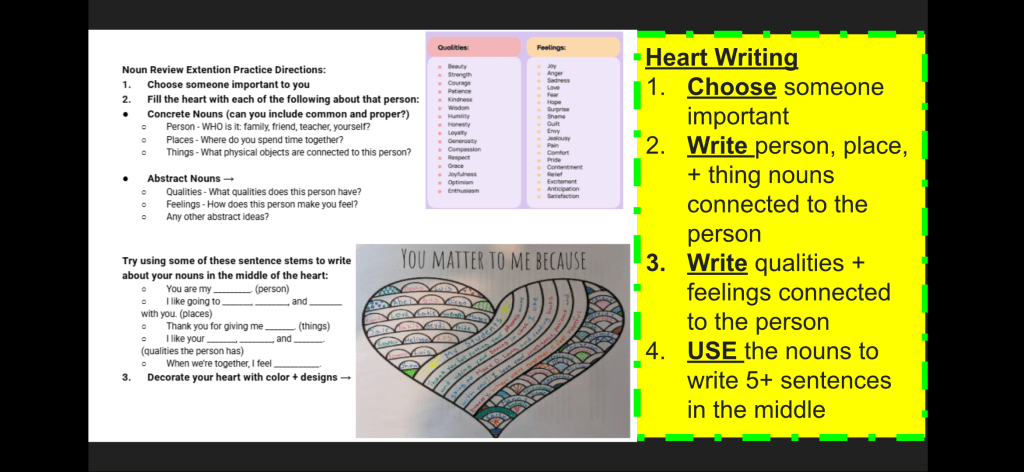
As a culminating project, students create a “noun heart” for someone important to them—a family member, friend, teacher, or mentor. Around the outside of the heart, they brainstorm meaningful nouns connected to that person, thinking again about the different types: people and places, concrete objects, abstract ideas. On the inside, they use that brainstorm to write five or more sentences directly to that person. Sentence frames like You are my ____. I enjoy going to ___ and ___ with you. Thank you for giving me ____. You make me feel ____. support students while still allowing for authentic voice.
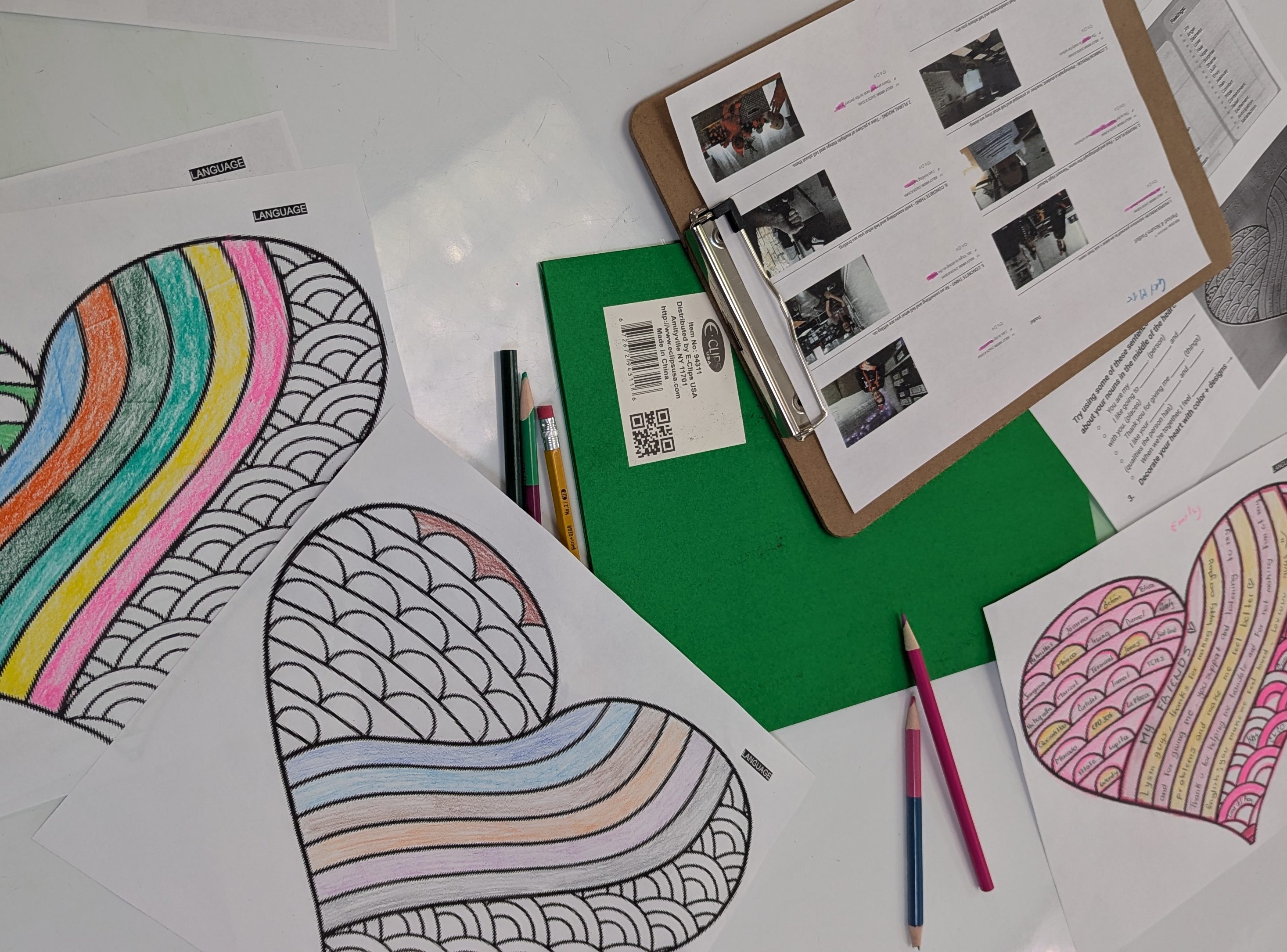
Because this project happens the week before Valentine’s Day, I encourage students to color their hearts and give them to their people as a valentine. It’s a simple addition that adds motivation and joy—providing an authentic audience always enhances any writing task.
In the end, this work solidifies the fact that grammar is not a set of rules to memorize, but a living part of language. When students use grammar to express their identity, relationships, and gratitude, it becomes meaningful and human. Students aren’t practicing grammar in isolation – they’re using it to communicate ideas that matter to them. In this way, it lives in their reading, their writing, and their lives beyond the classroom.
Kelly Virgin is a WCWP teacher leader who teaches high school English for the Kennett Consolidated School District.




 write.share.connect