Skip to content

Posts from the ‘Book Reviews’ Category

Book Review: Renew! Become a Better and More Authentic Writing Teacher by Shawna Coppola

Written by Robyn Chegwidden, Amanda Dudek, and David Richard
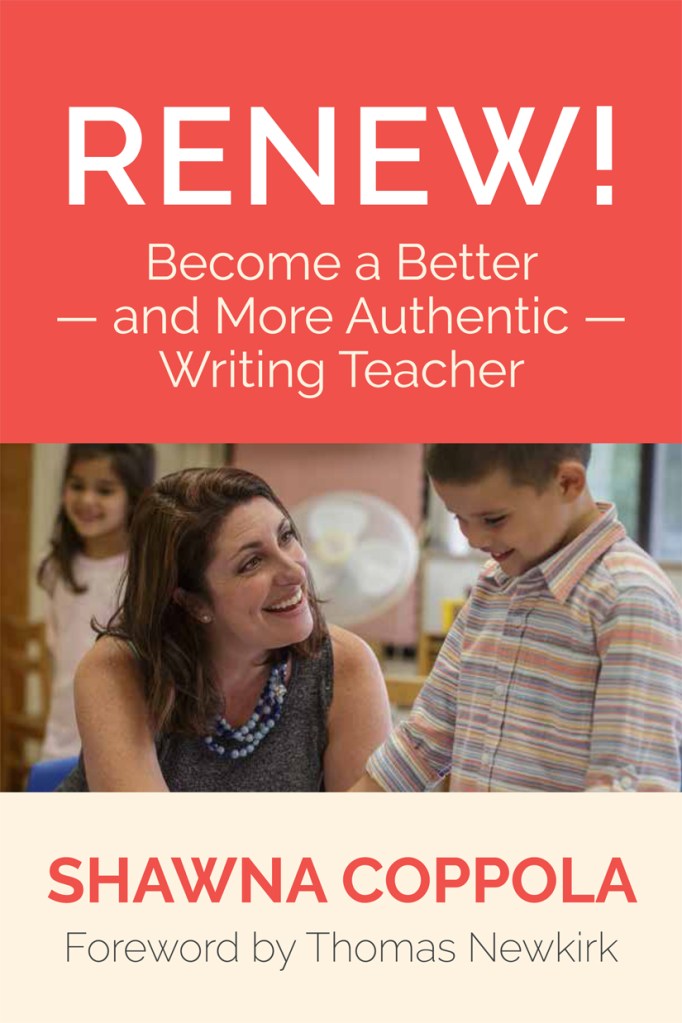
Take everything that you know about the “writing process” and put it on hold. Shawna Coppola challenges the effectiveness and orthodoxy of every aspect of what it means to be a writing teacher. At times cheerleader, at others a scold, Coppola leads the reader through many different methods of teaching emerging writers their craft.

 “The minute—no, the very second—that we believe we have done all we can for our student writers—that we have learned all there is to learn about, say, teaching them how to write satisfying conclusions, or how to generate ideas for writing—well, that is also the very second we become less effective.”

The author contends that there is no one way to reach a finished project and many of the traditional methods may not be helpful to all students. Rather than a linear process that begins with a “brainstorm” on through a finished, polished final draft, the writing process may take many different routes. Rubrics may be too confining. Five paragraphs may not be enough. Five paragraphs may be too much. Indeed, limiting the process at the outset does both the author and the evaluator a disservice. Donald Graves, largely hailed as the creator of the early ideas regarding the writing process says:

“Don’t be fooled by the order in which I describe the writing process. I have to use words, which follow each other in systematic and conventional fashion, for you to understand what I am about. This suggests that thoughts follow in a systematic order for everyone. Not so.” (Grave 2003, 220-221)          

Coppola is nothing if not passionate about her subject. Her anecdotes, gained from sixteen years as a public-school teacher and mother of two, illustrate the practices that she wishes to challenge. Are rubrics helpful? What should a graphic organizer look like? How is a story told? What should the revision process look like? What is the most effective way to grade? In the end, the most important idea about writing is that the story gets told. This can be accomplished either through visual composition, written word, or a combination of both. All these topics and more are discussed in her easy to read, 100-page work. The author includes many different ideas and concepts with which to assess our own writing pedagogy in the ongoing struggle to meet the ever-evolving needs of our students in a constantly changing social environment.

           Renew! is easy to read; it is aimed at those that teach emerging writers in the elementary grades. Secondary school teachers may find that much of the content is inapplicable to students in high school, but this detraction is ameliorated by the upbeat tone and lively language of the author. There are so many different techniques offered that there is guaranteed to be something for every teacher of writing to apply in the classroom. Renew!Become a Better—and More Authentic Writing Teacher, is sure to offer some new ideas for all. It is Coppola’s hope that we all can internalize a habit of rethinking, revising, and most–important –renewing our teaching practices.  
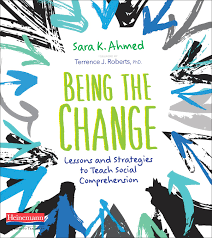
Book Review: Being the Change by Sara Ahmed

Written by Danielle Agan and Karen Friel

Sara K. Ahmed offers an equitable approach to fostering social comprehension in the classroom through her book, Being the Change: Lessons and Strategies to Teach Social Comprehension. Ahmed offers a personal approach to teaching social comprehension through the lens of a Muslim American identity. The introduction of this text is not one to be skimmed over. Ahmed gets the reader ready to face their own social comprehension and the work ahead by providing essential questions and guiding principles to reflect upon. As she states, “we have an obligation to make kids feel visible” (2). Now, more than ever, we have an obligation to create a space that feels safe and accepting for all of our students, which is the focal point of this text. The text guides a teacher and class through an entire school year, offering the progression of teaching social comprehension, while providing detailed lesson plans and mentor texts as resources in chapters one through five. In chapter six, the text is concluded with thoughtful reflection and reminders with how to proceed into the future and the importance of celebrating identity. 

Ahmed’s personal voice is strong and passionate about the topic in this easy to read book. She offers several mentor texts and resources to get a teacher started with incorporating lessons on identity into the classroom. This is a great tool for a beginning teacher, or a veteran teacher who is looking to incorporate social comprehension into their curriculum. Ahmed does not fall short in offering a plethora of resources including: picture books, poetry, short stories, short story anthologies, novels, nonfiction, and videos. All of these resources are equipped with appropriate lessons that are detailed and spelled out for the educator. The text is embedded with scripted dialog, or “teacher talk,” so if you are someone who would like this as an support, or are not yet comfortable with social comprehension, it is available to you. However, it is easy to skim over due to the different font and color, so if you prefer just to focus on the lesson itself, this can be easily done. 

The versatility of the lessons and mentor texts makes this an appealing read for teachers K-12. As mentioned before, Ahmed leaves no stone unturned, and packs the book with mentor texts for all levels. In chapter one, Ahmed informs the reader how to “affirm our identities” through identity webs. This lesson begins with a mentor text in order to give the students a model of what an identity web is and how to create it. Then, the students are in charge of creating a definition of identity. Together they brainstorm and jot down words that come to mind on a giant piece of chart paper. From there, the work of social comprehension can begin. The goal of an identity web is to get to know your students while also starting to bridge connections between the kids and yourself. It is a way to initiate the process of learning about each other in a safe space. Ahmed thinks of just about everything with her lessons, including a “follow-up” section and an “addressing tensions” section to coach you, the teacher, through difficult situations that may arise in the classroom. 

Overall, Being the Change would be a strong book to add to your collection of professional development books. Ahmed’s passion about social comprehension resonantes through each page and guides any reader through activities that are ready for the classroom. As reviewers, Karen and Danielle are in very different stages in their careers. Danielle is a first year teacher. She teaches 7th grade English Language Arts, and was able to try these activities in her own classroom. She started at chapter one and is now on chapter three, and plans to continue progressing through the lessons until the end of the school year. Her biggest takeaway is that even if you do not follow each lesson exactly, it is about making a safe space for identity and differences. Karen has been teaching for seven years, as a reading specialist. While she teaches small groups and does not have a classroom of her own, she realizes the importance of having ongoing conversations around social comprehension. Karen highly recommends Chapter 2 – Listening with Love. She agrees with Ahmed’s beliefs that by teaching active, empathic listening real communities are built which strengthen real learning.

Book Review: Oh, Yeah?! Putting Arguments to Work Both in School and Out by Amy Ahart

As part of an independent book study for the Reading and Writing Argumentative Texts course, Amy Ahart created the following flyer. The advertisement highlights key parts of the book that directly affect English instruction.

Converted (1).jpg

After checking out some of the key concepts in this book, what do you want to learn more about? What are some of your go-to professional texts for teaching argument writing?

180 Days Book Review

by: Bruning, Cardillo, Clarke, Coladonato, Patton, & Peltier

180 days

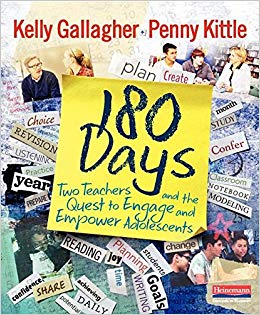
Kelly Gallagher and Penny Kittle’s new book, 180 Days: Two Teachers and the Quest to Engage and Empower Adolescents, published by Heinemann, is a stimulating read during a time of educational dismay. Gallagher and Kittle disrupt the mold of state-mandated testing as well as tightly bound curriculums and bring educators back to their original teaching philosophies. While many education texts provide quick-fix teaching strategies for a specific skill set, this book, as the title suggests, opens up a discussion on what 180 days in the classroom looks like with engaged and motivated students. Gallagher and Kittle work together on lesson plans and teaching approaches in two very different environments—Gallagher in an urban, California school with a diverse student population and Kittle in a rural, New Hampshire school with a homogenous student population. They base their year of collaboration on research and core beliefs, all in hopes of sharing what they believe is most important: creating student readers and writers that are engaged, inspired, and curious about the world around them. Read more

Book Review: Sparks in the Dark by Travis Crowder and Todd Nesloney

by: Anne Busciacco, Marissa Caldwell, Lauren Foley, Erika Hunsicker, Tom Lang & Dan Lonsdale

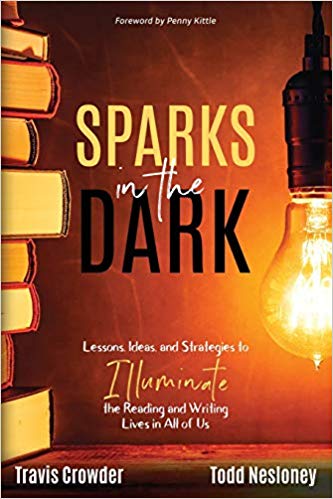
sparks in darkNavigating through a maze of students absorbed in their independent reading books, I pause before Ryan. Our second-day-of-school conversation echoes in my mind . . .
“I don’t like to read,” he declared, doubtful seventh grade would change anything.
His friend, Charlie, smirked at him, “That’s because you only read teacher-assigned books.”
Now, four weeks later—after interviewing many texts and abandoning two—Ryan sits nestled in a bean-bag chair, engrossed in Booked by Kwame Alexander. During our last conference, he claimed it as one of the best novels he had ever read.
“ # What child have you seen impacted by a different kind of teaching style?” (79).
In Sparks in the Dark, by Travis Crowder and Todd Nesloney, you will meet a plethora of  students like Ryan whose lives were forever impacted by the power of choice. Read more

Books on the Blog: YA Books to Spark Real Discussions about American Race Relations

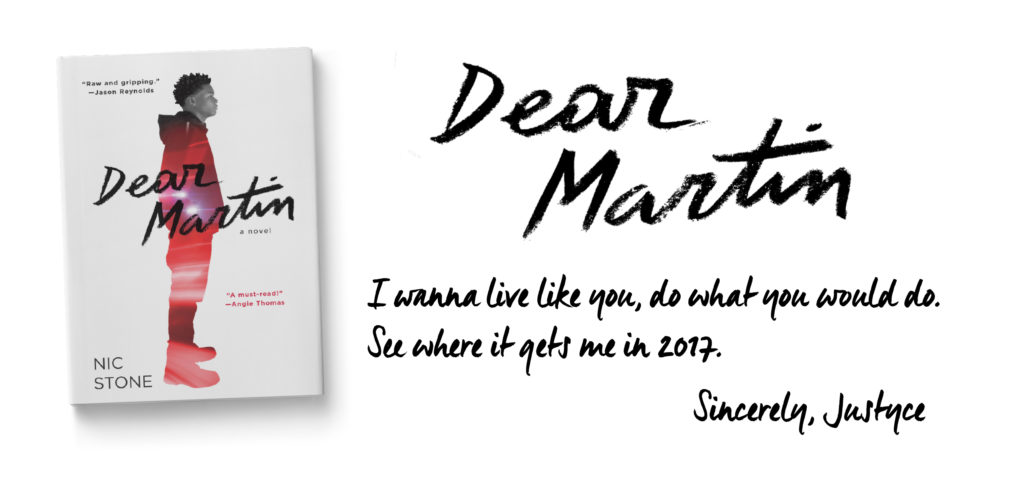
by Kelly Virgindear martinIn the first chapter of Dear Martin by Nic Stone Justyce McAllister, an Ivy League bound, black teenager, is handcuffed and detained by the police when they mistakenly assume he is up to something as he attempts to keep his drunk and slightly belligerent ex-girlfriend from driving herself home. This incident is understandably jarring for the teen and he thinks to himself:

Yeah, there are no more “colored” water fountains, and it’s supposed to be illegal to discriminate, but if I can be forced to sit on the concrete in too-tight cuffs when I’ve done nothing wrong, it’s clear there’s an issue. That things aren’t as equal as folks say they are.

In an attempt to come to terms with the experience and to deal with the pressures he feels from the neighborhood he managed to escape and the prep school he doesn’t entirely fit into, Justyce starts a journal to Dr. Martin Luther King Jr. However, tragedy strikes his life and he starts to question whether Dr. King’s teachings still apply to the world we live in today.  Read more