Skip to content

Posts from the ‘From the Classroom’ Category

From the Classroom: Second Draft Reading

by Tricia Ebarvia

As I walk around the room, I notice students talking—generally enthusiastically—about the book we are reading. They have a few discussion questions on a handout to take notes, which they dutifully fill out. What I don’t notice are any books open on their desks. In fact, I see many students with no books out at all, and what books are out are closed on their desks.

“Mrs. Ebarvia, do you know remember what Piggy said to Jack when they went to Castle Rock?”

“Sure, I remember.”

Pause. Expectant looks.

“You know, you could open your book to find out,” I suggest. My students smile and begin searching their books.

Years ago, when I first read Kelly Gallagher’s Deeper Reading during the PAWLP summer institute, one particular section that stood out to me was the chapter on “Deepening Comprehension through Second-Draft Reading.” In this chapter, Gallagher emphasizes the importance of getting students to go back to the text to reread:

Students need to return to the text to help them overcome their initial confusion, to work through the unfamiliarity of the work, to move beyond the literal, and to free up cognitive space for higher-level thinking. They need both a “down” reading draft to comprehend the basics and an “up” reading draft to explore the meaning. (80)

Those who have been teaching English long enough know that getting students to go back to the text can often be a difficult task. Having gotten the “jist” of the story on their first reading, students often see no need to go back to the text unless prompted.

Yet we also know that rereading is one of the first steps towards a deeper understanding of a text. When students reread, they can better appreciate craft—they can see the choices that an author made and question why. When a text is complex and students don’t “get it” the first time, rereading is not only a valuable but necessary move that students can make.

So how do we encourage students to go back to the text—to explore the text a second, or even third time?  Read more

From the Classroom: Organization is an Act of Revision

By Brian Kelley

CaptureI’ve always admired my father’s garage. It is organized. Utility shelves on the left. Steel pegboards and hooks on the rear and right walls. Every tool has its place. He knows where everything is, yet he is constantly revising the content of the garage.
My mother keeps adding stuff to the house, and older stuff is belched out to my father into the garage. So, my father makes decisions. He replaces and rearranges. He adds what he must. And he deletes. I know for a fact that he would love to delete a lot more.

When I teach organization to middle school writers, the lessons of my father’s garage must be in the DNA of my methods. Everything has its place. Nothing starts organized, and this includes writing.

Organization is an act of revision.  Read more

From the Classroom: Finding “Moments Worth Writing About”

by Tricia Ebarvia

It’s just after 7:20 a.m. and my students are settling into their seats. Although it’s early, this class is usually lively, with students generally willing to try out whatever their English teacher has planned for them that day. This morning, I pass out cream-colored quarter sheets of paper and several tape dispensers. I go over the lesson plan to the sound of pages flipping, synchronized to the squeaky pulling and staccatoed tearing of tape. Into their notebook, students tape the following Willa Cather quotation:

“Most of the basic material a writer works with is acquired before the age of fifteen.”

Today is Day 1 in a brief unit on the personal history essay. I decided to call this next essay a personal history rather than the more familiar term memoir for a few reasons. One, the term memoir feels a little intimidating to me; the term has always implied a confessional quality to it, like a great secret is about to be shared, a great burden lifted. For better or worse, memoirs feel too big a task, too much to ask.

So instead, I like the term personal history. Read more

From the Classroom: Success Defined

By Brian Kelley

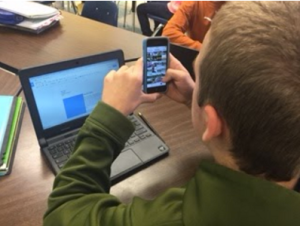
Searching photos on a phone while writing on a Chromebook.

Searching photos on a phone while writing on a Chromebook.

Change bothers most people.

We can be good teachers and still make room for change. Change does not mean we are bad teachers making bad decisions. There are many ways to teach, but consider this blog post as an invitation to grow.

Consider change as growth. Everyone can grow.

For example, I changed my approach in the classroom by adding writing and technology to my life outside of the classroom. It wasn’t a drastic change–and if writing and technology are changes you would like to make, neither needs to cause a seismic shift in your day.

Asking teachers to write is a scary proposition. Asking teachers to become more fluent with technology is a scary proposition. It sounds a little like going off of the script.  Read more

From the Classroom: Does Anyone Have Any Questions?

by Tricia Ebarvia

For years, whenever my students and I read a novel, I would pass out a study guide with a list of questions for each chapter. By giving students the study guide questions―questions I wrote―I could make sure that students wouldn’t miss anything in their reading. Too often, students would read too quickly and miss details. Requiring students to answer study guide questions was my way of getting them to slow down to notice what they were reading. To get them to see the dots that they could later connect together.

After we finished the novel, the next step would be a writing assignment. On that day, I would pass out a list of essay questions. I often included questions of varying difficulty in order to better differentiate instruction, and students could happily chose whichever essay question was most accessible (or least terrifying). In case none of the questions interested students, I always gave them the option of creating their own essay question (just so long as they reviewed it with me first).

Of course, rarely did students ever take me up on that option. After all, by creating essay questions for them, I had already sent the message that it was the teacher’s questions that mattered, not theirs. And while some students were more than happy to answer my questions―in fact, I think some of them preferred to―what I’ve come to realize that what I needed to focus on was getting students to answer their own questions about the text.  Read more

From the Classroom: Reading Conferences + Building a Professional Reader’s Toolbox

By Brittany Carlino

“Ms. C, I am giving up on post-it notes!” It is a Friday after school and I’m sitting beside Lily*, one of my brightest and most motivated students, and we are giggling about how much we hate when post-it notes stick out of our books too far.

Lily is here for a reading conference. As part of my Honors 9 Literature class, she’s in the midst of our first outside reading assignment where the kids are independently navigating a text and will have to do some writing on it in the end. As the honors kids, they mostly love to read, thus it would be easy to expect they read well. In most cases they do: they comprehend the content and can say interesting things about it. But when it comes to combing through a lengthy, complex novel to write about it with focused, meaningful, positioned points, well, no they can’t. They are 14 after all.  Even for my juniors, this presents challenges.  Read more