Skip to content

Posts from the ‘Key Strategies’ Category

How to Thrive as a Teacher: A Book Review
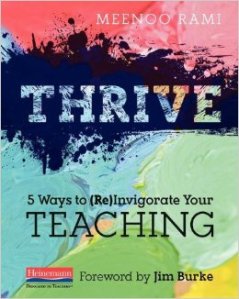
thriveThrive : 5 Ways to (Re)Invigorate Your Teaching  by Meenoo Rami

by Janice Ewing and Rita Sorrentino

During the winter months, teachers and students have more to cope with than just cold weather and icy roads. Deadlines, data-driven decisions, and daily demands of classroom life loom larger as testing schedules, teacher evaluations, and interim assessments fill up the calendar.   Finding time to accomplish all that is required of a teacher, while keeping students’ best interests at heart, can zap the energy of the best-intentioned educators. Read more

Resolve to Read this Book: A Review of Minds Made for Stories

minds made for stories newkirkBy Judy Jester

It’s not often that I read aloud to my husband from “teacher” books, but I found myself doing so from Tom Newkirk’s latest work as often as I was from Steven Johnson’s How We Got To Now on our recent road trip to Cleveland. The former, Minds Made For Stories: How We Really Read and Write Informational and Persuasive Texts, knocked me out with its treasure trove of facts (not all related to writing) just as much as the latter did. Read more

Revisiting a Closer Look at “Close” Reading

Falling in Love with Close ReadingBy Lynne R. Dorfman

* As we look at strategies that work in our classrooms, we thought it was time for another look at “close” reading. So this week, we’re reposting Lynne Dorfman’s wonderful post on what close reading is and isn’t from last year. Enjoy!

Kate Roberts, Maggie B. Roberts, and Chris Lehman engaged a rather large audience in their interactive workshop session about close reading texts and close reading lives at the 103rd Annual NCTE Convention in Boston. They gave us some practical advice and helped us define close reading in terms of what it should not be and what it could be. Read more

Moving Students Forward: Be Generous with Time and Space

By Janice Ewing

Time and SpaceWe all know that a teacher’s new year starts in late August or early September, but still, during the months of December and January, as the rest of the world closes out one year and starts the next, it seems appropriate to focus on the theme of moving students forward as readers, writers, and thinkers, and that’s what we’ve been doing on our blog. Moving students forward is what we’re all about, even if that movement is inconsistent or even imperceptible at times.

Lately I’ve been thinking about what it means to “see” growth in our students – whether in test scores, conferences, writing pieces, or observation. What’s happening when growth is not evident, and how should we respond? Read more

Gatsby, Hawthorne, and Being Sixteen

By Tricia Ebarvia

One of the last books I read in 2014 was Gabrielle Levin’s delightful novel, The Storied Life of A.J. Fikry.  At one point, the main character—a somewhat odd and sometimes churlish bookseller named A.J. Fikry—tells his daughter to remember that “the things we respond to at twenty are not necessarily the same things we will respond to at forty and vice versa. This is true in books and also in life.”  He adds, “Sometimes books don’t find us until the right time.”

Many years ago when I first read The Great Gatsby in high school, I didn’t like it very much. I remember listening to a classmate discuss how much she loved the book. “Gatsby,” she gushed, “The way he could change his entire life to win Daisy over? It’s soooo romantic.” I didn’t get it. Read more

Can You Hear Me Now?

Using Audio Tools to Provide Feedback to Student Writers

by Jen Ward

I’ve pulled out back issues of the English Journal, dusted off my copies of Kelly Gallagher’s work. In the course of my research on using digital tools to provide students access to audio versions of writing conferences, I have reviewed what compositionists from Peter Elbow to Ralph Fletcher have said about the need for supportive, verbal feedback during the writing process. Lucy Calkins and Nancie Atwell, two gurus of conferring in the classroom, strongly advocate for face-to-face writing conferences with students over the more traditional written evaluative feedback. Verbal feedback is powerful. And although technology has certainly changed how we work with practicing writers in our classroom settings, there are a few things that remain constant. Read more