Skip to content

Posts from the ‘PAWLP’ Category

The Color Conversation: A Classroom Strategy That Actually Gets Teens Talking

How do you get high schoolers to open up and share something real? If your students are anything like mine, they tend to deflect, joke, or suddenly become very interested in the ceiling when it’s time to make personal connections to literature.

So earlier this week, I tricked them—gently—into opening up with a “color conversation.”

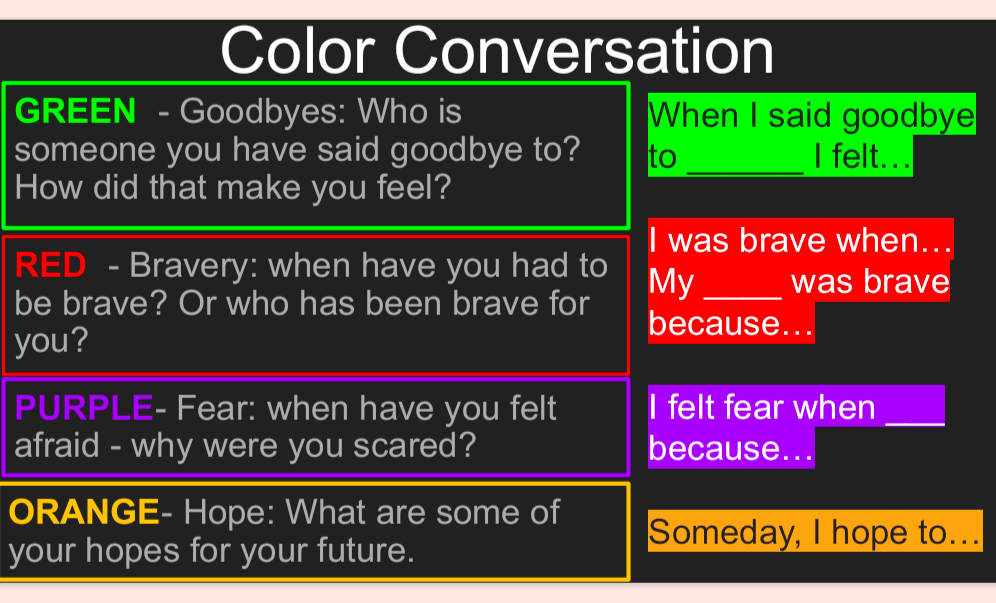
The setup was simple: a pile of sticky notes and a handful of colored Sharpies. Before showing the prompts, I told students to grab one marker. Then I revealed the color-coded questions:

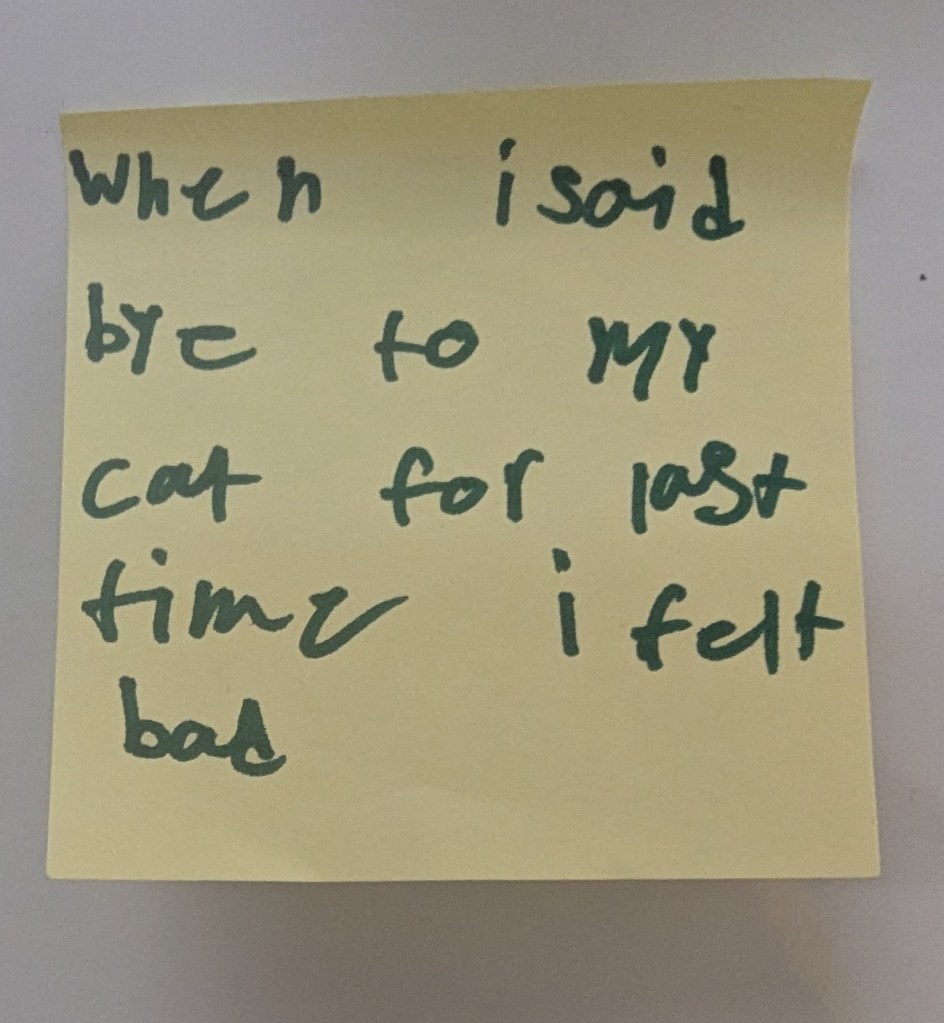
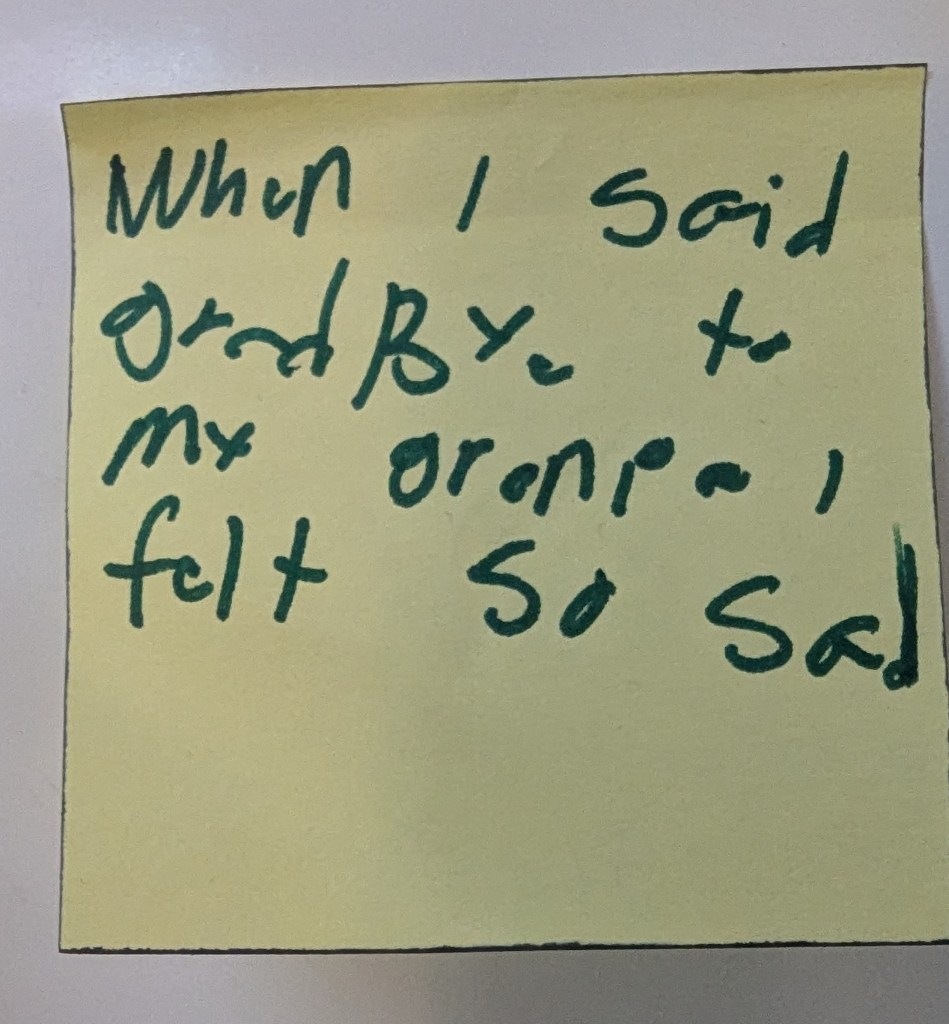
Green = Goodbyes: Who is someone you’ve had to say goodbye to?

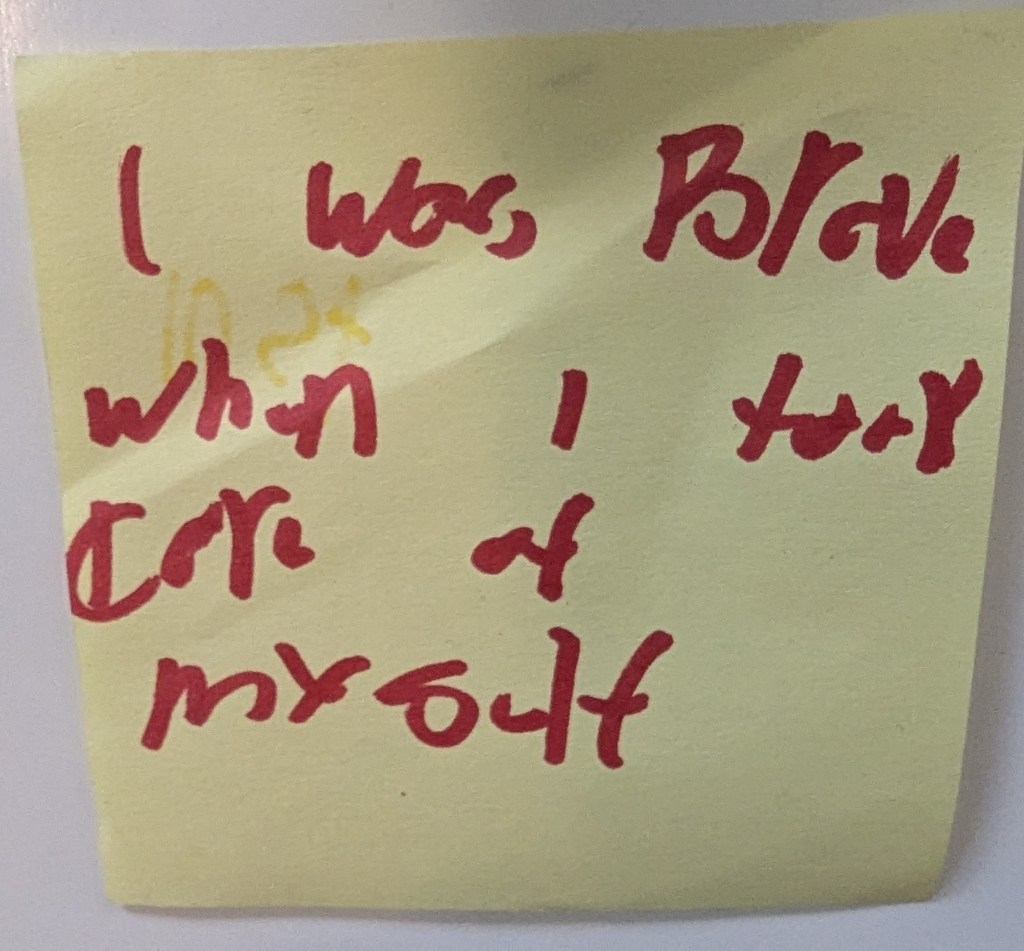
Red = Bravery: When have you had to be brave?

Purple = Fear: When have you felt afraid?

Orange = Hope: What are some of your hopes for the future?

These emotions connect to the memoir we’re reading together, and because my students are English language learners, I also provided sentence stems to support fluency. I set a 7-minute timer and told them to create and post as many sticky notes as they could. For a bit of motivation, the table with the most notes earned a trip to the class snack bucket.

When the timer dinged, we took a silent gallery walk. Of course, silence didn’t last long. A few whispers broke through: “Wait—whose house caught on fire?” or “Hey, who’s from Ciudad?” While I reminded them there was no pressure to identify their notes, most students did. They wanted to.

The best part? This activity works for any pre- or post-reading moment where students might hesitate to go deeper. And I’m saving the sticky notes. When it’s time for them to write their own memoirs and someone inevitably says, “I don’t have anything to write about,” I’ll point to their own words on the wall—a whole collage of lived experiences waiting to become stories.


Kelly Virgin is a WCWP teacher leader who teaches high school English for the Kennett Consolidated School District.

A Book Review:  Leveled Reading, Leveled Lives: How Students’ Reading Achievement Has Been Held Back and What We Can Do About It (Harvard Education Press, 2025).             A book review by Lynne R. Dorfman

Timothy Shanahan, a professor emeritus/educator who has long influenced literacy instruction in our country, has written a new book, Leveled Reading, Leveled Lives: How Students’ Reading Achievement Has Been Held Back and What We Can Do About It (Harvard Education Press, 2025).  In it, Shanahan discusses a common teaching practice in our classrooms that promote the idea of matching students with “just-right” books. Shanahan states that this protocol of getting students reading different texts depending on their assessed reading level is holding many students back. In addition, it is taking teachers away from time that could be spent helping all students learn how to understand challenging texts. He argues that comprehension skills cannot improve if students are not challenged to negotiate more complex, difficult texts.

Shanahan explains that it’s not helping anyone, and in content areas such as science and social studies, teachers are reading the texts aloud to the students. So, when do striving readers get the chance or develop the strategies and skills to tackle complex material on their own?

Shanahan is advocating for all students to read grade-level texts together, with teachers providing more support for those who need it. Everyone will have the same instructional goal, and some students may move more quickly into independent work while others receive more support in the form of another lesson or one-on-one conference or small group instruction. In this way, more students have a chance at reaching the grade-level learning goal.

Shanahan’s new book outlines a toolbox of strategies for tackling difficult texts, such as looking up unfamiliar vocabulary, rereading confusing passages, or breaking down long sentences.  He is not a believer in drilling students on skills like identifying the main idea or making inferences.  Although there seems to be little agreement on how to boost reading achievement for our children, Shanahan states there is not a body of strong evidence that points to greater improvement in reading achievement when students only read texts at their level. He also argues that developing background knowledge is not as powerful as explicit comprehension instruction. By contrast, a 2024 analysis found that the schools that were most effective were those that keep instruction at grade level.  Shanahan admits that more research is needed to target which comprehension strategies work best for which students and under which conditions. Shanahan believes that Vygotsky’s work is often misunderstood. Vygotsky believed teachers should guide students to learn challenging things they cannot yet do on their own.  Shanahan’s critique of reading instruction applies to children in second grade and above who are learning how to read and focusing on making meaning. In K-1, students are still learning phonics and how to decode the words on the page.  Learning to decode first is important. Shanahan says there are rare exceptions to teaching all children at grade level.  Advanced readers can be challenged through independent reading time and by exploring more complex ideas within grade-level texts. Shanahan also discusses the role of AI and of the parents.He also is concerned about what happens outside of school where our students aren’t reading much at all. His advice to parents is to let children read whatever they enjoy, regardless of level, but to set consistent expectations.  He says parents are the adults and need to take responsibility. The book is filled with practical advice for implementing grade-level reading instruction, including detailed descriptions of the types of instruction and scaffolding needed to increase students’ reading achievement.  His book is a powerful call for giving our students the guidance and support they need to make challenging texts part of their daily reading experiences.

Creating Confident Writers By Mark Overmeyer

If you want to build confidence in your writers, try using samples from their writing as mentor texts. I use professional mentor texts to motivate writers to compose and revise, but I notice writers respond more positively to the use of mentor texts when their own work is included in the mix.

Here are a few ways you might use student writing as a motivational and instructional tool:

Excerpt student texts that align with your teaching points. Since I know I will be focusing on specific craft moves during a genre study, I look for students using specific writing crafts during early drafting stages. For example, in a personal narrative unit, I might look for effective use of dialogue, setting descriptions, strong leads, and character development. I excerpt two or more examples of a craft move to include more student writing and to avoid the mistaken impression that there is only one way to develop character or describe a setting. During my mini lessons, I incorporate these student samples by saying something ike this: “We have been looking at a lot of published writers’ work during our unit, but I noticed that a lot you are already using many of the craft moves we will be studying. Let’s look at a few examples of how you are doing this work so that we can learn from each other.”

Excerpt student texts to highlight multiple writerly moves. Early in the school year, I excerpt one or two sentences of student writing from each student and identify the craft or writing move the writer is using. This bank of 20 to 30 excerpts can become a tool for all the writers in the room as they search for ways to revise and improve their own writing. Using student excerpts can be a powerful teaching tool, especially if you include a wide range of writing that moves beyond just description. For example, if I excerpt one student’s writing because it effectively uses a simile, the next excerpt might include strong verbs, and the next a few specific, proper nouns. Make sure to excerpt at least one sentence from every writer in your class if you use this strategy. Your message should be loud and clear: we are all part of the writing community, and we can learn from each other.

Excerpt student texts and ask your writers what they notice. Excerpt one or two sentences from student writing and then ask your writers what they notice. I often group the students and ask them to jot notes about what they notice about the first four excerpts, while another group of students works on the next set of excerpts, and so on. This way, more student voices can be heard while they engage in conversations about what they notice about each other’s writing. Because I want to frame the noticing around the purpose of mentor texts, I might cue the students by saying something like: “Look at these sentences from our writing. In small groups, I am going to ask you to identify what makes this writing work. Think about what strategies and crafts you can borrow as you read these excerpts. Do the sentences work because they describe? Or is it because of the verbs? Or nouns? You decide what makes them effective and then you will have a chance to share your thoughts with the group.”

Cue students to notice what they can borrow from other writers in the room. Once students can comfortably identify how to use mentor texts, you can ask them to read each other’s work for something they might borrow. One way to organize this type of work is to ask every student to leave one page of the writing on their desk. Then, ask students to filter around the room, reading at least four or five pieces with the goal of identifying one or more craft moves they might use in their own writing. After about 10 or 15 minutes, pause and ask students to share their thoughts, including the name of the writer who inspired them. A student might share something like this: “I noticed that Susan used the verb “trudging” when she described how hard it was to walk her dog in the snow. Susan inspired me to look at my verbs to see if I can change any of them to be more active.”

Professional mentor texts are an essential part of a writing workshop classroom. But remember that we have student writing mentors right in front of us every day, and their work can become an integral part of our writing routines.

Mark Overmeyer Author of When Writing Workshop Isn’t Working, 2nd Edition.

Culturally Responsive Writing Instruction: A Summer Writing Opportunity By Dr. Aileen Hower

One of the most rewarding experiences as a teacher educator and professional development coordinator has been coordinating and facilitating Summer Writing Institutes for Millersville University of Pennsylvania, one of the ten PASSHE Universities, alongside West Chester University of Pennsylvania. Since the summer of 2018, I have been planning these one-week intensive Writing Institutes, partially due to feeling so passionate about supporting teachers in their teaching of writing to their students, but also due to the strong feedback from graduate students about their interest in learning more about how to teach writing more effectively.

Previously, we’ve crafted Summer Writing Institutes around poetry, best practices in writing instruction, how to inspire reluctant writers, and even grammar (yes, grammar instruction). This past summer (2025), I felt called to combine the topics of Culturally Responsive Writing Instruction in light of all that is going on across the state of Pennsylvania. Millersville University, like West Chester, is located close to one of the 12 urban school districts, with most teachers across the middle of south-central Pennsylvania instructing students from a wide array of backgrounds, both culturally and socio-economically. Many teachers throughout the courses that I teach express wanting to know more about how to teach with cultural responsiveness in mind. Therefore, I felt that merging the two concepts: culturally responsive teaching and writing instruction would appeal to teachers. The response was positive!

Before we met for the one-week intensive, students in the course read Tricia Ebarvia’s Get Free: Antibias Literacy Instruction for Stronger Readers, Writers, and Thinkers (2023)text as well as Matthew Kay and Jennifer Orr’s We’re Gonna Keep On Talking: How to Lead Meaningful Race Conversations in the Elementary Classroom (2023). Due to having 3 high school teachers enrolled in the course, I gave them the option to read Kay’s Not Light, but Fire: How to Lead Meaningful Race Conversations in the Classroom (2020) instead. I find that the more opportunity for teachers to personalize the learning the more responsive they are to adopting some of the concepts they learn throughout the week into their teaching practices.

Being able to then hear from the speakers of the course texts was a huge benefit to the attendees. While not always possible, it is a great way to allow teachers (and presenters) to dig deeper into the concepts, as they have already prepared for the learning with the authors’ texts. Teachers also had the opportunity through the pre-Institutes writing assignments on the texts to think about how the information in the texts applied specifically to their teaching and students. They came prepared to ask in-depth questions and dig deeper than just a summary of the learning. Of course, we only had 2 hours with each speaker, but it was helpful to have the books already read before starting the conversation.

The format of the week includes time to collaborate in the room (and online in breakout rooms – the course is held multi-modally, meaning there are in-person and online students who attend. This has supported teachers’ attending in the summer and from further away. While I would still say that attending in person is the best (there are giveaways and food, as well as robust discussions and collaboration), feedback from online students has been positive as well, as sometimes the speakers are also online (helps in hearing from presenters regardless of their location (as well as budget)), which offers a more dynamic experience for the online attendees. Millersville University utilizes LiveStream technology, so when a speaker is present, we share the screen with online attendees and also have a camera on the speaker throughout their presentation. Online presenters (as well as attendees) can see and hear what’s going on in-person through the same technology.

We meet for more personalized learning each morning, learn from a keynote speaker for 2-hours in the morning, break for lunch and conversations, learn with a breakout speaker in the afternoon, and then have collaboration and work time afterwards until the end of the day. There is daily reflection built into the week, as well as the opportunity to work on an individualized final project while having access to colleagues (often from similar grade levels or districts) and the course instructor to guide this work.

One thing I greatly appreciate about all of the speakers who present during the week is how hands-on they plan their learning. For example, during Trisha Ebarvia’s presentation, teachers created a personal timeline to create a lens through which to view the information from the text and presentation. Ebarvia facilitated teachers’ reflection and also their critical view of what was present/absent in their timeline in tandem to the dominant and “more complete” narrative that texts read in school often communicate. Evarvia was also able to conduct hands-on simulations and share specific practices from the classroom, which was highly valued by the teachers who attended the Institute.

Likewise, Matthew Kay and Jennifer Orr were able to be Keynote speakers later in the week. Teachers, again, greatly appreciated simulations, in person discussions with the authors/presenters/teachers who have had first-hand experience with this work in their classrooms, as well as Jennifer’s extensive list of culturally responsive texts to use in classrooms. This especially resonated with teachers and their final project was to update a series or lessons, a unit, an instructional time of the day (such as morning meeting), to include more texts that discuss topics and characters that better align with the students in their classrooms.

The whole week is populated with Keynote authors/presenters and then breakout presentations delivered by local teacher leaders. While it is always a draw to have national/internationally acclaimed speakers/presenters, it is such a powerful opportunity, especially for networking, for local teachers, especially those who are looking to have presentation experience, or to share their personal research/work with others. This past summer, two of our most powerful presentations were delivered by a local spoken word poet/author and by a local school district administrator.

I met Julian “Juelz” Davenport through my work with “nErD Camp PA” a few years ago. He visits school classrooms, mostly in the Harrisburg area to discuss writing and the importance of one’s story with students. I thought it would be a powerful experience for teachers to meet Juelz to hear how he has been inspiring students in central Pennsylvania to write. Juelz shared his story with teachers and got them to write about theirs. Then he transitioned to sharing ideas for how to inspire students to write. It was an inspiring and extremely authentic time of learning and vulnerability that really resonated with teachers as all of them had taught a Juelz; all of them want to inspire their students to write the way that Juelz has been able to inspire students in local schools.

Our other huge local success was inviting Dr. Danielle Miles, an Administrator in the School District of the City of York. Dr. Miles has presented previously, numerous times, at Millersville University, on CR-SE topics. On the last day of the week, I like to invite a speaker that might seem slightly off-topic (writing), that works to be inspiring to the teachers. Typically, the attendees are an incredibly inspiring group of educators to work with. They are either in a graduate program or taking a graduate course in the summer to learn in a specific area. As a teacher educator, I want to make sure that teachers know that this is admirable. I work to leave them with something that communicates my admiration for the work that they do (during the year as well as all of the other times). Dr. Miles was the key to closing out the week well. She presented on: Rest, Responsibility, and Revolution. She started by validating teachers’ experiences, took them through some powerful thought exercises, and encouraged them in the knowledge that the work they do and every time they encouraged students to tell their stories, they were doing critical work for the future. I’ve been planning this summer’s Writing Institute since last November. I learned that Mark Overmeyer published a new book on writing. I am working to build the week around the theme: When Writing Workshop Isn’t Working. It will be a wonderful Institute and teachers will grow in their confidence in teaching writing and possibly learn to enjoy teaching writing even more. But there was nothing more inspiring than learning about and with a group of educators who wanted to learn how to best engage and instruct their students.

Learning Through Exploration

Throughout in the school year, I like to give students chances to learn beyond the four walls of the classroom. Early on, one of my favorite ways to do this is by turning them into “experts” on their own school building.

This week, for example, students started class by studying building maps. They drew routes to different resources around the school, then teamed up to practice their English by writing out step-by-step directions to those spots. After that, they got to put their directions to the test—walking the routes, talking through them, and even creating a second set of directions to a new location.

It’s a simple activity, but one that’s engaging and collaborative. The maps, conversation, and exploration help students build both confidence with language and comfort in their surroundings.

Later on, this activity will grow into a larger project. Students will each choose one school resource to research in greater depth in order to create a student-friendly guidebook that explains what the location has to offer. Their written directions will be just one small part of the final product—alongside a Q&A with the resource expert, plus the key facts and supporting details they uncover along the way.

This project not only strengthens their language skills, but also helps them see the school as a place full of people, spaces, and opportunities ready to support them.


Kelly Virgin is a WCWP teacher leader who teaches high school English for the Kennett Consolidated School District.

An easy strategy to kick start student collaboration

Want to get your students talking? Hand them a clipboard and get them on their feet. Early in the semester, I like to pose a simple question: What do you need to know about someone to know you’ll work well together? After a few minutes of brainstorming, I give each student a clipboard with a blank chart, and we head to the hallway.

Students line up facing each other, and with a 90-second timer running, they talk. The clipboard gives them something to look at, and the questions give them something to focus on. While these elements make the conversations feel low-stakes, they often lead to high-reward connections.

Conversations don’t always stick to the prompt—but honestly, those off-track moments are often the best ones. When the timer goes off, one row of students shifts down to new partners, and the process starts again. Before students leave for the day, I ask them to jot down the names of classmates they think they could work well with.

This quick activity gives me useful input for seating arrangements and helps students see that effective collaboration doesn’t always depend on sitting next to a friend.


Kelly Virgin is a WCWP teacher leader who teaches high school English for the Kennett Consolidated School District.