Skip to content

Posts from the ‘PAWLP’ Category

September Snapshot:Character Creature Creation

What would It look like if you combined a bear, pig, chicken, snake, and monkey? The possibilities are endless, as new species are developed in the minds of middle schoolers.

While diving into the characterization with short stories students take a hands-on approach crafting their own creature. My students completed this activity after we read and annotated the short story “Charles” by Shirley Jackson. Charles is quite the troublemaker causing chaos when he enters his kindergarten classroom. Needless to say, there are tons of ways to characterize Charles. Rather than having my students answer questions about Charles or write a paragraph describing Charles I get them thinking outside of the box and bring the makers space into the language arts classroom.

After reading the story I ask that the students come up with five-character traits to describe Charles. For my students who may have a difficult time coming up with character traits I provide them with a list of positive, negative, and neutral character traits to pull from. Once they have their five-character traits picked they then need to decide upon an animal that depicts that character trait. For example, if the character trait was conceited, I may choose a peacock, who are always displaying their feathers. Students continue this process until they have an animal for each character trait. Ideas bursting, laughter echoing, and risk-taking fill the air while working students spontaneously collaborate giving ideas about animal possibilities or explaining why that animal or character trait could possibly work.

Once the brainstorm is complete students begin designing their creatures assembling one body part at a time. Some students draw, others print pictures and cut them out, while a couple use online tools. The mode is up to them- the products are anything but monotonous. Once their creature is molded to their liking students provide it with a name.

The last part of this process is writing about the emergence of this creature. Students must write a response explaining how this character came about. They must also explain what each animal part represents and provide an example of how the character displayed that characteristic from the story.

Students infer, demonstrate an understanding of characterization, find text evidence, and hone their writing skills without even blinking an eye! This activity could be used for any novel or text.

When students are provided hands on learning opportunities ownership surfaces, creativity flows, and engagement prospers.

September Snapshot: Embracing Disruption

Homecoming week- a week of fun as recent alumni return home and current students sit in class, dreamy-eyed about a Friday pep rally to cheer on the greatest achievements of the school and our undefeated football team. The sugar plums dancing for a school dance on Saturday evening as fingers tap to the anticipated tunes that will fill the gymnasium with a liveliness only school dances can bring.

Though teachers look towards this potentially disruptive week with a sense of uncertainty and trepidation, I decided to approach this week with an aura of comradery with my students. Just like most of you in this boat, I understand the weaknesses that our students succumb to when the change in routine hits them. They are antsy, a tad rowdy, and less likely to fully pay attention. They look doe-eyed at you when you try to get them to focus on the deeper meanings in your lesson and you know instinctively, that when Monday comes around, you are rehashing Friday’s materials when they are better equip to handle learning.

So I embraced the spirit of homecoming week with a review football game on our hectic schedule. The class is split into two teams and are asked to create a “playbook” order. Each student receives a number and it is that order that they answer questions. When a team has the ball, they can choose to try to move 5, 10, or 20 yards. The questions they get are progressively harder based on the yardage they want to go. If the student gets the question right, I move their pawn piece across the projected football field (but if I catch a teammate trying to give them an answer, it is an illegal move and automatic loss of 5 yards).

The students have to try to make it across the football field into the goal line for 6 pts (there are no extra points for my game). If a team gets two questions wrong while trying to get their first down, it is a turnover on the down and the ball moves to the other team. If a teammate gets an answer wrong and the next question has not been given, the next player on the other team is allowed to stand up and shout the answer proudly. If it is correct, they can get an interception and the ball moves to the other team.

The kids have a blast playing a game on a Friday morning when they are still groggy and they love playing a game when the pep rally is getting closer (even if it seems achingly slow). And, in all honesty, I figured, why fight it? Why fight the inevitable loss of attention I will have from a number of students? This way, I know that my students are engaged and I can estimate their knowledge at this point in time. They feel like they are not doing anything and I feel like they are using their memory banks. Honestly, a win-win situation to me!

September Snapshot: The English Language Development Chameleon

So far this year I have jumped in enthusiastically to an improv game called “Bunny, Bunny” in an 8th grade class. This game encourages students to work as a team as they pass the words, “Bunny, Bunny” around, while standing in a circle.  The class kept erupting into laughter as another component of the game is to keep the rhythm going by chanting, “Goocha, goocha,” continuously. Then, I was off to a fairly new teacher’s classroom, who was sternly reviewing the rules of the class with a Powerpoint. I shed my “Bunny, Bunny” demeanor, stood up straight and donned a serious face to show support for my new colleague. Next, I went to a seasoned 4th and 5th grade teacher’s room and sat down with a table of students who were cutting out emojis that represented their identities. I relaxed into the seat and talked to the students informally about the choices they were making.

As an English language development teacher (previously known as ESL teacher), I don’t really run the show during the first weeks of school. It is a time for me to observe and notice as much as I can about the students and teachers with whom I will be working. As I move from classroom to classroom I adapt to the environment that the general education teacher has established for the start of the school year.  Until my caseload is finalized and I have some time to co-plan with teachers, this is my role and I believe it helps all the students to view me as a positive and natural part of their classroom community. That way when I begin to focus on the multilingual students to develop their language skills, they are not stigmatized and their classmates feel comfortable coming to me for guidance as well.

September Snapshot: The Importance of Discussion

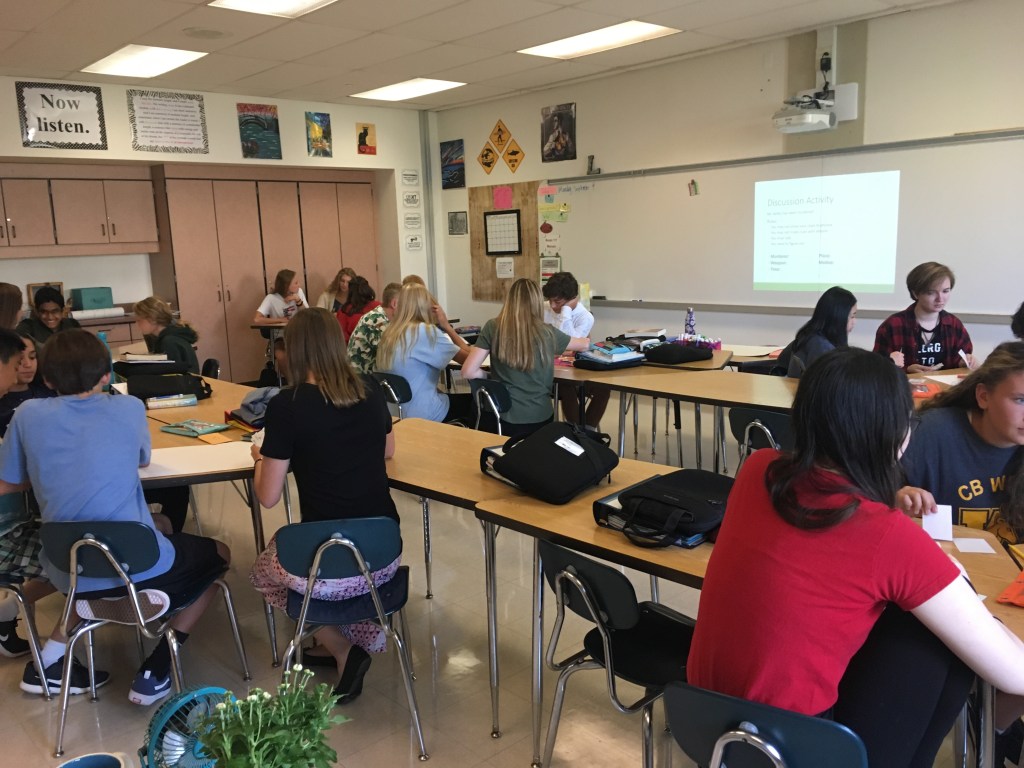
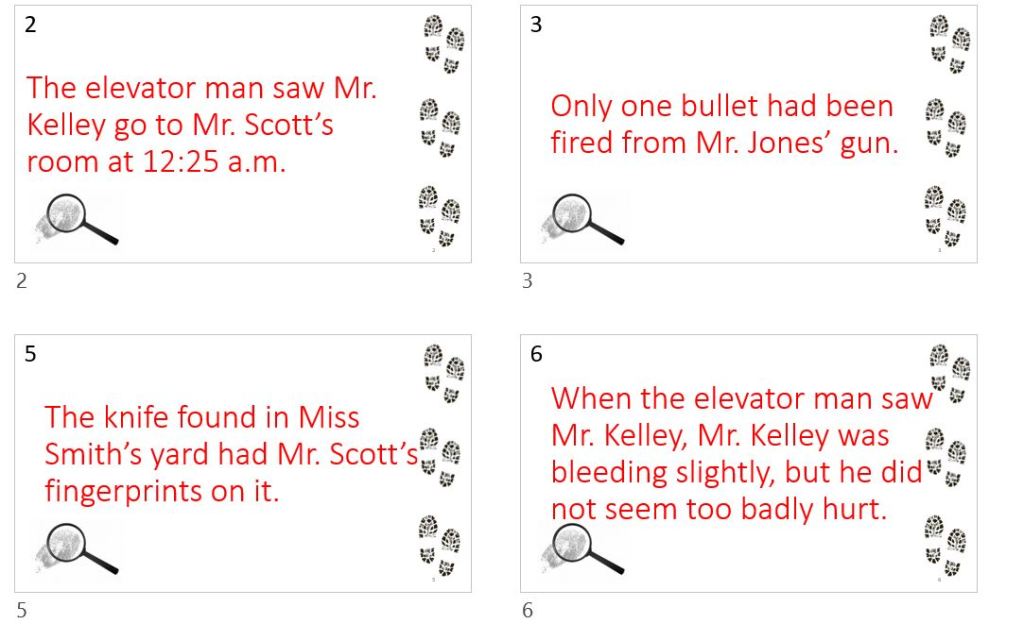
There’s been a murder!

Students are given groups, clues, scratch paper, and twenty-five minutes. They have everything they need to figure out who murdered Mr. Kelley.

I started doing this activity a few years ago when I found that my students either didn’t like to participate in group discussions or struggled to have conversations with peers that weren’t their friends. I started searching around, and I found a murder-mystery discussion activity.

I adapted it to suit my needs, piloted it, and it is now part of my opening week lessons.

When placing the students in their groups for the period, I try to pair them up with people I haven’t seen them interact with as much. I want to build community within our classroom. Students are dealt clues, and they are the only ones allowed to read their clues out loud. This is an easy way to make sure everyone within the group participates and that no person dominates the conversation.

Students work together, organize information, and collaborate and communicate with one another. Once the murder is solved, we discuss the importance of sharing ideas with one another, working together, and thinking critically. The students really enjoy the activity and it does a great job of highlighting the idea that everyone can make valuable contributions to a discussion.

September Snapshot – Using One-Pagers for Brainstorming Narratives

20190914_075349

I have used one-pagers before in the context of literature courses, asking students to respond to a book or a reading. But, during the first week of classes, when my first year writing students began thinking about their literacy narratives, I decided to try out something new (for me, at least): to use the one-pager as a brainstorming tool.

Why use a one-pager? 

  • Students are creating narratives, so allowing a visual representation in the brainstorming process can help them think about important details.
  • They don’t need to write complete sentences. The prompts I gave them asked more about the general aspects of their stories: Who are the characters? What visuals stand out? What are some of the keywords in your narrative? Are there quotes or ideas that could become dialogue? Etc.
  • Students don’t have to be artists. They just need to convey their ideas in short textual or visual representations.

What did I ask them to do?

  1. I first explained what a one-pager is and why we were using it for further brainstorming. On the previous class meeting, students had produced a list of potential topics for their literacy narrative. On this class meeting, they narrowed it down to the one they would develop.
  2. I used one of the templates from Spark Creativity
  3. Before starting their own, I showed students examples of one-pagers from my previous students. I explained that these were a little different because they were responses to a book rather than ideas about their own writing.
  4. I projected on the screen the following list of elements to include in their one-pager:

■A border with key words about your narrative. It can also be a quote you remember.

■Tone. What tone will you take? How will you achieve it?

■An image or set of images that relate to your narrative. Think about what you are including and why. Write about them.

■Key events in your narrative. You can list them, sketch them, or both.

■Characters in your narrative. Who plays a part? How are they part of your story?

■Lines- think about dialogue (this can be “made up”)

20190914_075224

What happened?

While including the main components, students created a variety of one-pagers. And each one addressed the individual needs of each writer. One student, for instance, brainstormed ideas learning to use a computer when they were little. In their one-pager, they sketched a keyboard that, instead of letters, was covered in what looked like chicken feet. As the student explained, thinking about their first time trying to use a computer, this is what the keyboard looked like– just indiscernible and confusing characters.

The verdict: The one-pagers worked! My students were able to brainstorm in textual and visual ways, with some structure yet also freedom. Next time, I will consider allow more time in class for this so that their one-pagers can be even more detailed.

How have you used one-pagers with students? What are some brainstorming strategies your students have enjoyed?

Opportunities Abound

Consider seven surprises from the start of the year:

  1. A 6th-grade girl dancing and leaping like Isadora Duncan all by herself. Easily 100 yards away from everyone out in the fields by our school–a happy little pink speck twirling and flickering across the grass.
  2. An 8th-grade boy handed me a knitted blue heart on his way out of class and said “there’s a really interesting project going on with these”: The Peyton Heart Project.
  3. I saw $25 dollars in cash outside. I’m “used to” seeing kids’ smartphones left unattended outdoors, but we’re doing cash now?
  4. The student who said: “I. Am. SO. Going. To. Raid. Your. Bookcase.” 
  5. And then there is the email titled “Writing” from a student on Sept. 3rd.
  6. And the boy who wore a full Spiderman costume to Picture Day and the rest of the kids didn’t blink.
  7. And the magic that happens when we provide kids colored chalk, an asphalt surface, and time.

Educator’s curate and plan. Administrators curate and plan. The top-down model of “doing business” is real. Yet, so much of our vocation is steeped in holistic responses–the “intimate and inexplicable connections”–generated within our small communities.

The seven surprises shared above may seem unconnected but that isn’t true. They all have something in common.

Me.

I was there.

And each act of creativity, sincerity, or folly can be impacted by my responsiveness…or silence.

I haven’t shared if or how I may have responded, but I know I can be better. I am reminded that, even after twenty-five years in the classroom, we have so much to learn…and give.

Opportunities to give emerge in unexpected ways every day.