Skip to content

Posts from the ‘PAWLP’ Category

Books on the Blog: Two Middle Grade Books About Growing Up and Discovering the True Meaning of Family

The World from Up Here by Cecilia Galante

Reviewed by Ginny McGarvey

Rating: V25648199.jpgery Good-Book of Note. Level: Elementary School/Middle School. Genre: Realistic Fiction – 309 pages.

Summary: Wren Baker is afraid of everything and when her mother is hospitalized in a different state, requiring her father to go also, Wren and her brother with Asperger’s syndrome are forced to live with their aunt and cousin who are new to their town; and Silver, her cousin appears to be afraid of nothing at all and inspires bravery in Wren.

Annotation: Wren Baker is afraid of everything. Her mother, suffering from depression must travel from their Pennsylvania home to an Ohio hospital for treatment which means that her father must go as well. Wren’s new to town and her Aunt Marianne and cousin Silver offer to care for Wren and her brother who has Asperger’s syndrome. Silver does not appear to be afraid of anything. As the girls become close, they inspire each other, and when they climb the forbidden Creeper Mountain, they discover parts of themselves and rely on each other.

This fast paced, well written novel is sure to thrill young readers. It is packed with suspense and its many plot twists will engage and entertain readers. With all the action that abounds, the story comes full circle and all that is mysterious is resolved and explained making it a very fulfilling read.

Recommendation: This book is highly recommended for any elementary or middle school library as a Book of Note and will relate well, engage, and entertain young readers.

Wish by Barbara O’Connor

Reviewed by Lynne Dorfman27414384.jpg

Then, as we were turning onto the main road into town, I saw a black horse out in a field, eating grass and swishing its tail at flies. I shook my fist at it three times and made my wish. That was the rule for black horse wishing. If you see a white horse, just make a wish. But for a black horse, you have to shake your fist at it three times. (p.43)

Set in a small town in North Carolina, Charlie (short for Charlemagne) learns many important life lessons. Her family is broken – “Scrappy” (her Dad) is in jail being “corrected” and her mom just can’t meet the everyday challenges of raising two children on her own. Charlie’s older sister Jackie goes off to live with her best friend’s family, and Charlie is sent to Colby to live with her Aunt Bertha and Uncle Gus.

Read more

Teacher to Teacher: Helping Students Spell

by Lynne R. Dorfman

How many times have you observed writers in your classroom who do not seem to know what to do when they want to use a word in their writing but do not know immediately how to spell it?  Do some of your students just stop writing when they are stuck on spelling?  How often do your students substitute another word they know how to spell for a more difficult word that is not part of their spelling vocabulary?

Kindergarten students are often fearless about spelling. They learn to use the consonant sounds they hear in a word, especially the initial and final consonants. Vowels are tricky, and come much later in the kindergarten year or in the first grade. Invented spelling plays a big part in the work of a primary level writing workshop. Minilessons involve teaching students to stretch out words to hear all the sounds and blend them together, writing down the letters for the sounds they hear. Primary grade teachers often offer some strategies to help students spell tricky words.

Kindergarten teacher Shelly Keller celebrates students’ attempts to spell tricky words independently during writing workshop. As she circulates for roving conferences, she takes note of her students’ spelling attempts and sends one or two students each day to fill in the chart with their kid spelling. If it matches the adult spelling, the students fill in that column, too. If not, Shelly fills in the adult spelling. The students often will edit without being asked to do so. Friday is a time to celebrate these writers with a silent cheer at the end of writing workshop. Then, a new chart goes up for the next week. Shelly is celebrating risk-taking and using invented spelling to communicate ideas with words her students want to use without limiting their choice to words they are sure they know how to spell.

Read more

Guest Post: Is reabhloideach mise.

by Meg Clementi

b4ce9c74625bfa28595da719e6f32686.jpg-2.gifIs reabhloideach mise.  I am a revolutionary.
As a math teacher, I am questioned by peers as to why I have my students write.  What is
my purpose in asking students to explain their thinking?  Why have I attended conferences, courses and programs whose attendees are comprised of 99% English teachers and Elementary reading and writing teachers?  I stand at the edges, accepting the shaken heads and wonderings of my peers.


Is reabhloideach mise
.  I am a revolutionary.

I have my students write because their ability to explain their thinking is important to me.   Their ability to justify their processes and answers is critical.  Their depth of knowledge is essential.  My students write because as their teacher, I demand this level of participation, performance and comprehension from them.  I am not satisfied with them simply renting knowledge and discarding what they have learned as they place their hands on the doorknob and walk out of my classroom for the last time.  I want them to own knowledge.

Is reabhloideach mise.  I am a revolutionary. Read more

Tools of The Trade: Student-Friendly News Sources

by Kelly Virgin

I recently gave my high school students a twenty-five question formative current events quiz with names such as Donald Trump, Hillary Clinton, and Keith Lamont Scott, terms such as Republican, Libertarian, and Pipeline, and places such as Syria, North Carolina, and Brazil. I asked students to match the names, terms, and places with the reasons they were recently featured in the news. On average, students scored a seven out of twenty-five, with some students scoring as low as a one or a two out of twenty-five. This quiz led to self-reflection and an insightful discussion about the importance of knowing what is going on in the world around us.

In their most recent book, Reading Nonfiction: Notice & Note Stances, Signposts, and Strategies, Kylene Beers and Robert Probst insist, “Far more important than the ability to capture the teacher’s information and thoughts is the ability to acquire information on ones’ own, to test ideas against one another, and to decide for one’s self what notions have merit and which should be rejected or abandoned” (32). It was clear from my students’ quiz results that they needed more opportunities to practice the acquisition of information on their own. Read more

A Writerly Life: Wisdom from Donald Graves

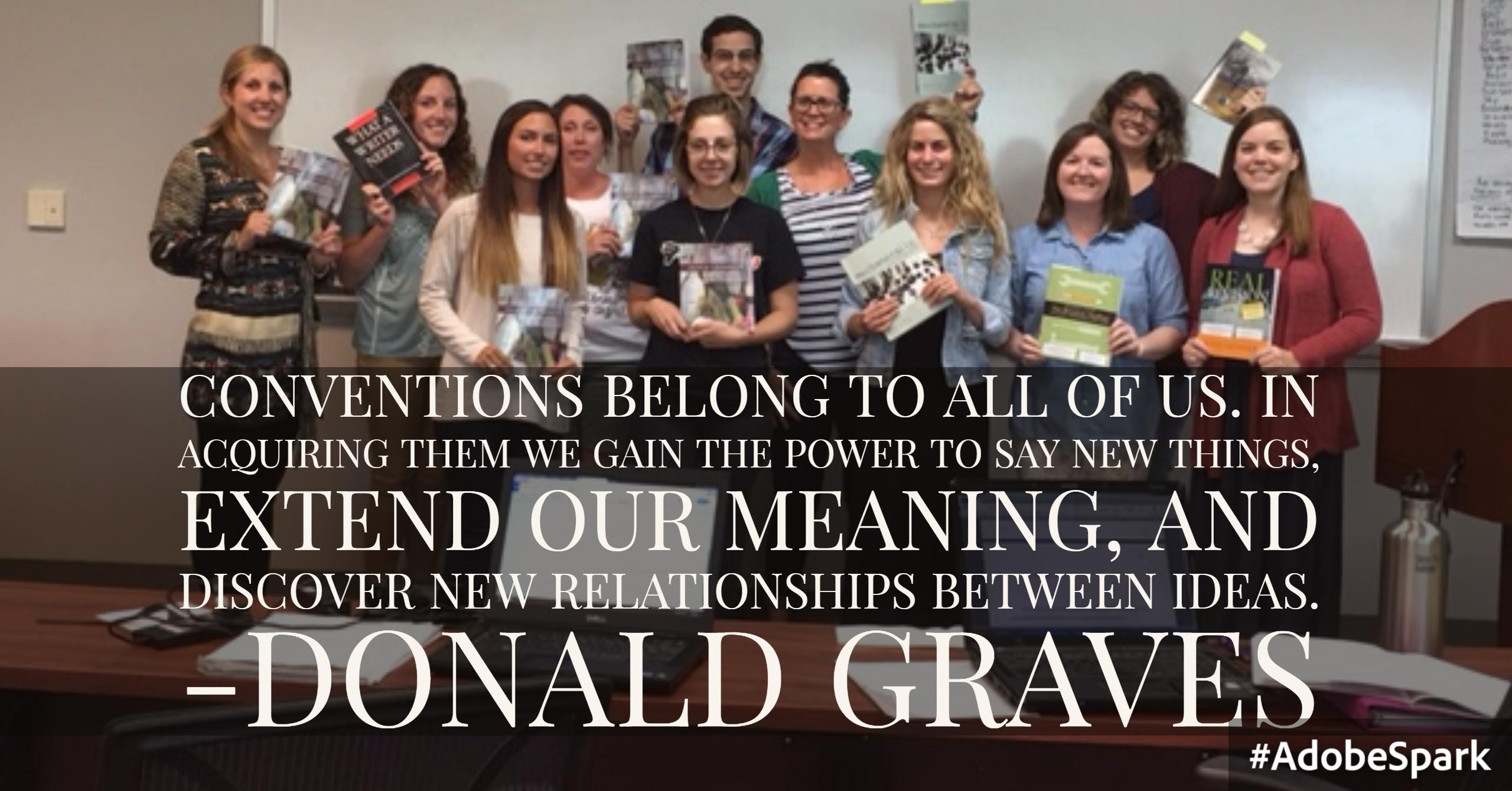
Teachers can empower their students with conventions.

-Kelly Virgin (2016 facilitator of Grammar Matters)

Adobe Spark (3)

Season of Inquiry

By Janice Ewing

Make a quick written or mental list: when you think of October, what are five words or phrases that pop into your mind? This is a month and a season of colorful and flavorful transitions. Maybe you had Halloween on your list, or changing leaves, or candy, or pumpkins, or pumpkin spice latte…

Most likely, as teachers, there are other transitions occurring as well. Whatever your grade level, whether you teach 25 students or 150, you have gotten to know them by now, perhaps not as well as you’d like, but more deeply than you did when you first greeted them in late August or early September. With that knowledge comes great fuel for teaching and relationship-building, but great challenges as well.

Think about what you’ve learned from formative assessment – conversations, observations, anecdotal records, reading and writing conferences, and all the other ways you get insight into your students’ processes and products. Regardless of your grade level or subject, you are probably seeing vast differences in interests, learning styles, strengths, and areas of need. This is important to know, right? Yes, but it can also be overwhelming. For many teachers, this is a time in the school year when we look at the information we’ve acquired about our students, and ask ourselves some questions: Read more