Skip to content

Posts from the ‘Reflective Practice’ Category

Guest Post: Finding and Honoring Our Many Stories (Part 1)

By Brittany Carlino

First day of school with VPG in backgroundI spent last year teaching in Budapest, Hungary through the Fulbright Classroom Teacher Exchange program. This means I traded places with a Hungarian teacher; she came to teach at my U.S. school, Great Valley High School, and I taught in her place at Veres Pálné Gimnázium.  As you might imagine, there were myriad ups and downs in that experience, but I would do it again in a heartbeat.  It made me into a better student, teacher, and person.  Most important, it sharpened the need to look for the many stories – personal, cultural, societal – that can be honored and celebrated, and how imperative it is that we teach our students to do so.  Read more

Slice of Life 2: Body Language

By Janice Ewing

Peering out at our back steps and driveway this morning, taking in the icy slushy mess, I’m somehow reminded of an old-fashioned refrigerator in need of defrosting. Once that image enters my mind, I’m taken back to childhood memories of my mother defrosting our chunky old General Electric.  I’m back in the small, normally neat kitchen, suddenly cluttered with odd-shaped packages that bear little resemblance to foods we eat. I think this must have been one of my mother’s least favorite tasks. I didn’t know this from anything she said, but, even then, I could read it from her body language. Her usually calm, measured movements were abrupt and choppy, almost violent as she did battle with the recalcitrant ice. Read more

Teacher to Teacher:  Does Reading Aloud Really Matter?

By Lynne R. Dorfman

As our already crowded day continues to be even more crowded, how do we fit in time to read aloud to our students?  Does reading aloud really matter? There are many reasons to read aloud, even when you are tempted to snatch that time for more independent reading and writing, or to fit in science or social studies.

A rationale for reading aloud is multi-faceted. It stimulates language development and helps students move more naturally into reading. When we read aloud to our students, we not only model what a fluent reader looks and sounds like; we also model just how enjoyable the act of reading can be. Read more

Learning and Sustaining Energy

by Brenda Krupp

As I write this post I am celebrating a birthday, a birthday that pushes me closer to retirement, a birthday that makes me one of those teachers others approach and ask, “Was it always like this?’” That scares me, especially in light of this blog post topic: sustaining energy. I have to admit that it was not always like this. There were no SLOs, PARCC tests or PSSAs when I began my career. Teaching with “fidelity” meant something different. And, in the elementary school, children were children not cogs that needed to be prepped for the next, higher level. Teaching was tiring, but not energy zapping. So, how does one sustain energy in this era of teaching? On a recent evening, I got a glimpse of how. Read more

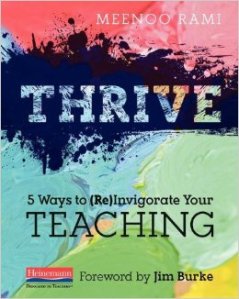
How to Thrive as a Teacher: A Book Review

thriveThrive : 5 Ways to (Re)Invigorate Your Teaching  by Meenoo Rami

by Janice Ewing and Rita Sorrentino

During the winter months, teachers and students have more to cope with than just cold weather and icy roads. Deadlines, data-driven decisions, and daily demands of classroom life loom larger as testing schedules, teacher evaluations, and interim assessments fill up the calendar.   Finding time to accomplish all that is required of a teacher, while keeping students’ best interests at heart, can zap the energy of the best-intentioned educators. Read more

Gatsby, Hawthorne, and Being Sixteen

By Tricia Ebarvia

One of the last books I read in 2014 was Gabrielle Levin’s delightful novel, The Storied Life of A.J. Fikry.  At one point, the main character—a somewhat odd and sometimes churlish bookseller named A.J. Fikry—tells his daughter to remember that “the things we respond to at twenty are not necessarily the same things we will respond to at forty and vice versa. This is true in books and also in life.”  He adds, “Sometimes books don’t find us until the right time.”

Many years ago when I first read The Great Gatsby in high school, I didn’t like it very much. I remember listening to a classmate discuss how much she loved the book. “Gatsby,” she gushed, “The way he could change his entire life to win Daisy over? It’s soooo romantic.” I didn’t get it. Read more