Skip to content

Emphasizing Multimodalities for Multilingual Learners during Distance Learning

by Courtney Knowlton

It is almost unbelievable that I entitled my Google Classroom assignments for this week, “Week 8. . . .” I have been teaching from my computer for eight weeks now? How is that possible? Although I must say that in those eight weeks as a virtual English language development (ELD) teacher, it seems I have learned a full year’s worth of strategies to support and enrich my students using technology.

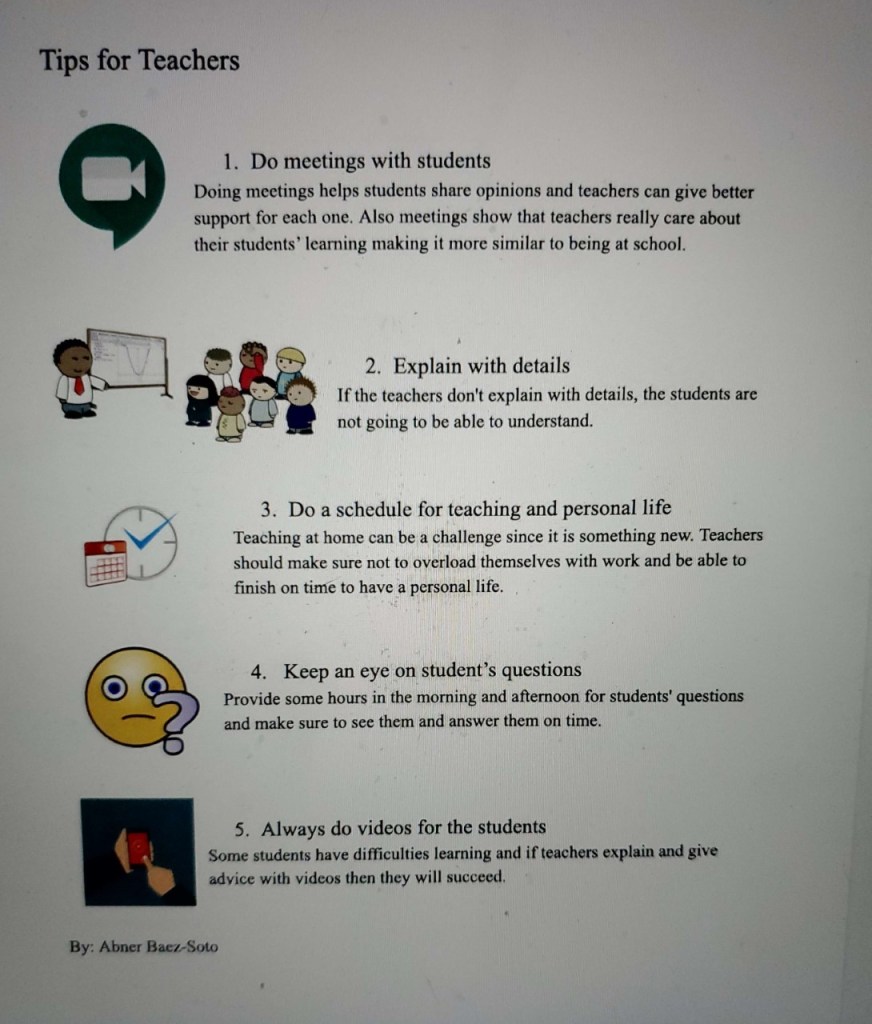
Recently, I asked my multilingual learners to reflect on their distance learning journey so far and create an infographic of tips for students and teachers. This project helped me reflect on my own journey as well. First of all, it was eye opening to watch the students create their projects. It helped me understand the range of computer literacy skills present in our group. For some students, the task of searching for images and formatting them on the Google Doc took them a substantial amount of time. Asynchronous teaching takes away our ability to adapt in the moment, which is why it is so important for us to continuously reach out to our students, especially those in the ELD program, and ask them, “How long did it take you to complete this work?” Chunking the tasks appropriately is crucial for student success.

Our infographic project also supported my belief in the value of visual literacies. Did the students get a little frustrated when their image pushed their text around in weird ways? They certainly did, but haven’t we all been there at some point? More importantly, the use of visuals led to students identifying the main idea of their tips, thinking metaphorically, and comparing the usefulness of different images for getting their point across. Creating a project with visuals is a task that is accessible to students of all language levels and it is a skill that can be used in many different contexts. When I first started teaching from home, most of my assignments involved students interacting with texts. For the last few weeks of school, I want to intentionally plan more opportunities for students to create with visuals.

When the students completed their infographics, I noticed that a common thread within their projects was praise for the use of videos and synchronous meetings. These students are missing all of the aural literacy development and person to person connection that they get when they are at school. In order to attempt to fill this void for them, I have been using a few free tools available through the Chrome Web Store. I use Screencastify to create videos to explain assignments. At the moment, they are offering a code for educators affected by the pandemic to access their premium services, which is CAST_COVID. Two more Chrome add-ons that have improved our distance learning experience are the Grid View Extension, which allows you to see all participants in a Google Meet, and the Nod Extension, which gives students the ability to click on an icon to raise their hand as well as to use emojis to communicate their thoughts and feelings. Lastly, I use an extension called Mote to leave voice comments on the students work in Google Docs and Google Slides.

When planning learning experiences for multilingual learners, it is crucial to keep different literacies in mind for both receptive and expressive communication. In my case, I have been using visuals and auditory information effectively to deliver lessons. However, I need to make more of an effort to invite students to express themselves using different modes as well.

Call for Distance Learning Blog Posts

The PAWLP Blog would like to hear from you! What does distance learning look like for you, your students, and your school district? What digital programs are you using? What lessons have you tried out? How has distance learning questioned or improved your best practices? How might distance learning improve and/or challenge your teaching in September 2020?

Blog posts will be featured in our Distance Learning column each Monday. Please email the PAWLP blog if you are interested or would like to find out more information.

Saying a Virtual Goodbye to our Classrooms and the Communities we Built Together.

The last few weeks of school are typically some of the best few weeks of school. This is when we get to enjoy all of our hard work and efforts together through writing celebrations, field trips, poetry slams, sharing our favorite reads, and reflecting on the year we spent together while looking ahead at our futures.

So as I  sit here separated from my students by a computer screen, I’m not only mourning the loss of our in-person connections but I’m also pondering how to honor the community we built with an asynchronous goodbye. 

First and foremost, I know I need to give my students choice with how they close out their school year. I realize this school shut down has presented a vast array of challenges for my students. While most deal daily with the boredom and loneliness of social isolation, others have become full time workers, some are trying to navigate online learning while sharing a computer with siblings and a home with 10 or more people, and a few are grieving lost or sick family members. With this in mind, I want to honor the school year we’ve had together while respecting the various hurdles they each have to jump in order to finish it. Accordingly, the following is how I plan to invite students, in their own ways and on their own time, to celebrate the community we’ve built before saying goodbye to it:

Virtual poetry slam: Since we’ve spent the few last weeks reading and writing poetry through our online learning platform, I want to take some time to communially celebrate the creative work we’ve done by inviting students to participate in any or all of several sharing options. Read more

Re-Visioning Brick and Mortar Classroom Practices: From the Mindful Minute to the Mindful Stretch

by Mary Buckelew

“The warm handshake at the classroom door, the encouraging hand on the shoulder of a student who is working through a problem—these small gestures, as well as the other rituals we have embedded into our classrooms, don’t all travel well.”

–Frey, Smith, Fisher (ASCD Express, 2020, Vol. 15, No. 17)

For many years, I’ve opened my brick and mortar writing classes with the same trio of activities. Some activities traveled well and some needed adjustment.

Pre-Pandemic Trio

  • The Mindful Minute (provides a segue from our busy lives to writing workshop)
  • Student Announcements (foster community and heighten our awareness of interests, diversity and similarities in our classroom)
  • The “Focused Freewrite” (leads us to the content of our class, writing)

Some students likened the opening of our face-to-face writing classes to a ritual, and I remember thinking that’s not so bad.  In “Classrooms Need Rituals and Routines — But Don’t Get Carried Away,” Brian Gaten writes of the importance of classroom rituals, “Rituals are more than a daily reminder of the hows and whys of your classroom. They also:

  • Give students consistency in their learning and routines to help center their thinking.
  • Reduce anxiety so students can be open to class content.
  • Create a flow in the day.”

So far so good, but then along came the pandemic.  The culture and context of the brick and mortar writing classroom evaporated in the blink of an eye, and I had to acknowledge that not all face-to-face pedagogy or content smoothly traveled to our online classroom.

Fast Forward to Remote Learning

The Mindful Minute became Mindful Stretching

As I looked at the somber faces of my undergraduate students, neatly lined up in Zoom, I realized that perhaps we’d been with our minds too much and needed something other than a mindful minute of silence and breathing.  Instead of sitting quietly (although this was certainly an option), I suggested stretching, walking, or dancing 😊 in place for a minute (video off/screen closed). Ralph Peterson suggests, “At best, ritual functions to keep students in touch with themselves, forge community bonds, and liberate imagination” (p. 27). Sometimes rituals need radical revision sometimes minor modifications.

Announcements became “Check In” time

Instead of asking students to share announcements regarding their campus activities (not happening), I invited students to share what was on their minds. It soon became apparent that there were vast differences in students’ experiences during the pandemic. One student was supporting her grandmother and herself by working overtime in the grocery store; another student was working double shifts as a pharmaceutical technician because he and his mother were the sole support of their family of eight! Other students had the time to embrace boredom and or to re-paint and reorganize their bedrooms at home. As the weeks progressed, students became a bit more reserved when discussing their boredom; i.e., they were sensitive to the disparity in each other’s experiences.   Eventually, Check-in evolved into sharing new movies/Netflix series and other items to bolster morale.  The change in focus necessary and the 10 minutes it took – very worthwhile.

Focused Freewrite (ala Louise Rosenblatt) essentially the same

The goal — to write for three and a half minutes without stopping remained the same. I reminded students that this was not just a time filler. Rosenblatt notes that the freewrite “should be a technique for tapping into the linguistic reservoir without being hampered by anxieties about acceptability of subject, sequence, or mechanics” (1072).

I also reminded students that timed writing and (timed reading) are great strategies to use when we are not feeling the flow; i.e. setting the timer gives us the opportunity to start and stop without feeling like a project or writing piece looms before with no end in sight. I noted that Jeff Anderson and other gurus suggest that freewriting builds our writing fluency, stamina, and endurance.  A colleague, Bob Z., told me that some of his students find that the freewrite has a meditative quality to it. So, our freewrites remained 3 ½ minutes long, but I asked students to supply the prompts for our freewrite for the duration of our online classes.  Clearly, they enjoyed being asked to do this – Here are just a few of the prompts students shared:

  • What do you wish people around you would not do or would do during this time of sheltering and social distancing?
  • If you could only listen to one band/musician/ensemble, who would it be and why?
  • What is the first thing you would like to do when this is over? Describe using all senses.

In our small group Zoom breakout sessions students seemed to share freewrites more readily and had more to say when we returned to the ‘main room” than in our old brick and mortar days. At the end of this semester, one of my students, Jack, shared the following in his final reflection: “but I believe that the most influential piece of the class that will stick with me after this semester is the focused free write time before every class began. What may seem like a short exercise to get the brain flowing was much more to me.  . . . This very small piece of the class was extremely impactful on my current life because it reopened a previously suppressed outlet for stress and anxiety. I could just write without sharing my words or ever having to revise. It was raw emotion or feeling about any topic I chose for that session. I plan to incorporate the focused free writes into my future writing processes to gauge my raw and unedited feelings and knowledge about a topic. I feel it will be most useful before brainstorming and then again after my research is complete to make sure I have a full understanding of the topic before engaging in writing the final product.”

Jack’s comment regarding how the focused freewrite helped him during this stressful time and how he would apply the strategy to his future writing endeavors – made this anxiety ridden and overwhelming online teaching endeavor worthwhile.

Admittedly, teaching online this past semester was anything but smooth, but it gave me the opportunity to ponder my teaching philosophy, my praxis, and the purpose/s of much of what I do. This chance to reflect was an odd gift from an unlikely source.

What did you learn about yourself this past spring? In the classroom? Outside of the classroom?  What aspects of teaching online did you enjoy What platforms and apps did you find most useful?  What will you focus on this summer to prepare for the fall? I would love to hear from you! mbuckelew@wcupa.edu

References

Bennett, P. (2020) “This grand distance-learning experiment’s lessons go well beyond what the students are learning.”  for CBC News Opinion · Posted: May 11, 2020 4:00 AMET  Last Updated: May 11 https://www.cbc.ca/news/opinion/opinion-distance-learning-education-covid-1.5547062

Burns, M. (2020) “Emergency teaching online: 7 steps to get started.” Global Partnership for Education. https://www.globalpartnership.org/blog/emergency-teaching-online-7-steps-get-started

Ferlazzo, L. (2020) “We might have gotten remote learning wrong. We can still fix this   school year.” Education Week Teacher. https://www.edweek.org/tm/articles/2020/05/13/we-might-have-gotten-remote-learning-wrong.html

Frey, N. Smith, D. & Fisher, D. (2020) “A Positive classroom climate, even from a distance.” ASCD Express: May 14, 2020; Vol. 15 Issue 17 http://www.ascd.org/ascd-express/vol15/num17/a-positive-classroom-climate-even-from-a-distance.aspx?utm_source=ascdexpress&utm_medium=email&utm_campaign=1517-motivation#.Xr0yWV-_6d8.email

Gaten, B. (2020) “Classrooms need rituals and routines — But don’t get carried away.” Blog: Share  https://blog.sharetolearn.com/curriculum-teaching-strategies/classroom-rituals/

Peterson, R. (1992). Life in a crowded place: Making a learning community. Portsmouth, NH: Heinemann.

Rosenblatt, L. (1994). The Reader, the text, and the poem: The transactional theory of the    literary work. Carbondale, Illinois: Southern Illinois University.

Reflect & Renew: Preventing the Teacher Summer Slide

Each year as the calendar turns to May, my mind starts to turn to summer and September. What will I be doing this summer? What am I planning for the next school year? I begin to map out my summer schedule with teaching and tutoring, hobbies and holidays. But not this year.

I don’t know about you, but I feel like for the past two months COVID-19 and lesson planning for online learning has consumed my life 24/7. Neither of which I was prepared for physically or mentally. This pandemic has taken its toll on so many people in so many ways, and it is causing me to rethink everything I thought I knew about ending a school year, planning for summer, and looking forward to a new group of students. My summer work is now non-existent, and I am not sure if I will have any virtual tutoring students, but I do know that I am not going to let the pandemic rob me of my summer even if it will look very different.

Reflection: As teachers we are always reflecting on our work. What lessons went well? What lessons should be scrapped. Which ones need revision? With the uncertainty of how school will look in Septemeber, this summer will give me time to reflect on my distance learning strategies and assignments. Here is my “plan.”

  • Explore new online platforms and applications to help me grow as facilitator of learning.
  • Reflect on my daily routine (or lack of one since working from home) and tweak it to achieve better results.
  • Attend virtual professional development webinars

Renewal: Teachers are givers by nature; we give to our students and their families, colleagues, and our own families and friends, but when do we give to ourselves? This summer especially should be a time for us to renew – mind, body, and soul. What is on your renewal list? Here is mine.

  • Read – professional books, middle school books, fun fiction.
  • Create a writing ritual
  • Explore a new hobby – painting with water colors

In the past I have set summer goals only to feel like a failure by August when I realize that many of them remain unreachable. This year I am trying something new. Right now I am reading Atomic Habits by James Clear. Clear describes how “tiny changes” can yield “remarkable results.” His advice to focus on the system – the process rather than the product struck a chord with me. Afterall, as a teacher of writing I am always trying to get my students to focus on the writing process not just on the finished product. Who knew I should have been applying that system to the rest of my life?!?

What are you planning for this summer? How will you reflect and renew? Whatever goals you set for yourself, I hope you take time to enjoy the process. Please feel free to leave me reading suggestions (professional, middle school, or fun reads) in the comments below. I will add them to my list!

Rita DiCarne is a 2000 Writing Fellow and is a member of the advisory board of the PA Writing and Literature Project at West Chester University. Rita teachest 7th grade ELA at Our Lady of Mercy Regional Catholic School in Maple Glen (Montgomery County). You can read more of Rita’s work on her personal blog – ritadicarne.com as well as on Twitter – @RitaDiCarne.

Distance Learning: Managing the Online Writing Conference

By Nicole Coppola

Online writing conferences are providing meaningful and important learning experience for my students and me as we write fantasy stories.  Students who normally do not participate in my online classes are joining my small-group conferences.  One of the biggest challenges for me was how to initiate and manage the online conferences.  When do I set up the conferences? How? How long are the conferences?  What is covered during the conferences?  Do I track attendance and how? What about feedback?

In addition to virtual classroom lessons, I am scheduling small group or individual conferences on Zoom.com for 15 minutes, two to three hours on Tuesdays, Wednesdays, and Thursdays. Once the schedule was established, I looked at several different websites and programs to allow students to sign up.  It seemed too cumbersome to have students create another log-on and password, so I explored all the Office 365 platforms. With the support of a district tech coach, I set up a sign-up sheet on FORMS with specific time slots and posted the sign-up link on my CANVAS homepage. See the message in Canvas below.

“Please plan to attend a writing conference once every two weeks.  
Next week – please sign up for a writing conference for the week of 5/11/20 using the Forms link.”

I did not set a limit for the number of students in each conference slot.  That is working out because, inevitably, some students do not show up.  Students are requested to show up to a conference once every two weeks, but they are welcome to sign up for multiple conferences, as many as they would like.  Both the parents and students seem to appreciate this flexibility and access. 

As on online assessment the week before the conferences, the students had to brainstorm about their stories. During the conferences (which usually have 2-5 students), I screen shared the assignment, so all students had a moment to read about the other student’s story.   After giving a specific compliment, I asked the student a question to get them talking. The other participants were encouraged to ask questions or give a compliment. This worked really well because the “research” part of the conference was already written.  This saved time and enhanced engagement because everyone was looking at a copy of the story together.  Students were encouraged to take conference notes about their stories. For students with special needs, I typed them an e-mail reviewing the conference as it happened.  This way, both student and teacher have the same notes about the conference for future reference. 

Going forward, I am planning specific assignments with the intention that I can access the assignment and share it during the conference. Small group conferences have been the most rewarding part of my online teaching.

Call for Distance Learning Blog Posts

The PAWLP Blog would like to hear from you! What does distance learning look like for you, your students, and your school district? What digital programs are you using? What lessons have you tried out? What routines and expectations are you establishing?

Blog posts will be featured in our Distance Learning column each Monday. Please email the PAWLP blog if you are interested or would like to find out more information.

Teacher to Teacher: Writing Groups for Senior Citizens

By Lynne R. Dorfman

Forming a senior citizen writing group is one way to explore the value of writing in the lives of older adults. I taught poetry, memoir, and fiction to seniors in their late sixties, seventies, and eighties at Upper Moreland Township School District for six years. Although some of the writers were physically incapacitated in a variety of ways, by the end of the workshop all were actively writing with enthusiastic involvement and participation. They brought their notebooks and pens, and we provided a light snack and coffee or tea.

Several high school students joined us each time to write, share with seniors, and help the seniors by typing their work on district computers in a nearby learning lab. Many seniors were members of the Key Club, a student-led organization that provides its members with opportunities to perform service, build character, and develop leadership. These high school students often wrote side-by-side with seniors during planning and drafting and shared their writing with us. They proved to be a source of motivation and the seniors were our source of inspiration.

The act of writing and the interaction within the group led to a sense of richness and value in the writers’ own lives. Participants often continued writing at home because they wanted to practice and share their work with peers. Initial writing included descriptions, observations, and poetry. Then we moved to our treasured stories – memories of childhood and young adulthood, memories of good times and bad times. This writing led them to want to write more to gain an understanding of their lives and share with others. Finally, the writing selected by the seniors was compiled into an anthology each year and distributed to the seniors. High school volunteers also submitted one piece to add to the collection. The school district graciously paid for publishing costs.

Read more