Skip to content

Bulletin Board Battles and Black History Month

by Renee Jacobs

Happy Black History Month! Although we know that good practice is to teach accurate history every day of the academic year, Black History Month is a wonderful time of year to highlight the contributions that Black people have given to the United States and the world. This year, during your school’s preparation, I would advise you to gauge the degree of crazy behavior or avoidance that could ensue.

Every year as February approaches, I see very caring teachers become crazy with trying to get Black history month bulletin boards up in the school. In some cases, the precision and focus involved with making sure things are colored, cut, and mini-lessoned is unmatched. Sadly, we feel accomplished, but the level of understanding that the students have about the importance of such contributions as the pacemaker (invented by Otis Boykin) is dependent upon if the students paid attention during the thirty second speech on the morning announcements or if they noticed the facts on those strategically placed bulletin boards. We don’t teach any other aspects of history with such disregard. I would like to recommend that you take some time to think through your presentation of our shared history because there is actually no Black history, only history. However, our curriculums don’t reflect this fact so we need to continue celebrating the month for now so our students can see and celebrate heroes of every race.

There are also schools that are so uncomfortable with discussions about race that they choose to avoid any story related to Black History that isn’t sweet or does not have an ending that ties a pretty bow on the way we “should” remember the past. It’s predictable that the same story of Dr. King’s dream, Harriet Tubman’s railroad trip, and Rosa Park’s seat will be on repeat in classrooms all over the country throughout the month of February. Many versions of these stories lack depth and in many cases are not shared accurately at all so that the teacher and our organizations can remain comfortable. Another form of avoidance is the “family heritage” approach. In these schools, teachers assign all students a project that requires them to research their family heritage in celebration of “Heritage Month” or “International Food Day”. This way, we can say that we looked at Black history as we looked at the family history of all our students. 

In case no one else told you, I will be your Black teacher friend that is going to tell you a bit of truth that will improve relationships and the authenticity of your practice. Crazy last-minute bulletin board frenzies and avoidance are not respectful. Your Black families are often inferring their significance to your school community based on many interactions, and this is one of them. This opportunity is important to connect with families. We need to approach Black History using professional reflection and excellence. For example, do educators ever discuss with students the fact that Harriet Tubman and Susan B. Anthony lived during the same time period? Black history is American history; it must be intentionally integrated. If teachers understood the importance of taking the time to find meaningful resources to engage students in rich conversations about the contributions of Black people throughout the year and also highlight this learning during the month of February with students and families in mind rather than remaining in the personal comfort of the repeating last year’s lesson, it would be so impactful. Our relationships can be strengthened by the amount of effort that we put into community building work such as respectfully and authentically celebrating people. This will be a process, but in the meantime try to remember… it’s not about the bulletin board.

Professional Learning: What Makes it Sticky and Sustainable? By Janice Ewing

            Here’s something to try: divide a page in your notebook in half. Write the term “professional development” in one column or section and “professional learning” in the other. Then, draw a quick sketch or jot down some words or phrases that you associate with each term. Look at your responses; are they the same, different, or is there overlap? There’s no right answer, of course. Reflect on your responses in each column and overall. You might ask yourself:

            Are your associations more positive or negative?

            Are people seated a particular way?

            Who is speaking?

            Is it a one-time event?

            What else do you notice; does anything surprise you or suggest a pattern?

            Of course, what’s important is the quality and relevance of the experience, not how it’s categorized, but I find the terms to have different connotations. To me, “development,” similar to “training,” suggests a more passive stance. I envision a pre-determined set of skills or capacities that an educator is meant to acquire, usually in a specific sequence of steps.  On the other hand, “professional learning,” to me, suggests a more active, agentive experience, in which the educator brings his or her needs, interests, and background knowledge and incorporates new perspectives and insight. Again, it’s not about the name – you may have participated in ‘professional development” initiatives that were extremely valuable, and events labeled “professional learning” that did not fit that description.

            So, moving beyond the terminology, what do educators need to facilitate learning and growth? There’s clearly no one answer, and maybe that’s the point. I think that the best professional learning reflects and respects the needs of the adult learner.  As educators, we live in a state of change. The needs of our students, our relationships with colleagues, parents, administrators, and countless other groups shift, sometimes gradually and sometimes minute by minute. That’s the nature of our work. In spite of that, and also because of that, there are constants. We need authentic, realistic experiences that we can integrate into our already overstuffed lives. We want to engage in professional learning that we can build upon and will not disappear as quickly as the donuts are packed up

             Think about what professional development or professional learning looks like for you. Here’s another set of questions for reflection:

            Do you attend conferences? If so, do you have a choice as to which conferences and which sessions to attend?

            After attending a conference, how do you hold on to your new learning or thinking? How do you share it and/or integrate it into your practice?

            What professional learning experiences does your school or district offer or require?

            How aligned are these programs or events to the needs of your students as well as your needs and professional interests or questions? What happens after the program? Is there follow-up coaching or opportunities for collegial problem-solving? Do you have the materials and supports you need to implement whatever was presented?

             If it is a new requirement, has something been removed from your plate, or does this feel like one more obligation? Do you know and believe in why you are doing this?

            What types of professional learning do you and/or your colleagues

 organize or initiate?

            Is it face-to-face, digital, or a combination?

            How did you get started?

            If it didn’t last, why do you think that was (maybe it was meant to be short-term?)?

            If it lasted and/or is still ongoing, what conditions allowed for that to happen?

            Do you engage in action research? How does that enrich your experience as a teacher and a learner? How does it help your students?

            Professional learning is the fuel that we need to grow and flourish as educators, at all stages of our careers. I invite you to reflect once again, and share your thinking in the comments.

            What are the conditions that make it stick, so it’s not just a one-time event that may or may not have been enjoyable?

             What are the conditions that make it sustainable, so teachers don’t jump in with enthusiasm or a sense of obligation, but burn out before long?

             If your professional learning opportunities have not been sticky and sustainable, what might you do? Are there colleagues you can connect with? Professional organizations to get involved with? Action research projects to embark on?

            What are your next steps on your professional learning journey?

Janice Ewing is an adjunct instructor in the Reading Specialist Program at Cabrini University and a member of the Advisory Board of the Pennsylvania Writing and Literature Project. She is a long-term member of ILA, KSLA, NCTE and a new member of CEL. She and her colleague, Mary Buckelew, are the authors of Action Research for English Language Arts Teachers: Invitation to Inquiry (Routledge, 2019).

From the Classroom: Many Languages in the English Classroom

By Lauren Heimlich Foley

The more I ask questions and learn about my students, the more I can guide them to make reading and writing choices that intrinsically motivate them and support their authentic selves.

Last September, Samantha refused to include dialogue in her micro fiction and Rob rejected internal thoughts in his memoir. After individually speaking with them and asking questions, I learned that language was holding them back. Because Samantha spoke in a language other than English at home and Rob thought in a language other than English, including dialogue and internal thoughts felt impossible. However, after our student-teacher conferences, these students took a writing risk and became mentors within our classroom.

In their final pieces, Samantha included her mom speaking to her in Albanian and Rob included internal thoughts—and his conversation with his mom—in Spanish. Their writerly struggles and accomplishments made me reflect. I reconsidered the way I taught dialogue and internal thoughts because I wanted to honor all of the languages my students spoke. Additionally,  I asked myself how I could further maximize the authenticity of all students’ writing pieces and incorporate a cross-curricular learning opportunity with the eighth grade Spanish and French curricula. To support this risk-taking, my classes explored how writers use language to enrich their writing. All student names are pseudonyms.

With Samantha and Rob’s permission, their pieces became mentor texts for their classmates. I coupled their work with young adult novels that exemplified this technique: The Astonishing Color of After, The Book Thief, Inside Out and Back Again, Salt to the Sea, and The Poet X. Three of the five texts were independent reading books that my students volunteered for the mini-lesson. I would also add Resistance to this list. Samantha and Rob helped lead the mini-lesson in their respective class periods, explaining why they choose this technique. I shared their work with my other classes. Afterwards, students explored the books. They collected a list of how the technique worked in the larger text and how authors helped their readers understand the meaning of new words.

After this initial mini-lesson, other students began employing a second language in their writing. For instance, one student wrote about the Holocaust and asked her neighbor to help her with the German dialogue she included. Another student, who spoke Russian, included authentic dialogue in his personal narrative camping trip. As students continued to refer back to the initial mini-lesson, they taught me and their fellow classmates about their lives and expertise. We learned about one another and were inclusive of one another. Furthermore, students contemplated how to make their writing as accurate as possible.

Fast forward to January 2020 and students are independently reading nonfiction or narrative nonfiction books. Their reading is two-fold; they are learning about something that interests them while simultaneously studying author craft. We are combining the reading unit with a researched, self-selected writing piece. Students are selecting topics, conducting research, picking genres, determining purposes, and choosing audiences. As they read like writers, they are noticing that many authors include languages specific to the topic, culture, and location of the subject matter. Particularly, one student pointed out a page in I am Malala. As writers and researchers, my students are considering how they might include this craft move in their final products.

In the future, I would like to invite students to explore authors such as Christopher Paolini who use made-up languages in their fantasy books. I am curious to see the impact of language creation on my middle schoolers’ fantasy and dystopian writing.

From the Classroom: Looking Back to Look Forward

Each year, as the new year approaches, my husband and I sit down to both reflect on our past year and set goals (not resolutions!) for the upcoming year. While for many the distinction between resolution and goal may be minor, for us it makes a big difference. A resolution is a decision to either start or stop doing something and, as we all know, they can be very easy to break. Goals, however, provide a clear view of where we want to go, what we want to accomplish and they enable us to begin to develop a pathway forwards.

For example, after reflecting on our past year and how busy our lives seem to have become – both working full time while raising our daughter – we realized one of the goals we wanted to set for the upcoming year is to spend more quality family time together. With this goal in mind, we set up mini goals for each month: no technology on Mondays, extended-family dinners every other Sunday, take at least one nature walk/hike a month, etc. Since our goal was clear, it was easy to develop concrete ways towards accomplishing it. We also take the time to write our goals out and keep them posted in our kitchen so that we are reminded of what we hope to achieve and continue working daily towards that direction.

So, as I’ve been sitting this week watching my students take midterms, I’ve been thinking about how I can help them start the new year and new semester fresh. Like my husband and I do, I want them to take some time to both reflect on their past in order to be more thoughtful when looking forward.

Accordingly, I plan to start next week by looking back. To begin, we will read and discuss “Dear Past Self” by Isbella Fillspipe (found in #NotYourPrincess).

Dear-Past-Self-1

After noticing what she does in this mentor text, I will distribute the letters of introduction students write to me at the start of the year in order to give them a direct portal to their past selves. In these letters, students tell me whatever they think I should know about them as their new teacher and outline their hopes, fears, and expectations for the new school year. To end the lesson, students will write a private letter to their past selves in their writer’s notebook.

goalsAfter we’ve spent some time in the past, I will invite students to start looking forward. Using my goals as a model, I’ll ask students to set goals (not resolutions!) for the second half of the school year by thinking about what they want to accomplish personally and academically.

To solidify these goals we’ll spend some time reflecting on why they matter and how they can be accomplished. And we’ll put it all in writing – displayed in the front of our binders – so we have a regular reminder of where we want to go and how we plan to get there.

Finally, as a wrap up, using Futureme.org I will have students write one more letter; a letter to their future selves. In this letter, I’ll invite them to reflect on what they hope they’ve accomplished, figured out, done, etc, by the send date – the last day of school.

How do you start fresh with your students? How do you set your own goals and encourage your students to set their own? Please share any ideas, mentor texts, or resources that you’ve found helpful!

Flexing Your Writing Muscles

I love to write, but I don’t always take/make the time to write on a consistent basis.  I am a master at finding excuses for not writing: papers to grades, lesson plans to write, or laundry to wash. While I do need to do those things, I can find excuses to avoid them too! When January rolled around, I decided that it was time for me to make the time to write.  I knew that if my plans were too ambitious, I would just be setting myself up for failure, so I decided to work on three easy practices.

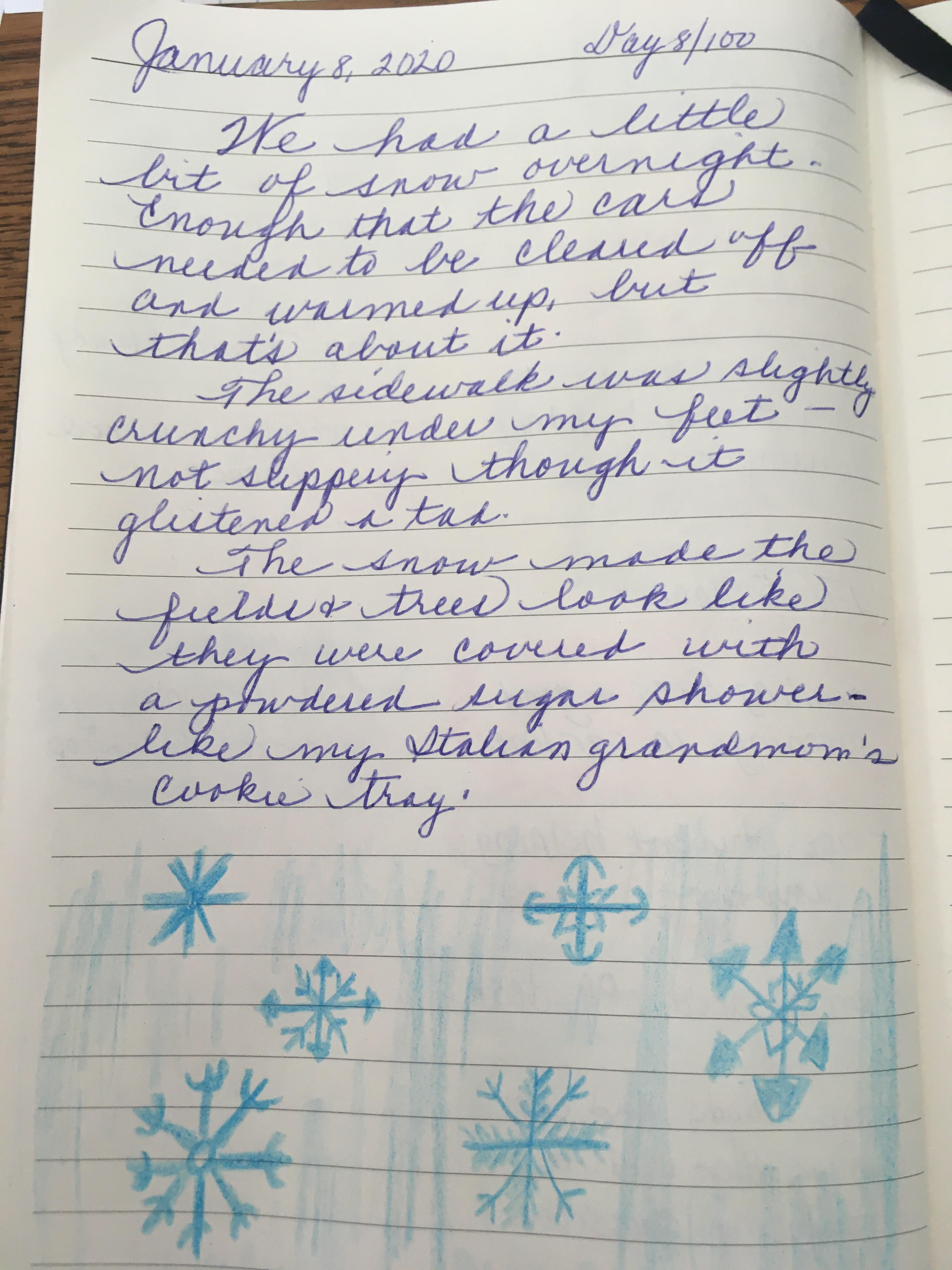
I began by signing up for #100daysofnotebooking which is being spearheaded by MIchelle Haseltine (michellehaseltine.com).  There are no prompts; the only “requirement” is to write in your notebook each day for 100 days. Some writers are posting in a private Facebook group while others are sharing on Twitter.  Some are doing both. You may think that writing for 100 days straight is daunting or impossible, but it is actually inspirational and invigorating. I have been writing in my notebook, sometimes taking a picture and sharing, sometimes just posting what the topic or my entry or how things are going. The best thing about this practice is reading what everyone else is posting. I have found so many good ideas for my own notebook, and have tried imitating other writers.  Viewing their creations have given me the courage to start adding sketches and color to my notebook. Will some days be harder than others? Absolutely! My goal is not to write print worthy entries each day, but to capture ideas and inspiration each day that can be the seeds for future pieces.

Snow

Next, I registered for The 30 Day Writer’s Happiness Challenge which is part of the Writers Happiness Movement (writershappiness.com). Each day I receive an email with a five minute prompt.  It is quick and easy and gives me food for thought. So far I have written a “permission” note from my future self, looked for beauty in the space I was in, sent someone a positive email with a sincere compliment, and made a list of things I find enchanting.  While I only spent five minutes each day writing on these prompts, I keep thinking about different ways to use them in the future.

Looking for beauty

Lastly, I am journaling every night before I go to bed.  I have tried this many many times over the years only to see that weeks or months had gone by without an entry, and the journal becomes a book of summaries.  Honestly, I don’t remember where I read about this idea, but the premise is to write a one-sentence journal entry each day. This journal lives in a basket next to my bed.  I have faithfully written each night since New Year’s Day. It is so unthreatening and come on – who can’t write just one sentence each night? It makes me stop and think about what the most memorable or meaningful thing about each day was. No matter how tired, or how late I go to bed, I can manage one sentence.

I have shared my writing goals with my 7th graders, and they are asking me what I am writing in my notebook;  most things I can share with them. Although I do write with my students, I want them to know that I write outside of school as well and how much that writing means to me.. I believe that the more my students realize the importance of writing beyond the classroom walls, the more they will want to write themselves for themselves. You what they say – “Use it or lose it.”   How are you flexing your writing muscles? Please comment and share below. You never know who you will be inspiring. 

cropped-rita-2017 Rita DiCarne is a 2000 PAWLP Writing Fellow.  She teaches 7th grade ELA at Our Lady of Mercy Regional Catholic School in Maple Glen, PA.  Rita married her high school sweetheart 39 years ago and with him she shares two wonderful children, their fabulous spouses, and four fantastic grandchildren!

Teacher to Teacher: Personal Goal Setting & Self-Reflection to Welcome the New Year!

by Lynne R. Dorfman

The new year is a great time for both students and teachers to reflect on literacy practices and set some new goals.  I decided to share my reflections and goals with you, and hope you all will have some time to do the same. Reflection and goal-setting is something we can do for ourselves, and it is always worth the effort!

I have evolved as a teacher over a career that spans 38 years of classroom teaching, facilitation of the K-5 gifted program, and extensive work as a writing extension teacher. This year is my 6th year as an independent consultant who often serves as a literacy coach.  Perhaps my biggest reason for wanting to be in this role is my commitment to the changes in instruction that take place when you put into practice what you’ve learned.  I look back on my experiences with the Pennsylvania Writing and Literature Project, and I know how important it is to “think big but start small!” – as Michael Fullan suggests.

When you begin to understand something new, you try to also figure out how it fits into what you are already doing. I think about the addition of portfolios in my own classroom, and how I first started with just a writing portfolio before eventually creating a portfolio across the content areas as well.  As a literacy coach, I had to recognize when a teacher gets it – has this new understanding, and is ready to put it into practice. Then I had to think about what resources and supports he/she will need to be successful.

Read more