Happy October and welcome to fall! Since our classroom snapshot feature was so successful last month (thank you to all the contributing voices!), we are running another regular feature this month focused on sharing writing activities that we or our students have found particularly engaging. Please check in daily to enjoy our Prompt-ober posts. If you are interested in contributing one yourself, please contact us!
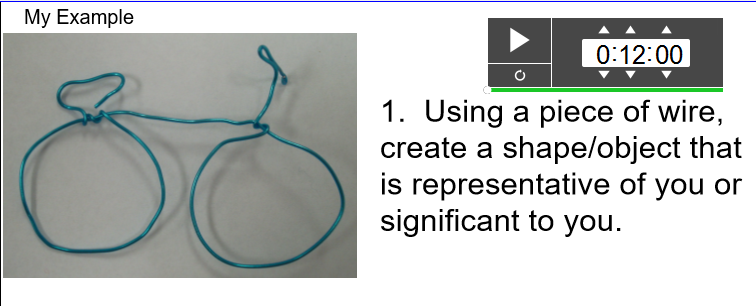
Wire Writing
Early in the school year I give my students a piece of wire about 8-10 inches long (I purchase this in the bracelet making section of any craft store) and I ask them to shape it into something that is meaningful to them or representative of them. This idea was inspired by a writing activity I engaged in at the PAWLP summer institute where the instructors gave us a piece of playdough and similar instructions. I give my students ample time to play with the wire and shape/reshape until they feel confident in their design. While they do this, I welcome conversation and meander around with my own wire checking in and talking with students.
When I first read Reading with Meaning: Teaching Comprehension in the Primary Grades (2013), I was struck by Debbie Miller’s question: “How can we hold thinking—making it both permanent and visible?” I’ve always been a big fan of anchor charts, using them as visible representations of students’ thinking. Not only does the collective thinking become permanent and visible, but the charts can also serve many purposes. Charts help students achieve greater independence by providing the information they may need o plan, draft, revise, and edit their writing.
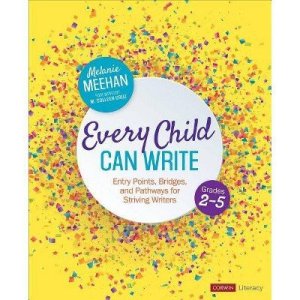
Naturally, when Melanie asked me if I was interested in being part of her blog tour for her new book, Every Child Can Write, I was thrilled to be able to take a closer look at Chapter 6: Co-Create Classroom Charts as Pathways Toward Independence. Immediately, I was captured by Melanie’s statement of rationale for using classroom charts, linking their use with Universal Design for Learning (UDL), a way of teaching and learning that helps teachers give all students an equal opportunity to succeed. Yes! It made perfect sense that charts can remove obstacles to success by building in flexibility in the ways learners can access information.
Melanie opens with an anecdote that describes how she used charts to help her daughter learn to cook, sharing that, as in the gradual release of responsibility model, the more her daughter cooked, the more competent and confident she became. One day, the cooking charts were taken down. Cecily had reached her goal.
Melanie gives us many reasons to use charts:
They can actually replace the minilessons for thriving writers.
Strong writers use them as memory joggers and scaffolds.
They provide choices or options student writers may want to try.
These big ideas are explored in this chapter. First, Melanie tells us we should decide on the types and purposes of the charts we display in our classrooms. The important thing to remember here is that a chart is a living, breathing tool. It can change and grow as the class thinking evolves. Always accessible and reflective of the work the students do, it does not need to be “perfect, beautiful, or laminated.” The important thing is that charts are created as a joint effort of the students and the teacher. A sense of ownership fosters a sense of commitment and pride in using the information the chart provides.
Chapter 6 explores four types of teacher-created charts: anchor, procedural, strategy, and inquiry. Meehan defines anchor charts as instructional tools that provide the overall skills necessary to complete a task. One use of this type of chart is to reflect the expectations for the overall tasks of each genre of writing.
After a robust & interactive summer experience at the writing project, I knew I didn’t want to start day one of the fall semester with a typical ‘read the syllabus day’; I just didn’t know what I actually wanted to do. After reading an article on edutopia about Learning Stations, I thought that the strategies presented could work at the university level. I let the ideas marinate in my mind for a few days and decided that I would give it a try.
As a teacher educator, I try to model best practices whenever possible so my students can experience activities and lessons as learners first, then reflect on their own (future) practice. To be honest, I wasn’t exactly sure what would happen, but I thought even modeling that vulnerability for my students would prove to be a good thing.
I started with making the ‘Station Markers’ on Canva and have linked a copy of them here. Once I settled on the template, and made the first one, it was easy to copy and edit the following. After that, I just needed to gather supplies and come up with a strategy to get everything to the classroom. (This is probably just an issue for us in higher ed or for teachers who have to share classrooms. You will most likely just set up your room for the stations and not have to transport everything.)
Going back to the original article, here’s how I modified her suggestions for my ENG 390: Teaching English in the Secondary Schools course:
Station 1: The Syllabus
This particular class is one of the final methods courses that students take before student teaching; I intentionally left space at this station for students to reflect on what they already know and what they want to learn this semester to best prepare themselves for student teaching. There was an excellent discussion that ranged from theoretical to practical components of the course. After the class was over, I categorized the post it notes into the following categories: Choice, Motivation, and Innovation. Those seemed like fantastic categories to use when framing the course.
I was really proud of my students for being so transparent on the first day of class; to be fair, most of these students already know me from previous courses or their involvement with the NCTE Student Affiliate on campus. This might be why they felt comfortable jumping right into activities like this. Other students might need more community and trust building before being asked such questions.
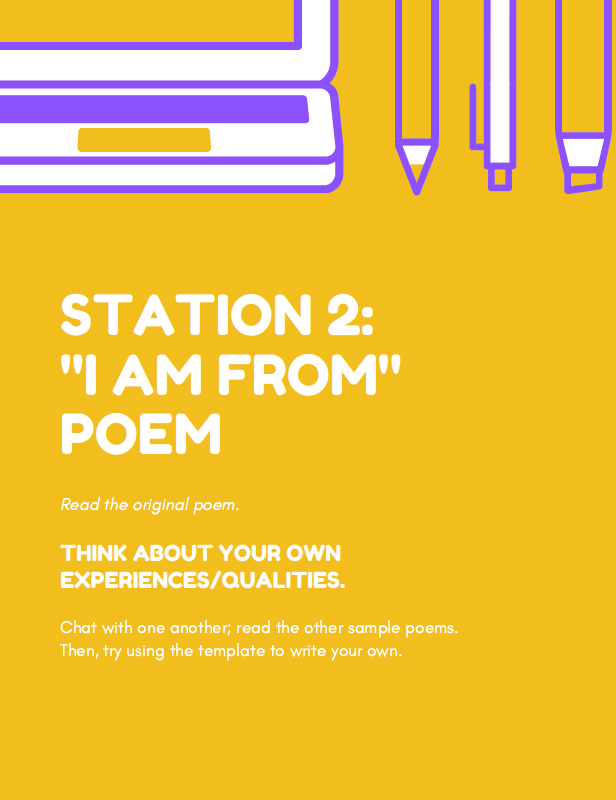
Station 2: : Poetry Station
Even though these students know one another, I wanted to include some sort of writing that would help them learn even more about one another. I thought a short piece would work for this type of classroom set up. I started with the original “Where I’m From” poem by George Ella Lyons and included a template for the students to use to write their own poems, along with some examples of other student work. Most students used their time at this station to chat and brainstorm then jump into writing. I thought they’d need more time to polish these, so they were actually due at the next class meeting.
Station 3: Reading Identities
This station had two parts really. Thanks to the generosity of Scholastic I had a box of newly released books for middle and high school classrooms. Students were to ‘judge a book by its cover’ and select one to read this semester FOR FUN. I was very clear that this was not an additional assignment, that they need to hold themselves accountable as readers.
Once they selected the text, I asked them to snap the QR code on the chart and share a little about themselves as readers. Those responses can be seen here on Flipgrid. I think this activity was important for several reasons – one, teachers of English need to see themselves as readers if they hope to inspire young people to be/become lifelong readers. Two, by sharing their response on Flipgrid, they could see how diverse the readers in our class were…again, thinking ahead to future classrooms with a wide variety of interests to manage. Three, I also shared my current reading with them to show that I, too, am a reader.
Station 4: Name Tent Construction
While this is pretty standard practice, I take it just a bit further…I ask them to not only write their names, but to identify other factors as well.
Hometown
Book you wish you wrote
Guilty pleasure
Favorite food.
If I’m not mistaken, I got this idea from Brenda Krupp and Mary Buckelew, when I took the PAWLP Summer Institute.
I leave my own name tent out so they can see it as a mentor text; we brainstorm what else you might ask students to reveal a little of their personality at the beginning of class. Since there are only a few students at the station, it’s easier to share that – perhaps – than it would be if you had to share with the whole class.
What I learned…
Students can surprise you with how open they are to new things. I mentioned that most of these students already knew me, but some didn’t. And, none of my WRT120 students knew me, but they did a modified version of this too and none of them dropped the course!
Their reflective feedback also informed my practice. Some students, even in teacher preparation programs, are introverted. The usual ‘go-around-the-room-and-introduce-yourself-to-the-whole-class’ activity can be utterly terrifying for some folks. This approach allowed them the intimacy of small spaces and then we could grow our community over the first few weeks of class. And through a variety of other activities, we did that.
I also learned that this type of activity really set the expectations for the course. We are all in this together. We are all here to learn and experiment. I shared that this was the first time I was trying it…I think they appreciated that vulnerability from a veteran educator and were willing to share constructive feedback that I will definitely implement next time!
At a recent meeting with colleagues, I facilitated a 15 minute opening session on mindfulness or also known as ‘practicing presence.’ The use of these 2 terms help remove the stigma that some have about the word ‘meditation’ and religious connotations. I explained this would be a brief time for self-compassion, something we so often tend to not do in our busy lives.
Step 1: I asked the learners if they have ever done body scans and/or mindfulness activities. I obtained a wide range of responses. I shared what mindfulness is- being in the moment, focusing attention on the environment around them and what is going on internally & physically with themselves while also being intentionally non-judgmental.
Step 2: I asked the group to sit comfortably, with their feet flat on the floor, hands in their laps or on their sides and were welcomed to close their eyes or to focus on a point on the carpet in front of them. I told them we’d be taking 2-3 minutes to do a quick body scan to help us ground ourselves in the moment. With a gentle voice, I guided them through the process, starting with them taking deep breaths, then feel their feet, shoes, soles, and let go of any tension while intentionally breathing deeply. We then moved up the body- legs, hips, backside, back, arms, hands, shoulders, neck, head and reminded them to keep breathing, noticing what is happening at the moment. What sounds do they hear? Smells? Feel? Are they being non-judgmental? Are they focused on the moment and their presence in that moment with our group?
Step 3: I guided them out of the body scan. I had them write on a 3×5 card their experiences that could include: What did they notice? What was easy for them? hard for them? Insights? Applications to their own lives- personally and professionally? I gave them 2 minutes and then they shared with a partner or triad.
Step 4: To bring closure to the mini lesson, I discussed gratitude. I shared some of my own for that day and a few from the previous day. I explained how it reminds me of how blessed I am in so many ways and helps me reframe negative thinking I may encounter. That positive thinking helps me appreciate all I have and actually helps my quality of life. I asked them to take another 3×5 card and to list 2-3 items for which they are grateful.
Step 5: I gave them about 1 minute to do this and then had them circulate the room (about 30 of us) to share with someone they have not spoken to in at least 3 days due to how our schedules all vary and we often are out in the field doing our work. This was to help people reconnect and feel part of the group, our commonalities. I had them switch partners 2 times and then we came back together as a whole group.
Step 6: A 1-2 minute debrief was held to discuss how they were feeling. Did they feel more positive? more focused? Less racing thoughts about their past day or the day ahead? Tension versus relaxed? More ‘present’? Then we moved to the agenda for our meeting.
As many elementary teachers know, a shared read aloud can be an effective way to set a positive and welcoming tone in the beginning of the school year. For many years, the first shared read aloud in my class was the course syllabus. I would pass out the copies of the syllabus and highlight the most important points, often to a room of blank or confused expressions staring back at me. This did little to set a positive and welcoming tone.
While it’s no doubt important to establish expectations for the course, building a sense of community—finding ways to communicate to students that they are seen and valued—is perhaps the most important thing and, really, the only thing we need to do in those opening days. Reading off a list of rules on the opening day also sends students the message about whose voice is valued (the teacher’s) and establishes a power dynamic that prioritizes what a teacher wants versus what students need. Consider the difference between a teacher reading a syllabus and teachers and students unpacking a shared reading: the former tells students, I will tell you what we will do while the latter communicates, Let’s read and learn about something together.
Two shared texts that I’ve found particularly useful in my classroom are Clint Smith’s TED Talk, “The Danger of Silence” and Dr. Margaret Wheatley’s essay, “Willing to be Disturbed.” Because we will likely discuss some contentious or controversial issues over the year, I begin the with both of these texts as a way to remind students to keep an open mind when engaging critically in issues with multiple perspectives.
The Danger of Silence
In Smith’s TED Talk, he outlines four core principles for students that he believes are necessary in today’s world:
Read critically.
Write consciously.
Speak clearly.
Tell your truth.
We watch the TED Talk in class and then discuss these principles. I ask students to write individually about what they think each of these principles mean. We then compile our ideas using sticky notes and large poster paper for each principle (Figure 3.8). After a gallery walk to view the posters, students return to their seats to write again; this time, I ask them to reflect on what they’ve read and to write a personal commitment to themselves about how they might abide by these principles. I also post these four principles on the wall in my classroom so that we can return to them throughout the year.
“Willing to be Disturbed”
In this essay, Dr. Wheatley argues that in order to foster a more civil discourse in our society, we need to start from the position of being open to being disturbed — in other words, to listen to the opinions of others with whom we disagree, even profoundly.
Before we read the essay, I first ask students to consider the denotations and connotations of the word disturbed. We brainstorm synonyms, and as you might expect, most students conclude that the word is negative, especially in the contexts that are most familiar to them such as “disturbing the peace” or “mentally disturbed.” We discuss how each of these instances prioritizes maintaining the status quo or what is considered “normal.” I then ask students to consider contexts or situations that might need to be disturbed: When might the status quo be harmful? When is disturbing the peace necessary? Why?
We then read aloud Dr. Wheatley’s essay as a class, with every student reading one sentence at a time. This shared experience not only allows all student voices to be heard, but my hope is that reading the words aloud, students may begin to internalize some of its key points. Students read it a second time quietly to themselves, this time marking the text for the lines that stood out to them as particularly powerful. Each student shares one line they found powerful so that we are able to hear what has resonated.
Here are just a few of the lines that students often choose:
Curiosity is what we need.
We do need to acknowledge that their way of interpreting the world might be essential to our survival.
When so many interpretations are available, I can’t understand why we would be satisfied with superficial conversations where we pretend to agree with one another.
But when I notice what surprises me, I’m able to see my own views more dearly, including my beliefs and assumptions.
When I hear myself saying, “How could anyone believe something like that?” a light comes on for me to see my own beliefs.
But the greatest benefit of all is that listening moves us closer.
We can’t be creative if we refuse to be confused.
The beauty of using a shared text like “Willing to be Disturbed” and “The Danger of Silence” is that they become touchstones that we can return to throughout the year. When we begin our formal study on argument or when I know that we’ll be discussing an issue that is particularly contentious, I remind students of these texts and our shared understanding that we need to be “willing to be disturbed” if we are to “read critically, write consciously, speak clearly, and tell our truth.”
What other types of read aloud can middle and high school teachers use? Consider the type of community you want to build in your classroom and the issues or content you’ll discuss. What attitudes or dispositions will be necessary for students to be prepared to engage in those conversations? Is there a line of inquiry or essential question that drives the course you’re teaching? Then find a brief text—something that can be unpacked during a single class period or two—that invites students to think about these ideas and their application to learning.
To instill a spark for wondrous words and lifelong learning, I READ.
To seek the truth and secrets that swim my in the pool of my soul, I WRITE.
To learning something new every day, I LIVE.
As a passionate (K-5) reading specialist at East Bradford Elementary in the West Chester Area School District, I service all grade levels including English Language Learners and Title 1 students. After weeks of assessments and data meetings, groups are created based upon strengths and needs. My ultimate goal is for all my readers to make increased gains based on working their personal BEST. Mindful learning practices, with positive mantras, goal setting, brain breaks, or focus breathing are assimilated into lessons for productivity.
As I launch my groups in late September, I really work hard to build trust and community by fostering reading identity. For each grade level, I carefully select poems, songs, mentor texts, and quick writes to reflect on literacy attitudes and habits. For some groups, bi-lingual poems and twin texts are utilized to honor and celebrate diverse languages. Interactive read alouds, word play maps, poem chants, and meaningful text discussions facilitated by me are integrated to stem quality thinking for varied literacy purposes. Listed below are the mentor texts and prompts I employ at each grade level. Below is the reading motto/mantra I post in my classroom.
Today I will:
Be an active reader with a great learning attitude
Do my personal BEST as a mindful thinker and problem solver!
Read to Succeed!!
Grade
Text
Quick Write/Writing Prompt
K
Hedgie Loves to Read Douglas Wood Chicka, Chicka, Boom! Boom! Bill Martin, Jr.
This is ME Self portrait/ Name Writing
1
Yes, I Can! Sam Mc Bratney Bucket Filler poem
Yes, I Can…. I fill a bucket when I
2
I am the Book Lee Bennett Hopkins GOOD BOOKS, GOOD TIMES
I love _______books that….. Readers can….
3
Wild About Books Judy Sierra Hey, World Here I Am Jean Little
When I read a book, Today I will….
4
Book Peter Catalanotto What is a book? (poem)
Book is… Come, Come Reader….
5
Song-This Is Me *The Greatest ShowmanSong I Live– One Republic
I AM (Bio poem) Reasons Why I Read/ Why I Write
**Stay tune for student pieces-I will gladly post in a few weeks, once I complete these literacy launch prompts!!





 write.share.connect