How can flexible seating be utilized to support classroom management? This September, I made some positive changes by incorporating flexible seating into my 6thgrade writing classroom. The writing workshop model requires students to “come to the writing area” for instruction. Last year, students were dragging chairs to the instruction area from all over the room, creating chaotic transition times.
Through a grant for flexible seating, from my district’s parent association, I purchased “Bolmen” bathroom step stools from IKEA, eight blue and eight white. With the help of one of my district’s literacy coaches, I mapped out a routine and a seating chart for the transition to the instruction area. Designated students unstack stools and move them to the center of the instruction area, surrounded by benches and chairs. The transitions have become calm and efficient routines.
The IKEA stools also provide the students a choice to make their independent writing space more comfortable. Because the stools are only about 10 inches tall, they are versatile. Some students sit on the stools, lean against them, or use the stools as little desks while sitting on the carpet. During partner activities, my directions are clear and simple, “The students on the blue stools share first. The students on the white stools listen.” Student helpers stack stools at the end of each class. Flexible seating has made a positive difference in my writing classroom.
What would It look like if you combined a bear, pig,
chicken, snake, and monkey? The possibilities are endless, as new species are
developed in the minds of middle schoolers.
While diving into the characterization with short stories
students take a hands-on approach crafting their own creature. My students
completed this activity after we read and annotated the short story “Charles”
by Shirley Jackson. Charles is quite the troublemaker causing chaos when he
enters his kindergarten classroom. Needless to say, there are tons of ways to
characterize Charles. Rather than having my students answer questions about
Charles or write a paragraph describing Charles I get them thinking outside of
the box and bring the makers space into the language arts classroom.
After reading the story I ask that the students come up with
five-character traits to describe Charles. For my students who may have a
difficult time coming up with character traits I provide them with a list of
positive, negative, and neutral character traits to pull from. Once they have
their five-character traits picked they then need to decide upon an animal that
depicts that character trait. For example, if the character trait was conceited,
I may choose a peacock, who are always displaying their feathers. Students
continue this process until they have an animal for each character trait. Ideas
bursting, laughter echoing, and risk-taking fill the air while working students
spontaneously collaborate giving ideas about animal possibilities or explaining
why that animal or character trait could possibly work.
Once the brainstorm is complete students begin designing
their creatures assembling one body part at a time. Some students draw, others
print pictures and cut them out, while a couple use online tools. The mode is
up to them- the products are anything but monotonous. Once their creature is
molded to their liking students provide it with a name.
The last part of this process is writing about the emergence
of this creature. Students must write a response explaining how this character
came about. They must also explain what each animal part represents and provide
an example of how the character displayed that characteristic from the story.
Students infer, demonstrate an understanding of
characterization, find text evidence, and hone their writing skills without
even blinking an eye! This activity could be used for any novel or text.
When students are provided hands on learning opportunities ownership surfaces, creativity flows, and engagement prospers.
Homecoming week- a week of fun as recent alumni return home
and current students sit in class, dreamy-eyed about a Friday pep rally to
cheer on the greatest achievements of the school and our undefeated football
team. The sugar plums dancing for a school dance on Saturday evening as fingers
tap to the anticipated tunes that will fill the gymnasium with a liveliness only
school dances can bring.
Though teachers look towards this potentially disruptive
week with a sense of uncertainty and trepidation, I decided to approach this
week with an aura of comradery with my students. Just like most of you in this
boat, I understand the weaknesses that our students succumb to when the change
in routine hits them. They are antsy, a tad rowdy, and less likely to fully pay
attention. They look doe-eyed at you when you try to get them to focus on the
deeper meanings in your lesson and you know instinctively, that when Monday
comes around, you are rehashing Friday’s materials when they are better equip
to handle learning.
So I embraced the spirit of homecoming week with a review
football game on our hectic schedule. The class is split into two teams and are
asked to create a “playbook” order. Each student receives a number and it is
that order that they answer questions. When a team has the ball, they can
choose to try to move 5, 10, or 20 yards. The questions they get are progressively
harder based on the yardage they want to go. If the student gets the question
right, I move their pawn piece across the projected football field (but if I
catch a teammate trying to give them an answer, it is an illegal move and
automatic loss of 5 yards).
The students have to try to make it across the football
field into the goal line for 6 pts (there are no extra points for my game). If
a team gets two questions wrong while trying to get their first down, it is a
turnover on the down and the ball moves to the other team. If a teammate gets
an answer wrong and the next question has not been given, the next player on
the other team is allowed to stand up and shout the answer proudly. If it is
correct, they can get an interception and the ball moves to the other team.
The kids have a blast playing a game on a Friday morning when they are still groggy and they love playing a game when the pep rally is getting closer (even if it seems achingly slow). And, in all honesty, I figured, why fight it? Why fight the inevitable loss of attention I will have from a number of students? This way, I know that my students are engaged and I can estimate their knowledge at this point in time. They feel like they are not doing anything and I feel like they are using their memory banks. Honestly, a win-win situation to me!
So
far this year I have jumped in enthusiastically to an improv game called “Bunny,
Bunny” in an 8th grade class. This game encourages students to work
as a team as they pass the words, “Bunny, Bunny” around, while standing in a
circle. The class kept erupting into
laughter as another component of the game is to keep the rhythm going by
chanting, “Goocha, goocha,” continuously. Then, I was off to a fairly new
teacher’s classroom, who was sternly reviewing the rules of the class with a
Powerpoint. I shed my “Bunny, Bunny” demeanor, stood up straight and donned a
serious face to show support for my new colleague. Next, I went to a seasoned 4th
and 5th grade teacher’s room and sat down with a table of students
who were cutting out emojis that represented their identities. I relaxed into
the seat and talked to the students informally about the choices they were
making.
As an English language development teacher (previously known as ESL teacher), I don’t really run the show during the first weeks of school. It is a time for me to observe and notice as much as I can about the students and teachers with whom I will be working. As I move from classroom to classroom I adapt to the environment that the general education teacher has established for the start of the school year. Until my caseload is finalized and I have some time to co-plan with teachers, this is my role and I believe it helps all the students to view me as a positive and natural part of their classroom community. That way when I begin to focus on the multilingual students to develop their language skills, they are not stigmatized and their classmates feel comfortable coming to me for guidance as well.
Over the last few years, my students and I have experimented with using independent reading books as individualized mentor texts. While students studied their books individually or in small groups, I wanted the entire class to benefit from the rich examples of word choice, conventions, style, and craft. I also wanted to highlight exemplar student writing.
What I Did
From October 2018 to December 2018, I invited students to help teach mini-lessons based on their individualized mentor texts and writing pieces. When deciding what skill to teach when, I considered several factors: students’ writing needs and strengths, their Self-Selected Writing Pieces, upcoming whole-class genre and novel studies, and curriculum requirements. As I read student drafts and conducted one-on-one conferences, I noticed techniques that would benefit the entire class. Occasionally, students volunteered a specific skill that they wanted to share.
After asking students to
present, I met with them as a small group to practice what we would say and decide
who would read the mentor texts. These pre-meetings took place during
independent reading or writing time.
During the co-led lessons, each student shared an excerpt from their book and talked through their observations. If a student used the technique, then they discussed their example and writing process. Usually, two or more students taught the mini-lesson with me. As students presented, I helped explain the technique and provided the examples for the class on our Learning Management System (LMS).
Below are two examples of co-led, student-teacher mini-lessons from last year. All names are pseudonyms.
In early October, repetition emerged in my students’ writing pieces, so I asked them to co-teach a mini-lesson with me. During our sixth period class, Emily shared how she repeated “I’ll come back for you” three times with the font getting smaller to mimic the father leaving his daughter. She wrote, “My mind flashed back to Papa’s words, ‘I’ll come back for you . . . I’ll come back for you . . . I’ll come back for you.’ I remember him fading farther and farther away from me, until his voice disappeared into the darkness.” She wanted the visual to help her reader hear a fainter and fainter voice. Next, Elsa included repetition to emphasize a scary scene in her story: the moment a Nazi soldier captures the main character’s sister. She hoped the reader would feel the intensity as the crunching leaves got “louder. Louder. LOUDER.”
In seventh period,
Jack employed repetition to emphasize the impact of his character losing an
important object: “Oh no. No No No NO NO NO
NO NO NO NO NO NO NO NO NO! Where is it? I swear I
put it right here! Where is it?!” For Pat, he repeated “No mercy” to reveal the
struggle his soldiers experienced during the battle in his sci-fi story: “‘Get to the guns. No mercy,’ he says.
We run forward, hopping into the seats, powering on the cannons. I hear a loud
boom then a scream. . . . The words no mercy ring in my mind. No mercy,
no mercy, no mercy.” For these students, repetition established
voice and emphasized specific moments. By sharing their craft moves with the
class, they took on leadership roles, increased their confidence, and served as
writing role models for their classmates.
Then, at the beginning of November, I asked students to observe the em dash in their independent reading books. Three weeks later, I approached a number of students who had experimented with the technique in their writing and located the em dash in their books. Ten students participated in the co-led mini-lesson (four in one class and 6 in another). The students shared their examples and explained whether their em dash cut off dialogue, interrupted an idea, accentuated a point, or replaced a comma. Sam read the following example from This is Where it Ends, “The silence from the auditorium is tense and loaded. Except it’s not silence. All around me there are sobs, prayers, and curses—friends are trying to calm each other” (Nijakamp 62). From Harry Potter and the Chamber of Secrets, Brad added, “‘I heard you speaking Parseltongue,’ said Ron. ‘Snake language. You could have been saying anything—no wonder Justin panicked, you sounded like you were egging the snake on or something—it was creepy—you know’” (Rowling 196). All the examples were available for the class to review on our LMS. After the mini-lesson, the class worked in groups to practice adding em dashes to their own writing. The student presenters acted as leaders within their small groups, guiding their peers’ writing process.
My Plan
These co-led, student-teacher lessons prompted my students to take a front-row seat in sharing their writerly observations and explaining their writing process. Overall, these lessons and procedures proved successful, but I wanted to increase the number of co-led mini-lessons while streamlining the collection of student writing and mentor texts. I also wanted a way to collect titles for book talks and excerpts for quick writes.
Step 1: For the 2019-2020 school year, I am in the process of creating an assignment that will ask students to submit text excerpts for mini-lessons, book talks, and quick writes. They will collect and post their observations by the last day of each month in our LMS. Students will submit in one of the following four categories:
Independent reading book mentor text excerpt
Student writing mentor text excerpt
Independent reading book excerpt for quick writing
Independent reading book for a book talk
Step 2: During the month of September, students read like writers, completed quick writes, and listened to book talks. We also reviewed MLA In-Text Citation and Works Cited. The first monthly assignment will launch in October and be due on October 31st. Students will be able to submit their work during class or at home. If they find more than one excerpt, technique, or book that they wish to share, they may do so.
Step 3: Each month students will submit a reflective assignment that includes:
The
category they chose
The
except from the text or their writing (either typed or a picture)
The
reason (specific technique, craft move, idea) why they selected the book and
excerpt
Works
Cited
Step 4: As students share their work, I will schedule the mini-lessons, book talks, and quick writes as they fit into our Writing-Reading Workshop. I will approach students a few days before their lesson to review their assignment submission and prepare them for their book talk, quick write, or co-led lesson.
Step 5: Before the selected students present their findings to the class, I will upload the necessary materials to our LMS. Depending on the mini-lesson’s content and the class’s ability, the co-led mini-lesson will require varying levels of teacher support. Students will be able to present their book talks and quick writes independently.
Next Steps
I am excited to see where this
new initiative leads. The LMS should streamline my ability to collect student
work. The assignment puts more onus on my students because they submit their mini-lesson,
book talk, and quick write ideas. As they assume these new leadership roles
within our workshop, I hope it builds confidence in their abilities and offers
opportunities for peer collaboration. I will continue to model successful book
talks and quick writes as well as share texts that foster their abilities to
read like writers.
If you have tried something
similar or have questions, please share your thoughts below. I would love to
hear from you! Take care for now and have a great school year!
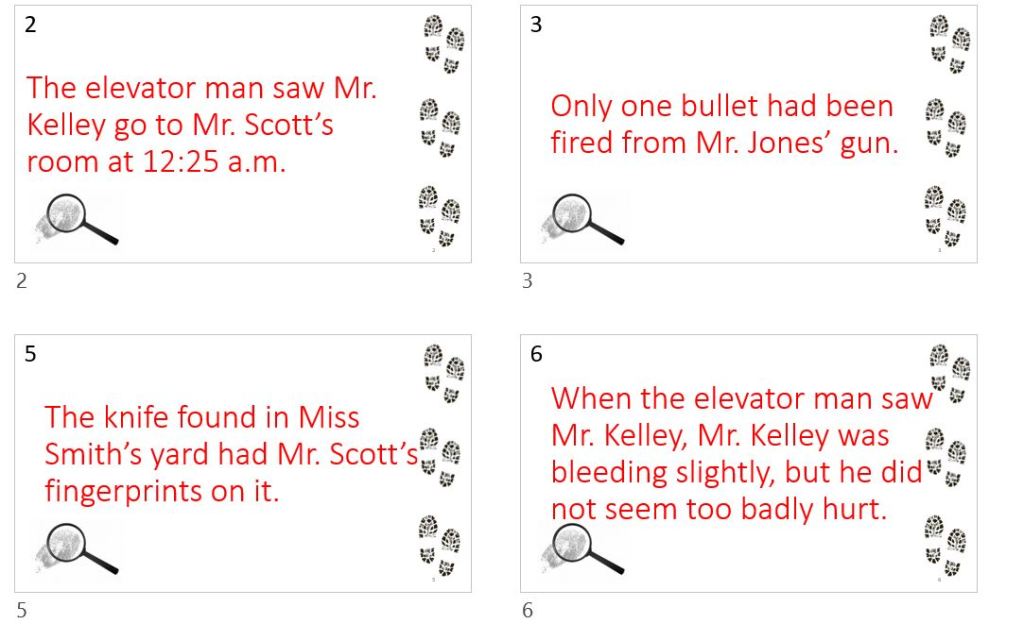
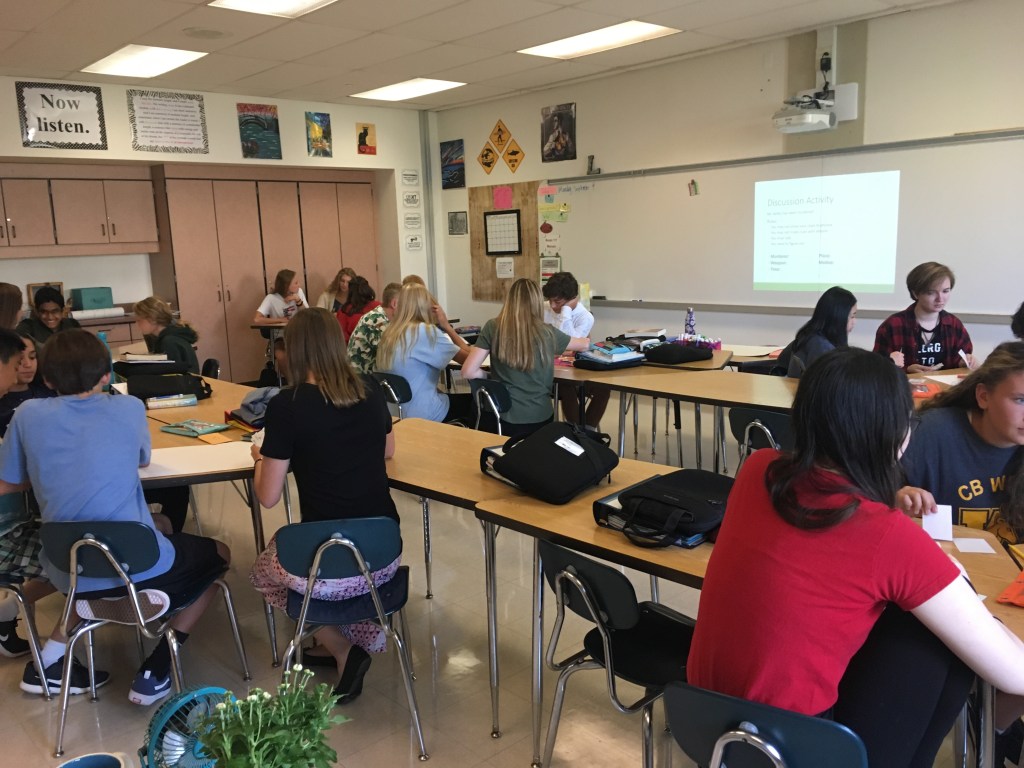
Students are given groups, clues, scratch paper, and twenty-five minutes. They have everything they need to figure out who murdered Mr. Kelley.
I started doing this activity a few years ago when I found that my students either didn’t like to participate in group discussions or struggled to have conversations with peers that weren’t their friends. I started searching around, and I found a murder-mystery discussion activity.
I adapted it to suit my needs, piloted it, and it is now part of my opening week lessons.
When placing the students in their groups for the period, I try to pair them up with people I haven’t seen them interact with as much. I want to build community within our classroom. Students are dealt clues, and they are the only ones allowed to read their clues out loud. This is an easy way to make sure everyone within the group participates and that no person dominates the conversation.
Students work together, organize information, and collaborate and communicate with one another. Once the murder is solved, we discuss the importance of sharing ideas with one another, working together, and thinking critically. The students really enjoy the activity and it does a great job of highlighting the idea that everyone can make valuable contributions to a discussion.







 write.share.connect