Skip to content

Classroom Library Refresh

by Kelly Virgin

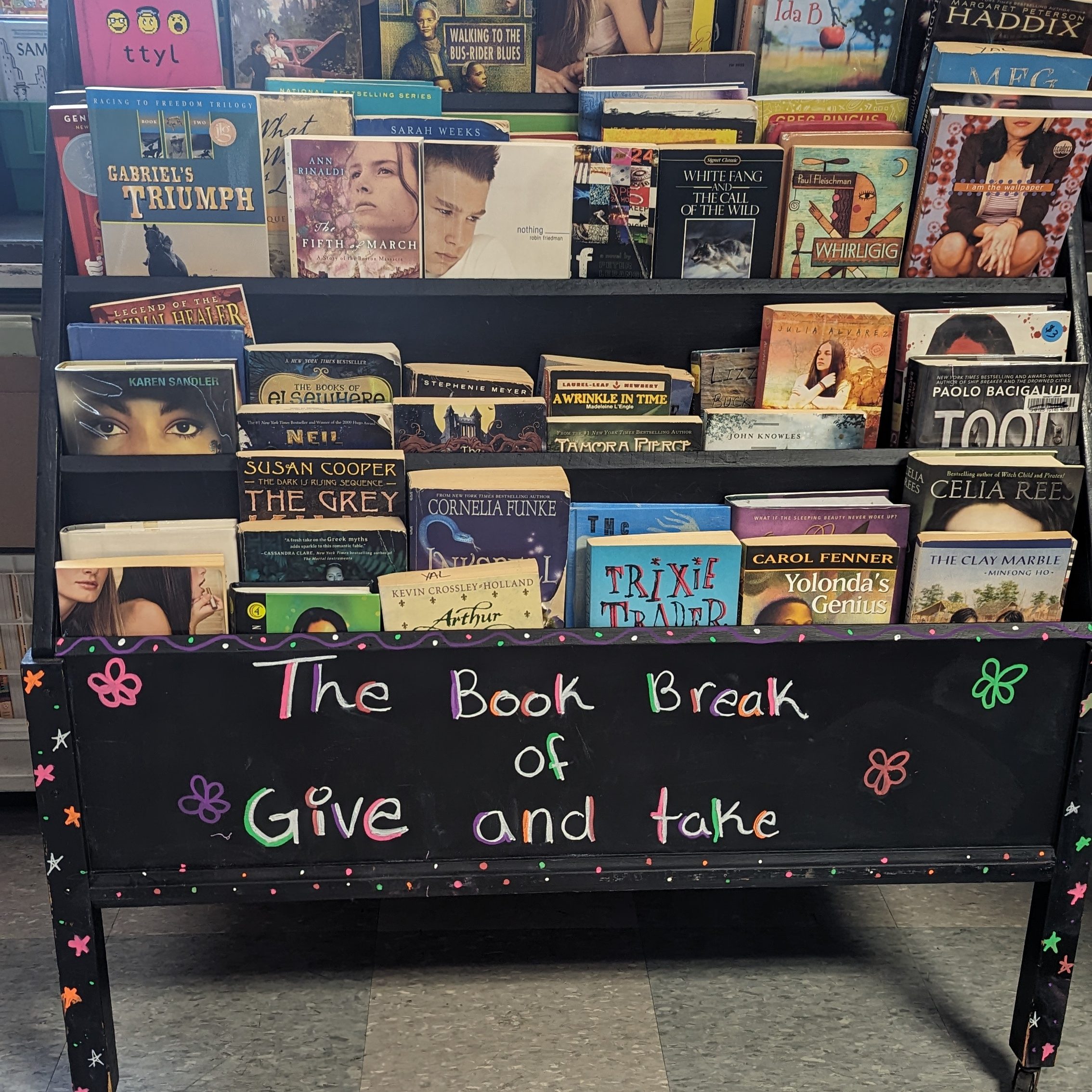
As the school year came to a close, I took a moment to look around my empty classroom—and something caught my eye: a thick layer of dust on many of the books in my lending library. After 20 years of teaching high school English, I’ve built quite the collection… maybe too big, if I’m being honest. While offering choice is essential, too much choice can actually overwhelm students.

So I rolled up my sleeves and started weeding out books. Channeling my inner Marie Kondo, I asked myself, “Does this book spark joy in my student readers?” Most of the process was instinctual, but here’s a general breakdown of what stayed—and what didn’t—for my student population:

Stays (joy-sparking titles):

  • Dust-free titles (any books that were routinely borrowed)
  • Quick reads (graphic novels, novels in verse, etc.)
  • Relatable stories with diverse, teen protagonists navigating real-life challenges
  • Readable content at or below students’ reading levels

Goes (joyless titles):

  • Dusty titles (books that hadn’t been borrowed in years)
  • Doorstop-sized classics
  • Obscure or overly complex fantasy/sci-fi
  • Outdated publications
  • Books above students’ current reading levels

With help from a few awesome student volunteers, I gave many of the castoff books a second life in a new hallway community library. As a bonus, each volunteer walked away with a few titles they discovered while sorting—books they were actually excited to read.


Kelly Virgin is a WCWP teacher leader who teaches high school English for the Kennett Consolidated School District.

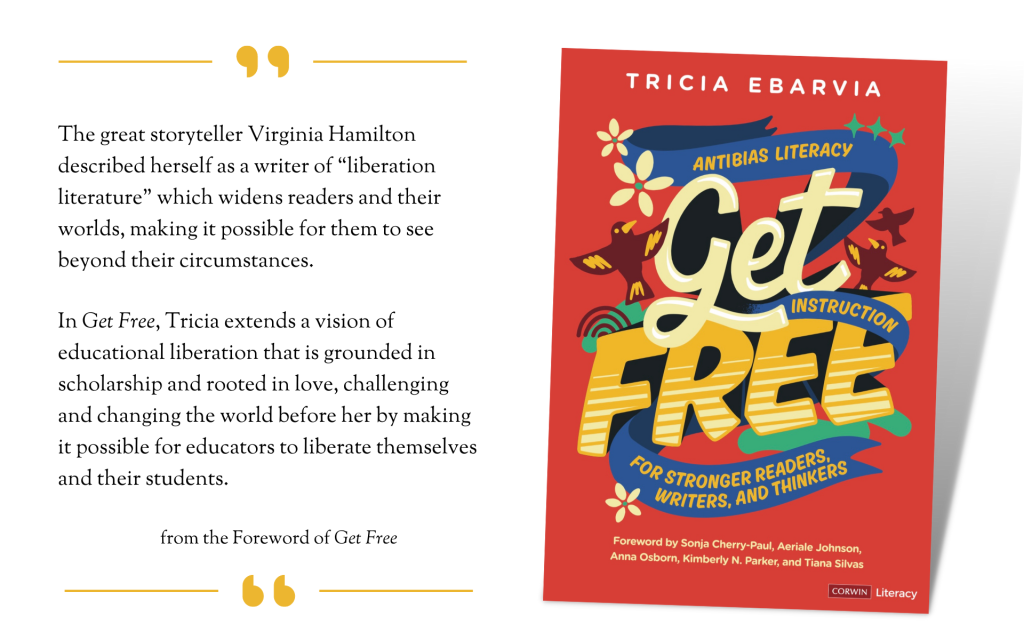
A Review of Tricia Ebarvia’s Get Free

by Heidi Fliegelman 

Overview: 

Tricia Ebarvia’s book, Get Free, functions as both an instructional guide and a reflective piece that surrounds the pursuit of equity in education. Across six chapters, the seasoned English Language Arts educator explores what it means to provide a liberatory education for all students. Her combination of anecdotes, research analysis, classroom activities, and student reflections make for a well-rounded, detailed, effective guide. 

Chapter Breakdowns:

In her first two chapters, Ebarvia focuses primarily on identity, unpacking how teacher bias and curriculum bias are ingrained and pervasive in the classroom. This begins with a deep dive into her early understanding of what constituted good literature, and how her understanding has changed as her own learning has progressed (2-3). Ebarvia provides a myriad of strategies and reflection questions for educators throughout these chapters, as well as provides anecdotes from her own teaching experiences, and that of her peers. She mentions bias early, outlining the different types that show up specifically in school settings, and providing privilege checklists and other methods of identifying such ideas in our own practice. 

For instance, Ebarvia discusses the way in which teacher privilege directly affects how comfortable one might be in discussing difficult conversations in the classroom (15). While having more privileges might make some teachers wary of overstepping in talking about a social group they do not belong to (or, worse, feel as though it’s irrelevant), Ebarvia focuses her analysis elsewhere. Through the anecdote from Wolfe-Rocca, Ebarvia prompts reflection on how yes, while sensitive topics should be discussed and brought forth by those who have the privilege to do so, these topics still need to be handled with care, and encourages teachers not to rush into big conversations– they should be planned, intentional, and empathetic, considering “as teachers, we wield tremendous power in our classrooms” (14). This section closes with Ebarvia asking educators to consider the question: “In what ways do you think your own identities might have affected your interactions with your own students?”, keeping with the earlier emphasis on educators understanding the “I who reads” (4). 

From here, Ebarvia moves on to discuss the importance of classroom community in Chapter 2, noting the potential growth that students can access when learning in a positive, safe, brave community. Aside from debunking the more traditional definition of what a “troublemaker” student would be, Ebarvia fills this chapter with tangible, realistic activities and strategies from her own public school classroom. She expands upon more known techniques (name tags, interviews, etc.) to provide opportunities to 1.) get to know students on deeper, more authentic levels, and 2.) support students of various identities, and various comfort levels when it comes to speaking their stories out loud. 

The middle section of the book moves beyond teachers’ experience and understanding of identity, and instead centers on students’ own understanding and support of both their own, and their classmates’, identities. Chapter 3 of Get Free focuses on methods for aiding students’ own understandings of identity, whereas Chapter 4 puts those understandings into action, providing strategies for fostering “critical conversations.” Ebarvia’s various frameworks provide students and teachers alike with tangible frameworks and processes within which everyone can be genuinely seen, heard, and respected. 

For example, in a section regarding the support of LGBTQIA2S+ students, Ebarvia articulates the need for ALL teachers, regardless of content or identity, to understand modern language and definitions regarding sex and gender. After providing resources, she strikingly discusses how she discusses difficult identity-centered topics in her classroom, telling students that “How [they] respond today might be different from how [they] responded in the past or how [they]  might respond in the future” (95). This ideology could be applied to so many topics, with the potential to create those truly brave spaces. With this mindset, students can understand that it is okay to be wrong about something, or to alter their opinion; changing, based on the acquisition of more knowledge and more experience, is not a bad thing. 

Finally, the last two chapters offer an opportunity for expansion, offering strategies that encourage students to analyze such dynamics in their texts and, most importantly, in society at large. Ebarvia dives into biases here, explaining the importance of educators not only identifying them within themselves and their curriculum, but actually teaching students what various biases are, and how to identify them themselves. Extending from her Chapter 5 discussion of “reading against our biases”, Ebarvia’s final chapter urges the use of perspective-taking and perspective bending in order to encourage empathetic, less-biased reading. She continues her work with bias from the first few pages, now bringing students into the fold by asking them to identify dominant narratives, locate trends in how different identities show up as different types of characters, and more. Centering her curriculum around social justice standards serves as a helpful anchor to her work (218). 

Key Take-Aways:

In even the title alone, Get Free, it is evident what Ebarvia’s core message seems to be: it is the duty of educators to use their presence in the classroom in order to guide students to view the world in way that is “more complicated, nuanced, [and] deepened”; good education “is empowering for all […] not necessarily in the same way, but in the ways each student needs” (226). To do this, carrying identity work throughout the year, and doing so extensively, is important; when it is incorporated only in the fall, it is harder to communicate its value. In Get Free, identity work is at the heart of everything, even literary analysis. 

Ebarvia also asserts that changes within the current school systems are necessary in order to make such progress, and that such work is vital and urgent, especially given the current state of the world. In essence, “reimagining education” is needed, but it must truly move beyond “keeping the status quo” (292). Such a goal sounds daunting, even in its most bite-sized presentation. However, through her inclusion of anecdotes, strategies, and student reflection, Ebarvia presents a reality in which successful moves towards these goals are possible. 

Within the brief epilogue, Ebarvia stresses her renewed understanding of the importance of the work she outlines throughout the book. In acknowledging how “the list of things to fight against is relentless,” Ebarvia argues for the persistent pursuit of education for liberation (293). After outlining experiences, reflections, and strategies across her previous chapters, Ebarvia remarks that the strong presence of hate and conflict in the world should not cause one to give up; rather, it should be all the more reason for educators to do all that they can to create more equitable education. 

Text Usefulness:

As a high school teacher, the vast majority of the activities presented in Get Free are tailored to older students, mostly regarding the complexity of information and the critical thinking involved in many of the activities. However, one would imagine that many of the activities throughout, especially those presented in chapters two and three, could be easily adapted to middle school, or even elementary school, understanding of the concepts presented, as the goals of English Language Arts are fairly similar, even as one ages. If this work is indeed as vital as Ebarvia presents, then this book should not just be for high school educators. In fact, if students are expected to be able to maturely handle these conversations, then equity and curiosity needs to be presented as early as possible. For that reason, though focused more heavily on teaching older students, Get Free is an effective tool for educators of any level. 

My Experience: 

My biggest complaints with instructional guides is usually either that the students presented are “textbook students” –flat, overly simplified, inauthentic–  and that the strategies seem unrealistic and/or pretentious. I’m thrilled that neither was the case with this book. Likely because of her real life experience with high school students, pretty much all of the activities presented seem attainable and effective. I already have multiple activities saved for use next fall. My only reservations surround potential community pushback, rather than the actual quality of the strategies. In fact, the only idea that I wish had been more prevalent is her experiences with any backlash, and what her thoughts are on the current climate of educator critiques.

Notably, I also really appreciate the use of anecdotes, for a variety of reasons. For one, though not a new concept, it is indeed much easier to understand and remember a concept when it is posed as a story. The variety and frequency of stories throughout the book made it easy to want to keep reading– something I find quite difficult with most textbooks. In addition, the use of anecdotes presented Ebarvia in a more human way. It is easy for textbook / instructional guide authors to come across as all-knowing, inaccessible, or even pretentious. Even with the inclusion of stories, authors sometimes –understandably – only choose their most shining moments. However, even in communicating her successes, Ebarvia is not gloating. Instead, she presents her worries, her struggles, her concerns, and her intentions. She even acknowledges what successes were born out of previous failures, a brave thing to do when presenting oneself in a position of authority. Reading Ebarvia’s book made me feel as though I was chatting with a department mentor, a welcome experience any time. 

Overall, Ebarvia’s work offers a realistic insight regarding the current state of public education. To combat many current issues, Ebarvia provides strategies and activities for engaging students in meaningful, productive discussion, leading to the creation of a more authentic, effective schooling experience. 


Heidi Fliegelman (she/her) is a high school English Language Arts teacher, an English graduate student at West Chester University, and a theatrical teaching artist and director in the PA area.  Heidi’s work has been included in Voices from the Middle, English Journal, TEDxUniversityofDelaware 2021, and the National Council of Teachers of English. Having the opportunity to foster spaces of creativity, curiosity, and empathy is her favorite part about pursuing education.
The End of the School Year Approaches By Janice Ewing

            The approaching end of the school year is often a time for reflection. For many teachers, this has been and continues to be a year filled with local, national, and world events that challenge our basic understanding of humanity and of our role as teachers. In this context, I believe that reflection is of more value than ever, as we pause to look back and ahead.  We might consider:

What worked well, what we would do differently?

 What new opportunities and challenges might the new school year bring?

 What elements of change are within our control?

 For goals that don’t seem to be in our control, what are our options to attain them, or work around them?

 If we’re advocating for change, at any level, what form can that take?

 In that spirit, here are some areas of reflection that educators might want to explore, individually or within partnerships or groups:

Physical arrangement of classroom

How did the layout of my classroom work for my students and for me? If you made changes to the physical organization of your space during the  school year, what effects did they have? What do you want to keep the same for the next school year? What do you want to change, and what do you need to do to accomplish that?

Relationships with students

What were some positive aspects of your students’ interactions with you and with each other? What did not go well? Did you make changes to increase the quality and quantity of interaction with and among students during the school year? What were the effects of those changes? What are your goals for next year in this area?

Relationships with faculty and staff

Did you have supportive, collegial or mentoring partnerships with other adults at your school? If so, how can you deepen those relationships? How might you begin to develop them if they were lacking, or look to a larger educational community for sustenance?

Relationships with parents and larger community

How did you connect with the adults in your students’ lives? What have you learned about the community in which you teach? How might you learn more, or interact more authentically?

Curriculum and teaching strategies

What aspects of your content, strategies, and pacing were most and least effective this year? What would you like to do differently next year? What can you do to bring about those changes?

Reflection on practice

Were you able to reflect on your practice in a way that was helpful and sustainable? If so, how might you deepen that practice? If not, consider how reflection might be of value, and what might be a realistic way to integrate it into your day or week.

Overall sense of agency and integrity as a teacher

Whatever your specific challenges were, to what degree did you feel that you were the author of your teaching story? How closely were you able to align your teaching with your beliefs about education?

What patterns are emerging as you reflect on these questions? You might want to do some journaling or graphic representation about what you see. Then perhaps continue with goal-setting for next year. Who can serve as a mentor, coach, or supportive colleague? What resources might you want to explore over the summer? What actions do you need to take? What types of experiences do you want to have over the summer to replenish your spirit? Picture yourself on the first day of the new school year. Who do you want to be? How do you want to be? What do you need to do to move closer to that goal?

Janice Ewing is a 2004 Fellow of the Pennsylvania Writing and Literature Project, now the West Chester Writing Project, and a current member of the advisory board. Her interests include teacher inquiry, collaboration, and mentoring. She and her colleague Dr. Mary Buckelew, are the authors of Action Research for English Language Arts Teachers: Invitation to Inquiry (Routledge, 2019).

Teacher to Teacher: The Importance of Being a Mentor

by Lynne R. Dorfman

From Oxford Languages dictionary

men·tor    /ˈmenˌtôr,ˈmenˌtər/

noun

noun: mentor; plural noun: mentors

  1. an experienced and trusted adviser.

“he was her friend and mentor until his death in 1915”

Similar: adviser, guide, confidant, counselor, consultant, guru

  • an experienced person in a company, college, or school who trains and counsels new employees or students.

“regular meetings between mentor and trainee help guide young engineers through their early years”

Similar: trainer, teacher, tutor, coach

  1. instructor

Years ago I read a book called A Hope in the Unseen: An American Odyssey from the Inner City to the Ivy League by Ron Suskind. I must admit, the title immediately drew me in. The author followed Cedric Jennings, an intelligent and determined honor student at a high school in one of Washington D.C.’s most dangerous neighborhoods, where the dropout rate was well into double digits, to his years at Brown University. Cedric Jennings’s driving ambition was to attend a top college.

The idea that stood out to me was the way Cedric seemed to know when he needed another mentor in his life. His strong mother, his pastor Bishop Long, a high school teacher, and his sponsor, Dr. Donald Korb all served as mentors for him in his journey to achieve his goal. In September 1995, after years of struggles and dedication, he realized his dream when he began as a freshman at Brown University. When I finished reading the book, I could not help but think that today’s teachers might be able to turn the tide around and provide some hope to more of our children in what is unseen now.

Students need mentoring relationships to grow and flourish. I thought about Allyn and Morrell’s Every Child a Super Reader: 7 Strengths to Open a World of Possible and how the authors address hope as a strength of a “super reader.”  These books have been important to me and have nurtured the idea of mentorship being key to our success as students and as capable, productive citizens. 

It’s important to have mentors in our lives; essential, really. Some of our mentors stay with us for a long time and continue to help us grow, push forward, and evolve. My grandfather was an important mentor. I think he modeled for me what is meant by the Golden Rule. I still try to live my life by his example. He is always with me. Often, if we are lucky, our parents and grandparents stay with us as mentors for a very long time. Other mentors may be short-term such as a grade school, a secondary school teacher, or a university professor. Coaches such as a basketball or Little League coach, or a gymnastics or dance coach can provide years of mentorship.

New teachers are often assigned a mentor who is a support, a guide, and a counselor during a three-to-five-year induction program. Often, the bond created here goes well beyond the program. In my case, the last mentor relationship I was assigned to in my district blossomed into a lifelong friendship. I read at Karen’s wedding and she was a bridesmaid at my wedding. We celebrate our birthdays and often, holidays. We email, talk and text; sort out problems, provide advice and support, laugh together, sharing bits and pieces of our lives. What joy it brings me to continue this mentor relationship past my retirement from Upper Moreland nine years ago!

Mentors encourage and enable another person’s professional or personal development. A mentor can help focus their efforts by setting goals and giving feedback.  A mentor’s knowledge can create a high-quality and productive workforce. Employees appreciate workplaces that encourage development, as it can demonstrate that their employer values them and wants to see them grow. A mentor can help their mentee set personal or professional development goals and help their mentee be accountable for accomplishing those goals.  When mentees find themselves struggling to perform their job or reach a goal, they can turn to their mentor for support. This encouragement can motivate them to keep moving forward despite challenges. A mentor can also identify and express their mentee’s strengths to instill confidence in them. Having a strong sense of confidence can make the mentee less likely to give up on their goals.

A mentor can serve as a resource to discuss new goals or problems that arise. The mentor can provide unbiased advice or opinions using their relevant knowledge and experience. With these insights, the mentee can better understand what steps to take and whether to pursue the idea or walk away. Similarly, a mentor can also listen and advise them on daily concerns, such as workplace conflicts. A mentor provides valuable, honest feedback. By establishing trust, the mentee understands that constructive criticism aims to build their professional growth. Both mentor and mentee improve their interpersonal skills as a result of their relationship. Being a mentor offers many rewards.

Becoming a mentor has many benefits. Mentors build leadership skills and confidence, grow networks, and provide a sense of fulfillment. Being a mentor reminds us of what we enjoy about our profession, fostering renewed engagement. Knowing that you made a positive impact on someone’s life or career is a reward beyond monetary compensation.  Thinking about the mentors in our lives can spur us on to be a mentor to family members, students, or colleagues at work. It can offer an opportunity to pay it forward, and how great is that!  And who knows? One day, you may serve as inspiration for your mentee to do the same for someone else.

Lynne R. Dorfman is a 1989 Writing Project fellow and serves on the advisory board for the West Chester Writing Project. She loves to garden, write poetry and short stories, and spend time with her three goddaughters. Lynne is working on a new book for Stenhouse Publishers with Brenda Krupp, Succesful Readers: Creating Scaffolds, Structures, & Routines That Help All Students.

Memoir, Anyone?

Main Entry: mem·oir

Pronunciation: \ˈmem-ˌwär, -ˌwȯr\

Function: noun

Etymology: Middle French memoire, from memoire memory, from Latin memoria

Date: 1571

1 : an official note or report : memorandum
2 a : a narrative composed from personal experience b : autobiography —usually used in plural c : biography
3 a : an account of something noteworthy : report b plural : the record of the proceedings of a learned society

— mem·oir·ist \-ist\ noun

  • an account of the author’s personal experiences
  • an essay on a scientific or scholarly topic

THE CHARACTERISTICS OF MEMOIR:

  • It focuses and reflects on the relationship between the writer and a particular
  • person, place, animal, or object.
  • It explains the significance of the relationship.
  • It leaves the reader with one impression of the subject of the memoir.
  • It is limited to a particular phase, time period, place, or recurring behavior in
  • order to develop the focus fully.
  • It makes the subject of the memoir come alive.
  • It maintains a first-person point of view.

According to J. A. Cuddon, “An autobiography may be largely fictional. Few can recall clear details of their early life and are therefore dependent on other people’s impressions, of necessity equally unreliable. Morever, everyone tends to remember what he wants to remember. Disagreeable facts are sometimes glossed over or repressed ….” Cuddon, J. A. The Penguin Dictionary of Literary Terms and Literary Theory, 1991. The English novelist Anthony Powell said, “Memoirs can never be wholly true, since they cannot include every conceivable circumstance of what happened. The novel can do that.”

SUPPORTING SKILLS AND PRIOR LEARNINGS:

To write memoir, the writer should be able to:

  • narrow topic and focus.
  • identify audience and purpose.
  • use an individual voice.
  • develop characters through thoughts, characters, words.
  • use dialogue effectively.
  • use sensory details.
  • choose language appropriate to audience and purpose.
  • write a lead which engages the reader and sets the context for reading.
  • create a single impression of the subject of the memoir.
  • place ideas and details of the memoir in meaningful order.
  • focus on the purpose of relating the significance of the relationship between the writer and the subject of the memoir.

To write a memoir, begin by brainstorming on paper all the events you can remember from your life that were either very important to you in a positive way, or very important to you in a negative way. Talk to other members of your family to get ideas, help you remember events from when you were small, and to help fill in the details that might have been forgotten. Select the event, or series of related events, that seems most interesting to you right now. Brainstorm again but in more detail, trying to recall names, places, descriptions, voices, conversations, things, and all the other details that will make this turn into an interesting memoir. Work at this notetaking stage for a few days, until you feel you’ve got it all down on paper. Then begin to write. You will be surprised to see that even more details begin to appear once you start to write. For your first draft, write quickly to get all your ideas down from beginning to end. Don’t worry about editing. Before you revise, share your first draft with someone in the family. Consider their response but go with what feels right. Rewrite, and then start editing as needed. Good memoirs are about everyday things, but they are interesting, sometimes just as interesting to read as a good novel. Remember, a memoir is supposed to be true, so be careful not to exaggerate or embellish the truth.

Memoir is a form of autobiographical writing dealing usually with the recollections of one who has been a part of or has witnessed significant events, a slice of the author’s life, one centered on specific events. The memoir has the same characteristics of a fictional story: memorable characters, conflict or an obstacle to overcome, and movement of the protagonist to overcome the obstacle. Memoir is differentiated from autobiography which is a recounting of the events of the author’s life. Usually, we are pulled through an autobiography less by conflict and its resolution and more by our interest in the author because she/he is famous or familiar.  It must be true to life as the author experienced them.  In memoir, we consciously omit things and people that do not relate to the particular slice of life on which we are focused. We can add not events but sensory details that enhance the scene. We can also create dialogue as long as it is true to the event and the person speaking. Care should be taken, however, not to create someone else’s thoughts or motivations. All we know of another’s behavior is our own interpretation. While we can report on what we think or what we have thought of their thoughts and motivations; we cannot report them as their thoughts and motivations. Fictionalizing our lives provides a good alternative to memoir. Reasons to fictionalize our stories abound. We can protect identities. We can gain distance on people, so that we can truly see them as characters caught in their own dilemmas rather than people we assume we know. This distance allows us to see ourselves and our role in the drama in new and deeper ways. 

Memoir writing, anyone?

Lynne R. Dorfman is a 1989 Writing Project fellow and a co-editor for PAReads: Journal of the Keystone State Literacy Association. She loves to take walks with her three Corgis and read mystery stories and poetry.

Book-banning: Some Questions By Janice Ewing

            As we begin to see some indications that Covid numbers are receding, we are surrounded by another epidemic. Every day, it seems, we’re seeing more fanning of the flames of book-banning.  As a corollary, we see restrictive policies and proposed laws arising to prevent teachers from fostering critical thinking, respect for others, and an understanding of the complexity of our history. It seems that texts and curriculum are to be designed to prevent discomfort, to present a sanitized view of history, and to include characters that represent a limited view of human behavior. There are no easy answers to any of this, but I thought it might be helpful to share some questions; they might be of use for reflection as individuals or discussion in partnerships or groups. On the issue of book-banning, these are some question that I thought might be helpful to consider:

What do we know about the history of book-banning?

What groups have used it in the past? For what purposes?

What groups are using it now? For what purposes?

What do we see happening?

What might be happening that we do not see?

What is our role as individuals? As classroom teachers, teacher educators, librarians, authors, book-sellers, publishers?

What is our role in the communities of which we are members?

What do we need to learn?

From whom can we learn?

Where can we find support?

What is surprising us about others?

What is surprising us about ourselves?

            I am hoping that these questions can serve as place to begin or to deepen our understanding of where we are, how we got here, and how to move forward. There are no easy answers. What other questions are you asking? Please share your thoughts.

Janice Ewing is a 2004 Fellow of the Pennsylvania Writing and Literature Project, now the West Chester Writing Project, and a current member of the advisory board. Her interests include teacher inquiry, collaboration, and mentoring. She and her colleague Dr. Mary Buckelew, are the authors of Action Research for English Language Arts Teachers: Invitation to Inquiry (Routledge, 2019).