Skip to content

From the Classroom: Finding “Moments Worth Writing About”

by Tricia Ebarvia

It’s just after 7:20 a.m. and my students are settling into their seats. Although it’s early, this class is usually lively, with students generally willing to try out whatever their English teacher has planned for them that day. This morning, I pass out cream-colored quarter sheets of paper and several tape dispensers. I go over the lesson plan to the sound of pages flipping, synchronized to the squeaky pulling and staccatoed tearing of tape. Into their notebook, students tape the following Willa Cather quotation:

“Most of the basic material a writer works with is acquired before the age of fifteen.”

Today is Day 1 in a brief unit on the personal history essay. I decided to call this next essay a personal history rather than the more familiar term memoir for a few reasons. One, the term memoir feels a little intimidating to me; the term has always implied a confessional quality to it, like a great secret is about to be shared, a great burden lifted. For better or worse, memoirs feel too big a task, too much to ask.

So instead, I like the term personal history. Read more

Tools of the Trade: Goodreads

By Kelly Virgin

goodreads-booskA few years back one of my real life friends asked me to be her virtual friend on yet another social media site.  I was already lagging with my tweets, feeling overwhelmed by my newsfeed, and completely out of touch with current hashtags, so I was leery of signing up for anymore social media tasks.  However, when she described it as “a Facebook for readers,” I knew I had to give it a shot. Since I accepted her invitation to join Goodreads.com in February of 2009, I have extended that same invitation year after year to over 300 of my students.  
Read more

Teacher to Teacher: A Metablognitive Moment

By Janice Ewing

Snowy Days HaikuSo winter finally arrived. Remember how during the mild days of December we wondered where it was hiding, and if it would ever make an appearance? Then in January the snow burst in, followed by a couple of languid snow days, and now it’s that slushy, drag-along season, when we sometimes find ourselves struggling to maintain energy and enthusiasm.

A bit of metacognition about the blog (metablognition): when we first designed this project in 2013, we identified monthly themes that seemed to follow the path of a teacher’s year. As we’ve grown and changed over the years, we’ve continued to use those themes as a guide, rather than a mandate for the topics of our posts. The theme we chose for February was “Maintaining Positive Energy for Teachers and Students,” and that still seems relevant. Read more

Books on the Blog: Ready, Player One, and Buck

By Bob Zakrzewski

readyplayeroneReady Player One by Ernest Cline

I became aware of Cline’s first novel a few years ago when a close friend and fellow English teacher raved about it.  His rare enthusiasm made Ready Player One a title I kept stashed away in my memory, but also contributed to my falling into the dangerous trap of judging a book by its fanbase.

When this particular friend went on and on about this bildungsroman, dystopian, virtual-reality video-gamer adventure tale, I dismissed it.  He is a gamer, and I am not.  He loves Star Wars, obscure comics, and prog rock.  I can appreciate these, but nowhere near the extent he or many of their avid enthusiasts do.  This book sounded like something right up his alley, and something several blocks away from mine.

Last year, my curriculum supervisor sent out a message that she read the book and loved it, asking if any teacher would want to use it in class.  Always open to trying new books with my students, I reconsidered the text. Read more

Guest Post: Finding Their Brilliance

by Rose Cappelli

In Jacqueline Woodson’s beautiful novel in verse, Brown Girl Dreaming, the author talks about being compared in school to her older sister, Odella, who was “brilliant.” But school is difficult for Jacqueline, so soon the teachers

“…remember that I am the other Woodson
and begin searching for brilliance
at another desk.” (p. 220).

Jacqueline loves stories, and she quickly discovers that by reading the words of a story over and over again, that story eventually becomes lodged in her memory and becomes part of her. So when she is asked to read aloud to the class, she doesn’t need the book, and amazes her teacher and classmates by reciting a whole story from memory.  Read more

From the Classroom: Success Defined

By Brian Kelley

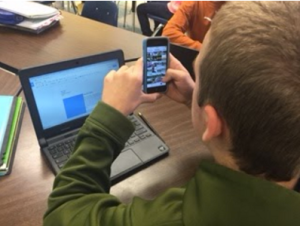
Searching photos on a phone while writing on a Chromebook.

Searching photos on a phone while writing on a Chromebook.

Change bothers most people.

We can be good teachers and still make room for change. Change does not mean we are bad teachers making bad decisions. There are many ways to teach, but consider this blog post as an invitation to grow.

Consider change as growth. Everyone can grow.

For example, I changed my approach in the classroom by adding writing and technology to my life outside of the classroom. It wasn’t a drastic change–and if writing and technology are changes you would like to make, neither needs to cause a seismic shift in your day.

Asking teachers to write is a scary proposition. Asking teachers to become more fluent with technology is a scary proposition. It sounds a little like going off of the script.  Read more