Skip to content

Tools of the Trade: Using the Classroom Library as a Tool to Move Students Forward as Independent Readers

By Kelly Virgin

My first year teaching I half filled a little book shelf in the back corner of my classroom with all the YA novels I’d collected throughout college.  A part of me was excited to share these books with my students, but most of me was just happy to clear the totes out of my closet at home.  However, as the year progressed, I soon realized the books were getting about as much use on the shelves as they had received the previous year living under my winter coats. I attributed this to the unimpressive size and slightly outdated contents and vowed to do better.

As years passed, my library grew to include the latest hits and began to take over a larger part of my classroom. I naturally expected my students interactions with it to increase accordingly.  I thought I was doing everything right.  I added bookshelf after bookshelf.  I organized by genre into colorful bins. I tagged the spines of books with color-coded labels.  I created display shelves and rotated best sellers in and out of position.  I dedicated an entire bulletin board to the library and I posted book news, and reviews, and suggestions. I added a magazine section and a children’s book section. I moved in an old comfortable papasan.

Besides increased bickering over who got to sit in the “comfy chair,” I noticed only a little increased interest in my classroom library. Year after year, I amped up my efforts but continued to lament over what I was doing wrong. Then it hit me.   Read more
Teacher to Teacher: Wish List

PAWLP PostBy Janice Ewing

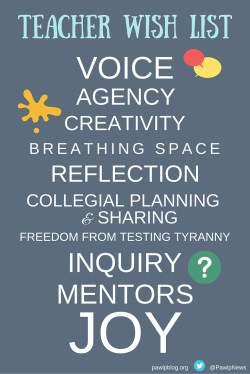
In this season of giving and receiving, of lists and recommendations, I’ve been thinking about teachers, especially new ones, and what they need. So, here’s a wish list for new (and not so new) teachers:

  • Voice: the confidence to share ideas, ask questions, raise doubts about questionable practices and about why things have always been done ‘that way’
  • Agency: the understanding that it is teachers’ day to day and moment to moment decisions, based on knowledge of their students, that move students forward, not following a scripted plan with the goal of raising test scores x number of points for x number of students

Read more

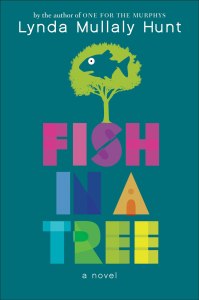
Books on the Blog: Fish in a Tree

Every first Monday, join us on the PAWLP Blog for a digital “book talk.” Today, we have PAWLP Fellow Sarah Burkholder with us to review Lynda Mullaly Hunt’s Fish in a Tree.

fishinatree


Review by Sarah Burkholder

“Everyone is smart in different ways. But if you judge a fish on its ability to climb a tree, it will spend its whole life thinking that it’s stupid.”

Ally Nickerson has lived by one rule throughout her school years: Lie low – when called upon, always respond, “I don’t know.” Now in sixth grade, Ally’s inability to read perpetuates her perception of herself as “slow” and “dumb.” Ally has always had trouble learning and is consistently the target of peer criticism. Acting disruptive is the only way she has been able to cope with these challenges. However, her newest teacher, Mr. Daniels, realizes Ally’s potential and encourages her to embrace her learning differences. With the help of Mr. Daniels and two close friends, Ally recognizes that everyone has their own special talents and abilities, and with hard work and perseverance, anything is possible. In doing so, Ally’s peers begin to appreciate her creativity, imagination, and resiliency. The impact that Mr. Daniels has on Ally’s life is heart-warming and inspiring to read. Read more

Digital Tools Support Students on the Autism Spectrum (Guest Post)

by Aileen Hower

Digital tools that have proven helpful in supporting students on the autism spectrum to express their thoughts better in writing are those that allow them to create comic strips and videos. Likewise, digital tools like QR codes, podcasts, and interactive sites like BookFlix and TrueFlix can support a student’s reading more efficiently and effectively.  Read more

Teaching is Not a Normal Job (Guest Post)

By Barry Lane

I met this guy at the Newark airport years ago. I remember feeling both puzzled and offended by his tee-shirt. Puzzled, because I have never really understood the purpose of retirement and offended, because he appeared to know and was taunting me. I approached him and asked for a photo of his shirt and then I confided in him my bewilderment.

“I don’t really understand what it means to be retired,” I asked with great earnestness.

“What do you do when you are retired?”

He paused a moment and then looked me right in the eye and said,

“I do whatever I want to do, don’t I?”

Yes, of course, that’s it. That’s retirement, and by this definition I have been retired for years now, along with the thousands of dedicated teachers I have met over the years at reading association meetings, like KSRA. There is no other place they want to be, but in the classroom. These are not normal people who work a boring job and relax on the weekends with their family. They are not extrinsically motivated by money or vacations or golden parachutes, (though all bets are off when free picture books are in the equation) . Many work in a profession for far less material reward then they could be getting in other less meaningful jobs. But they have this spark in their eyes and a passion for learning and children that is undeniable. To say they love their job would be an understatement. They don’t even see it as a job. They see it a calling. They see it as a life.

Barry Lane 1

Read more

From the Classroom: Toughest to Teach

By Brian Kelley

In preparation for a guest appearance in a Classroom Management course at Temple University, adjunct professor―and PAWLP co-director―Jolene Borgese asked her college students to email questions to me.

One question gnaws at me. For several days I have felt the need to write about it: Which students are toughest for you to teach? How do you address those students?

If I answered this question twenty years ago, I would have said the resistant students. My answer is different today. Yes, even after 20 years, I still find some students tough to teach. And I think I always will.

The toughest students for me are the students whom I do not know.

This one, my friends, is squarely on me. Not on the students.  Read more