Skip to content

Posts tagged ‘distance learning’

Distance Learning: Summer Reading Recommendations

by Lauren Heimlich Foley

Rita DiCarne and Kelly Virgin inspired this week’s blog post. Each summer I choose a combination of professional texts and YA novels to read. This July and August, one area I am focusing on is online learning, blended learning, and the digital workshop. I will not have time to read everything mentioned below but will use this post as a guide and reference point for my own learning. I hope it helps you to cultivate your professional development summer reading list.

1. Digital Writing-Reading Workshop

I mentioned the following two books—The Digital Writing Workshop by Troy Hicks and Adolescents and Digital Literacies by Sara Kajder—in my last distance learning blog post. I believe these texts are important for me to reiterate because they are foundational. If you have not read these books, I would highly recommend one or both to begin your journey at digitizing your writing-reading workshop. The theory, practical application, and resources will enhance your teaching whether you return to the brick and mortar classroom, remain distance learning, or teach a hybrid model. These books will serve as references as I continue to reflect on my own teaching practices. Looking ahead to next year, I want to explore more ways my middle schoolers can engage with texts they are reading whether a whole class novel, book club book, independent reading book, or online articles. I also want to cultivate additional online, real-world writing opportunities. The following titles will help me further hone my digital workshop best practices:

2. Creating Videos to Enhance Student Learning

At the end of the school year, I asked my students for feedback on distance learning. Three students mentioned that they greatly appreciated the PowerPoint lessons with my voice over. They also said my directions in Canvas were clear and easy to follow, but they asked for more videos and/or audio clips of me speaking the directions. They explained that reading the mentor texts, following along on the PowerPoints, and reviewing all of the written directions in Canvas added up to a lot of online reading. Not to mention when you multiply that routine times all of your classes. For the last week of school, I left a personalized message on the module overview page using the Canvas audio recorder. I liked the concept and wished I had discovered it sooner.

As I explored possible books for my summer read list, 99 Tips for Creating Simple and Sustainable Educational Videos caught my eye, especially “Tip 19: Take Students on a Tour.” In this section, Karen Costa suggests creating video virtual tours to “show” students how to navigate the learning management system. The video might review prior knowledge, module organization, course assignments, and weekly directions. After perusing more of the book on Google, I will be ordering my own copy as a reference.

3. Social Networking Influences on Adolescents

To better understand why social networking sites appeal to my teenage students, I want to read more about their digital, social lives and the psychology behind it. In learning about what makes them gravitate toward social media, I will be able to use Canvas, Microsoft Teams, and other technology platforms to further engagement students and enhance our digital workshop. As of now the following articles will assist me on this journey. I am currently looking for others and will comment on this post if/when I find additional titles.

4. Blended Learning

Blended learning may be a reality for many teachers this coming fall. Learning how to navigate and balance my brick and mortar best practices with technological enhancements will be important if I am going to create an engaging, meaningful, and relevant learning experience for my students. My district’s professional development secondary education coach, Michele Meyers, recommended Catlin Tucker’s books. Her blended learning philosophy will be of help as I envision my 2020-2021 classroom. She has many published books, resources, and videos on her website. I am still deciding whether I am going to order one or both of the following titles:

5. Structuring your Summer PD + Additional Resources

Dr. Buckelew shared the article “How I’m Spending My Pandemic Summer Vacation: A professor creates a syllabus to guide herself and other faculty members in preparing for more remote teaching this fall, amid Covid-19.” by Sarah Rose Cavanagh. The author’s voice is inviting, and she offers a plethora of reading options and great resources.

With the whole summer ahead of me, I am looking forward to enjoying the extra time to read and write for me, bird watching on my apartment balcony, finally getting to hang out with family and friends—six feet apart. This list of books and articles will guide my professional summer reading and help prepare me for the fall.

What resources are you using and what texts are you reading to prepare for the Fall 2020-2021 school year?

Call for Distance Learning Blog Posts

The PAWLP Blog would like to hear from you! What did distance learning look like for you, your students, and your school district? How will distance learning change or enhance your brick and mortar routines and best practices? What does Fall 2020 look like for you, your classroom, your school, and/or your district?

Blog posts will be featured in our Distance Learning column each Monday. Please email the PAWLP blog if you are interested or would like to find out more information.

Distance Learning: Re-Imagining Student Conversations and Collaboration in the Digital Writing-Reading Workshop

by Lauren Heimlich Foley

At the end of each school year, I find myself reflecting. I wonder how I can enhance the order of my units, improve my mini-lessons and assignments, foster more meaningful student collaboration, and so forth. Students’ end of year reflections help me hone my best practices and prompt me to consider the ways I can better meet their needs. This year marked a first for me: asking my students to reflect on distance learning. Although there are best practices for the digital workshop, blended learning, and online teaching, teaching solely on the computer was something I had not yet studied or tried. I considered how best practices in the digital writing-reading workshop applied, contemplated my teaching philosophy, explored my district’s technology resources, and—most importantly–remembered my students.

During the last decade, my digital writing-reading workshop focused on a variety of digital, multigenre, and multimodal projects, the electronic portfolio, various online platforms to create and share work, and student collaboration using Microsoft products. These assignments were enhanced through student-student and student-teacher face-to-face conferences and conversations. Even when my district implemented Canvas, our learning management system, I balanced high- and low-tech assignments and class periods. I was cognizant that I re-defined the ways students used their laptops to ensure that technology enhanced and re-imagined materials, assignments, and collaboration instead of simply replacing pencil and paper and in-person interactions.

I found the discussion boards to be a strength of Canvas, but I did not want these blog-like forums to replace students’ verbal conversations. So, discussion boards became a place where they could post writing inspirations for their classmates, make book recommendations, receive feedback on writing assignments, publish their drafts, post a summary of their verbal table group discussion for the class, and share individual or group practice examples from mini-lessons. These boards housed information, writing pieces, feedback, and conversations for later reference and use.

Then, distance learning hit. I—once again—had to re-imagine how I could foster student conversations and collaboration as well as student-teacher conferences. One-on-one and small-group Canvas discussion boards and Microsoft Teams proved helpful. Weekly Canvas discussion boards enabled students to share their quick writes, book insights and recommendations, and drafting with their brick and mortar table groups. However, students often logged in to complete their work at different times. Although students could ask questions, offer answers, and leave feedback, their peers were not present to engage in real-time digital conversations. For our final unit, the electronic portfolio, I asked each class period to sign in at the same time so that they could read one another’s work and have conversations with each other. This invitation proved the most successful: it had the most participation. Additionally, our optional Teams meetings enabled students to ask questions, review directions, discuss books, and share writing pieces. Students signed up for these calls, and they left with new book titles, writing inspirations, and clarity.

Now, with more than a marking period of distance learning under my belt, I have begun to see its limits and possibilities. Armed with student reflections, my experiences, and new and old resources, I am asking myself these questions for the 2020-2021 school year:

  • How can I enhance distance learning practices to better meet the needs of my students?
  • How will distance learning change my best practices in the brick and mortar classroom?

Currently, I am exploring how Canvas and Teams can foster student conversations and collaboration. I returned to the work of Sara Kajder and Troy Hicks—two teacher researchers who, early on in my career, greatly informed my digital writing-workshop practices. The following research will inform my practices next year:

  • Lenhart et al. in “Teens and Social Media” (2009) posit, “The primary motivation for participation in a social network is to interact with friends and/or members of the participating community (as cited in Kajder, 2010, p. 18).
  • Ito et al. (2008) explain that digital adolescents use social networking spaces to “find a different network of peers and develop deep friendships through these interest-driven engagements, but in these cases the interests come first” (p. 14, as cited in Kajder, 2010, p. 18).
  • Students and teachers “can use blogs to offer responses in the form of posting, tagging, and commenting (Hicks, 2009, p. 41).
  • “Students can simply post responses to journal prompts or share links” and “they can write analyses of online materials, synthesizing across sources and building on their previous posts” (Hicks, 2009, p. 41).
  • “[Will] Richardson suggests that blogging invites writers to synthesize ideas and opens up conversation between writers through commenting on the posts of others and then incorporating those posts into one’s own writing” (Hicks, 2009, p. 41).
  • Blogging “demands that students read, respond, and write in ways that encourage more specific response and utilize features of a digital writing space. That is, students who blog are able to hyperlink to sources of information and inspiration, embed multimedia for specific rhetorical purposes, and engage in larger conversations about their topics” (Hicks, 2009, p. 41).

Kajder and Hick’s insight in social media networking and blogging is influencing the way I perceive Canvas discussion boards and Teams meetings. I am also considering how my students’ interests in YouTube, TikTok, Instagram, Facetime, and other social media can give me insight into how I can appeal further to their digital, social lives.

My students’ feedback confirmed the desire to share more through discussion boards and have more opportunities to socialize in Teams. They enjoyed the portfolio publishing the most out of the publishing opportunities because their group members were all present. They wanted different groups to share with and a variety of discussion boards for different purposes. And, they liked being able to use text, audio, and/or video to post. Moreover, they preferred when the discussion boards remained open, so they could access them and post without time limitations. Students praised the one-on-one office hours discussion board which replicated the conferences I would hold during independent reading time and our workshop time. In terms of Teams, students wanted set times for regularly scheduled meetings. Some appreciated that these calls were optional while others would have preferred them being mandatory. A common thread that surfaced was the desire for more and varied opportunities to share with peers.

Next year, I will use Canvas and Teams to tap into my middle schoolers social and digital nature. They will have more online opportunities to forge connections with peers and make new friends while simultaneously thinking creatively, critically, and empathetically as they enhance their reading, writing, speaking, and listening skills.

I have been doing some brainstorming. Below are the ways I would like to employ Canvas and Teams next school year whether we are teaching remotely, in school, or a hybrid of both. Some ideas I have tried before in my brick and mortar classroom and during distance learning while others I will experiment with for the first time next year. I am sure this list will grow and change as the summer continues and once school starts.

Canvas Discussion Board Creation Notes

  • Create groups based on friends and interests.
  • Rotate groups weekly or by unit so students can interact with new/different classmates.
  • Include small-group and whole-class posting opportunities.
  • Create groups with students from my different class periods.
  • Vary what students are sharing and commenting on.
  • Consider the names of discussion boards to help students and me locate conversations.
  • Provide commenting sentence starters.
  • Set clear expectations.
  • Provide directions for using the boards.
  • Stress the different ways they can post information: text box entries, Office 365 uploads, attachments, pictures, audio recordings, and webcam videos.
  • Find out if there is a way to see all posts even if students edit or delete them.
  • Keep discussion boards open and ongoing.
  • Remind students that they can share digital media along with their own posts such as external links, videos, articles for research, links to books, pictures, music, videos, related online texts, etc.

Canvas Discussion Board Topics and Purposes

The following items could be adapted for small-group and whole-class discussion boards.

  • Collaboration: a place to share and create materials for group projects, to discuss book club books, and to receive feedback on writing components
  • Student examples for reading and writing mini-lessons
  • Receptacle of genre study or whole-call novel questions that other students and I can provide answers to
  • A place to share drafts throughout the writing process for revision and editing feedback as well as publication celebrations
  • Foster topic and genre brainstorming and rehearsing in which students ask each other to expand and reflect on their initial writing ideas
  • Conversations that build off of previous conversations with their peers or professional posts  
  • Replication of brick and mortar quick write shares and informal table group book talks
  • Book recommendations with links to Goodreads and/or Amazon for their peers’ further exploration
  • Create separate threads for students to reply to which would focus around student-selected texts for mini-lessons, poetry analysis, book passes, common themes in independent reading books, recommended books in different genres, genre study mentor texts, etc.
  • Create separate threads for jigsaw lessons
  • Sharing of mini-lesson ideas or workshop inspirations such as strong words I’d like to use in my own writing, literary devices, figurative language, conventions to experiment with, ways to include MLA in-text citations, authors’ mood and tone, etc.
  • First book chapter or page posts: reader responses, observations, recommendations, first impressions, etc.
  • Independent reading book posts: analysis, read like a writer observations, writing inspirations, and mini-lesson application

Teams Meetings to Support and Enrich Canvas Discussion Boards

  • Create a standard Teams meeting time each week. At this point, I am unsure whether attendance will be mandatory or encouraged, and I am waiting to see if there is a directive from my district.
  • Conduct small-group Teams meetings based on students’ needs and/or similar interests (e.g. table groups, weekly discussion board groupings, interests, genres, book topics or themes, and/or skills differentiation), which will either be mandatory or encouraged.
  • If we are back in the brick and mortar classroom, but social distancing, I can use Teams to have one-on-one or small-group conferences with students from across the room. I imagine us sitting six feet apart and plugging in our earplugs to quietly talk to one another.

Since my district has a partnership with Canvas and Microsoft, I am primarily using them; however, these ideas can be easily applied to a variety of platforms such as Google, Zoom, and Flipgrid. Kajder and Hicks also reference a variety of platforms that are available to teachers.

With summer almost here, I anticipate plenty more personal reflection and professional development. I look forward to what September brings.

References

Hicks, T. (2009). The digital writing workshop. Heinamann.

Kajder, S. B. (2010). Adolescents and digital literacies: Learning alongside our students. National Council of Teachers of English.

Call for Distance Learning Blog Posts

The PAWLP Blog would like to hear from you! What does distance learning look like for you, your students, and your school district? How will distance learning change or enhance your brick and mortar routines and best practices? What does Fall 2020 look like for you, your classroom, your school, and/or your district?

Blog posts will be featured in our Distance Learning column each Monday. Please email the PAWLP blog if you are interested or would like to find out more information.

The Odyssey: My Distance Learning Journey

by Molly Leahy

The third marking period began with such promise after I attended an invigorating session with smart colleagues and new ideas at the PAWLP Day on February 8, 2020. I had a new stack of books recommended by keynote speaker, Angela Stockman, and after Dr. Emily Aguilo-Perez’s session, I was so excited to try zines with my students for our end of the year unit on Speak. Reconnecting with PAWLP Fellows restored my professional soul and rekindled creative energy during the season of hibernation. Just a month later, our school life and dependable bell school schedule morphed into the unknown with the closure of school and the start of our continuity of learning at home.

During this transition phase, my anxiety stemmed from trying to figure out how my real classroom could be repackaged, uploaded, and sent out electronically to our classroom community. One of Angela Stockman’s slides on that cozy Saturday in February, asked us to examine our own teacher heritage, or profile, with a slide entitled “How might you build your teacher identity?” This is what I struggled with the most during our two week period of preparing for learning to resume remotely on March 29th. Every year, I save the best pieces of literature for last, and I kick myself for never feeling like I have enough time before the bell rings for the summer break. This year’s crisis was not whether I had enough time for the works of literature, but rather deciding what was essential from the literature units. While many of our students have been working more hours because they are essential to the grocery stores and the nursing homes in our communities, I had to decide what was truly essential for my 9th grade English classes to do at home. Together, we managed to go on a journey.

From the start of this digital odyssey, I wish I could say I gained wisdom from Athena along the way, but like the great hero Odysseus, I made mistakes. For me, the Land of Lotus Eaters meant I was definitely eating comfort foods and emotionally eating over the stress of the news and my fear of online learning; I ignored my own goals of eating healthfully and exercising. Yoga pants or sweatpants—like the Lotus Eaters—are not my friends; they kept me from my goals and normalcy.

Fortunately, after adjusting and creating a routine that included more exercise, I was ready to hear from the Sirens, my students.  I was perhaps a bit too zealous right out of the gate on day two, creating a back together bingo based on their first writing prompt. Basically, I hosted a party and then sat there by myself wondering if I even copied the link for Google Meet Hangouts correctly. I think some students were too shy to use Google Meet. In some ways, I shared that feeling.

As I learned to overcome my own digital shyness, I knew I had to put myself and my image out there more—or maybe I needed to remember my teacher identity before downgrading to the sweatpants uniform. While I created my own read aloud videos with my IEP students in mind, I also needed to challenge my students who were headed into honors courses next year. Choice seemed important to include as a means to motivate all students, and I hoped their curiosity would compel them to click on links leading to enrichment.

I created a survey at the start of our online learning and then again at the midpoint. The survey assignments had the highest completion rate of all my assignments because students love to give their opinion, it’s not hard work, and they don’t have to worry about wrong answers. Mental note—how can I trick students into thinking every assignment is a survey? Their responses indicated that they wanted more

  • Interactive work
  • Opportunities for group work
  • Choices for some of our assignments

This was the proof I needed to make sure my digital classroom resembled the physical space I packed up way too early.

Sometimes lesson planning was like trying to navigate between Scylla and Charybdis. Each decision for the day’s lesson seemed to have unlimited possibilities, but hard decisions had to be made in determining essential skills and content. I questioned which path or approach would reach students best. My colleagues who serve as coaches throughout the district offered wise counsel, better than the advice Circe gave Odysseus. These sages led professional development online through Google Meet and provided directions and suggestions for many options and tools in our ever-increasing technology repertoire, arming me with edPuzzles, flipgrid, screencastify and loom—all nouns that did not exist in my early career lexicon. I could attend a session live and ask all of my questions, or I could log on later to the recorded session and review the lesson and all of the resources. Just like our PAWLP teacher consultants have always done, this professional development offered practical strategies to improve choice and communication, and best of all, the professional development served as a model for how I wanted to run lessons.

During another adventure, I didn’t quite crash the cave of Polyphemus, but I was led into the minds, homes, and lives of students through their writing. Between The Odyssey and Romeo and Juliet, students wrote a letter to their Future Self-Post Pandemic. As expected, the personal writing assignment resulted in more students completing their work, but reading their letters made me really regret that we weren’t all together in the classroom. I read letters from some students whose views seemed very limited, and then I read letters from students who experienced losing someone they loved to the virus, working more hours at nursing homes, or caring for their younger siblings while their parents went to work. I worried that without being back in the classroom together, our community of students wouldn’t be as empathetic. And then current events taught everyone in this country that we need to see other viewpoints and not be myopic monsters, but were my students paying attention and making connections?

I realize that I will need to adjust our typical-in-class-community-building work right away in the fall so that we can build a sense of community virtually where students feel they have a safe and trusted space to encounter honest dialogue with others who might have different views.

My students definitely did not adopt Penelope’s cunning and strategy from “Test of the Bow.”  Perhaps they were testing me—No, I’m sorry, just copying the brainstorming template and saving it to your Google folder doesn’t count as completed work! Clearly, I need to be more crafty in designing work that the students really want to engage in, and wow—doesn’t that critical thought bubble seem very familiar, so brick and mortar normal.

Odysseus made it back to Ithaca, although his home palace was a very changed place with a few more battles for him to win. We return in the fall for our new school year. At our very first digital in-service day last week, my department decided to start the next school year by planning as if we will be teaching remotely. This unified decision helped us to move past wondering what will happen, and it gave us back some control in our destiny. By using our newfound tech skills and by planning for remote learning, we can create our opening units to work for students whether they are with us in the building or at home. I know I can return to familiar territory: choice, connection, and community in the classroom. Somehow, I will navigate my way through self-selected reading to promote the love of reading even from afar. I have survey data to prove students crave interaction, and it turns out, I do know how to send out links for Google Meets correctly, so writing conferences can resume virtually.

Did I drag out the Odyssey longer than 10 years? Maybe, but ultimately, this teaching phase was really my very own odyssey with challenges, discoveries, and help along the way.  My teacher identity, carefully crafted after twenty-seven years, needed some hi-tech retooling, like Odysseus installing GPS. I learned I didn’t want to be forgotten. I mourned the loss of my favorite works in order to end the school year triumphantly. And maybe, my pride or ego got in the way as I tried to pare down the content or curriculum to only essential work for my students, our essential workers. Trying new teaching approaches remotely has felt like a digital shot in the dark, without experiencing any adolescent faces or groans—the typical feedback to gauge the success or failure of new ideas. However, this time of separation from students and a brick and mortar classroom presented much needed reflection on an unusual professional adventure, and I feel more confident about the next journey.

Molly Leahy teaches ninth grade English at William Tennent High School in Warminster, PA. The 2019-2020 school year was her first year returning to the classroom full-time after five years serving as the district’s Lead Teacher for RELA. This return to the classroom full-time sparked such joy that the closing of school seemed extra painful. The next adventure for her is teaching the school’s newest course, AP Research. Her experiences as a PAWLP Fellow and Institute co-director continue to guide her professionally and personally.

Call for Distance Learning Blog Posts

The PAWLP Blog would like to hear from you! What does distance learning look like for you, your students, and your school district? How will distance learning change or enhance your brick and mortar routines and best practices? What does Fall 2020 look like for you, your classroom, your school, and/or your district?

Blog posts will be featured in our Distance Learning column each Monday. Please email the PAWLP blog if you are interested or would like to find out more information.

Distance Learning for English Language Learners

by Peter Suanlarm

Is it possible to incorporate distance learning with teaching English as a Second Language (ESOL)? By asking this, I realized that this question opened up an intended can of worms for me. For example, giving students a worksheet and then documenting their scores just does not work for someone who can’t understand you in the first place. Teaching ESOL students oftentimes requires a much more hands-on approach whereby any information delivered in class would have to be deliberate. This includes acting out every word, anticipating questions about the not-so-obvious nuances of the English language, annunciating clearly every syllable, reading every word very slowly, repeating directions over and over again, and so forth. Distance learning just seems incompatible with delivering effective instruction to ESOL students.

This past year was my first year as a teacher of English Language Learners. I wrestled with the steep uphill learning curve in tailoring a curriculum to 25 to 30 different languages and cultures over grades 7 through 12. My responsibility included skills in reading, writing, listening, and speaking the English language. I had hoped my experience as a secondary English and History teacher and my own life experience as an ELL would help me navigate this new challenge, but I was only half right.

My educational background allowed me to know where the students needed to go, but it didn’t necessarily prepare me for how to give them the means to get there. My own experiences did provide me with an understanding for how difficult it is to acquire the English language. The process was long and quite arduous and was extremely personal. It was my choice to learn English. It is in my understanding of where ESOL students need to go and how difficult it is to get there that informed me on how to incorporate distance learning into teaching ESOL students.

Here are some insights from what I learned during the past month or so:

First, ESOL students must want to learn English for themselves. It really does not matter why they would want to learn English but, in the end, they must choose to learn English. It is the job of an educator to show reasons for the necessity of being able to communicate effectively. Self-advocacy and self-determination will go a long way to help students be responsible for their own knowledge in distance learning.  

Second, ESOL students and their teacher have to understand that learning requires the use of senses (sight, sound, touch, taste, and smell). Lessons should be diverse and hands on. Although question-based lessons are great assessment tools, project-based assignments often produce the best results for me because it allows for asynchronous learning. Thus, students are able to take in information and express knowledge at their own pace. Perhaps, fluid or negotiated deadlines would allow students to take responsibility for their own time management skills.  

Third, ESOL educators must be available to answer questions by email, phone, and video conferencing office hours. Questions may come at any hour and educators must be ready at all times.

Lastly and possibly most importantly, clear and simple communication is the key to getting any student to do work in distance learning. If students cannot understand the directions, they will not do the work. This is even more important when it comes to ESOL students.

Although many of these insights may not differ much from other subject areas, teaching ESOL forced me to create lessons based on more tangible and reachable goals. I had to ask myself what do I expect students to learn during these unusual times and what kind of lessons will the students be able to do independently. Like most of you, I have mixed results in getting ESOL students engaged but will keep experimenting and growing as an educator.

Call for Distance Learning Blog Posts

The PAWLP Blog would like to hear from you! What does distance learning look like for you, your students, and your school district? What digital programs are you using? What lessons have you tried out? How has distance learning questioned or improved your best practices? How might distance learning improve and/or challenge your teaching in September 2020?

Blog posts will be featured in our Distance Learning column each Monday. Please email the PAWLP blog if you are interested or would like to find out more information.
Emphasizing Multimodalities for Multilingual Learners during Distance Learning

by Courtney Knowlton

It is almost unbelievable that I entitled my Google Classroom assignments for this week, “Week 8. . . .” I have been teaching from my computer for eight weeks now? How is that possible? Although I must say that in those eight weeks as a virtual English language development (ELD) teacher, it seems I have learned a full year’s worth of strategies to support and enrich my students using technology.

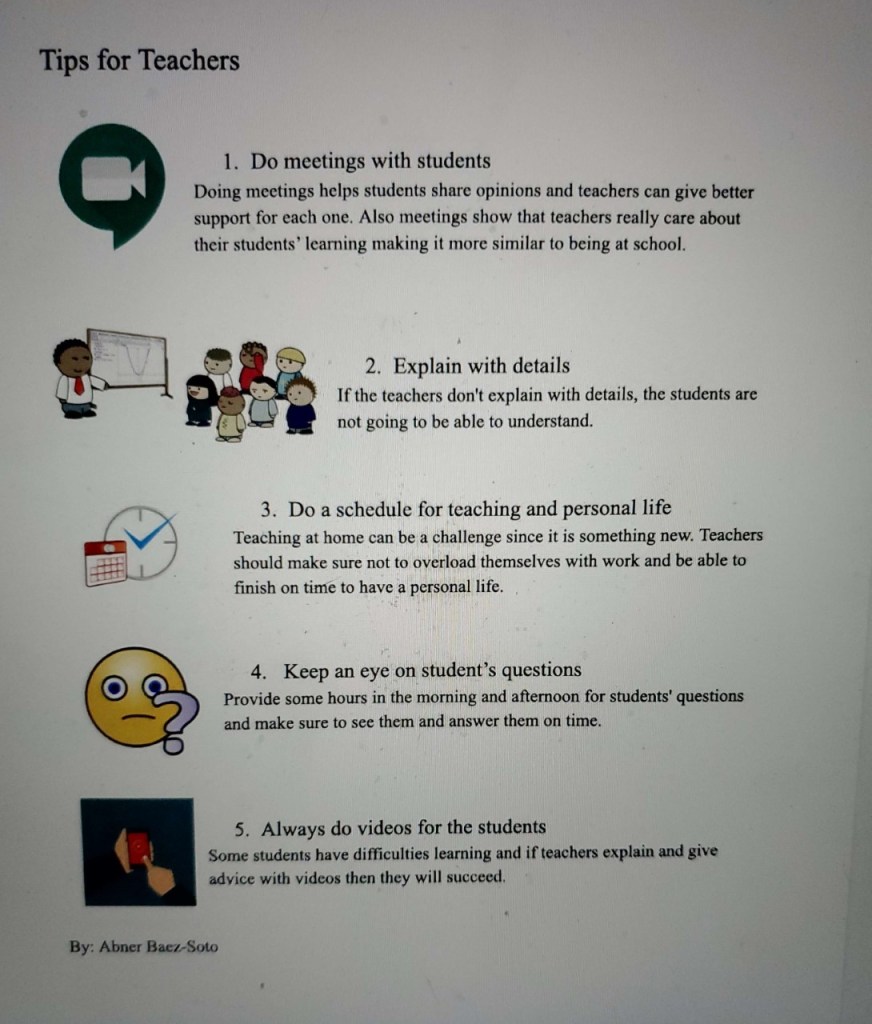
Recently, I asked my multilingual learners to reflect on their distance learning journey so far and create an infographic of tips for students and teachers. This project helped me reflect on my own journey as well. First of all, it was eye opening to watch the students create their projects. It helped me understand the range of computer literacy skills present in our group. For some students, the task of searching for images and formatting them on the Google Doc took them a substantial amount of time. Asynchronous teaching takes away our ability to adapt in the moment, which is why it is so important for us to continuously reach out to our students, especially those in the ELD program, and ask them, “How long did it take you to complete this work?” Chunking the tasks appropriately is crucial for student success.

Our infographic project also supported my belief in the value of visual literacies. Did the students get a little frustrated when their image pushed their text around in weird ways? They certainly did, but haven’t we all been there at some point? More importantly, the use of visuals led to students identifying the main idea of their tips, thinking metaphorically, and comparing the usefulness of different images for getting their point across. Creating a project with visuals is a task that is accessible to students of all language levels and it is a skill that can be used in many different contexts. When I first started teaching from home, most of my assignments involved students interacting with texts. For the last few weeks of school, I want to intentionally plan more opportunities for students to create with visuals.

When the students completed their infographics, I noticed that a common thread within their projects was praise for the use of videos and synchronous meetings. These students are missing all of the aural literacy development and person to person connection that they get when they are at school. In order to attempt to fill this void for them, I have been using a few free tools available through the Chrome Web Store. I use Screencastify to create videos to explain assignments. At the moment, they are offering a code for educators affected by the pandemic to access their premium services, which is CAST_COVID. Two more Chrome add-ons that have improved our distance learning experience are the Grid View Extension, which allows you to see all participants in a Google Meet, and the Nod Extension, which gives students the ability to click on an icon to raise their hand as well as to use emojis to communicate their thoughts and feelings. Lastly, I use an extension called Mote to leave voice comments on the students work in Google Docs and Google Slides.

When planning learning experiences for multilingual learners, it is crucial to keep different literacies in mind for both receptive and expressive communication. In my case, I have been using visuals and auditory information effectively to deliver lessons. However, I need to make more of an effort to invite students to express themselves using different modes as well.

Call for Distance Learning Blog Posts

The PAWLP Blog would like to hear from you! What does distance learning look like for you, your students, and your school district? What digital programs are you using? What lessons have you tried out? How has distance learning questioned or improved your best practices? How might distance learning improve and/or challenge your teaching in September 2020?

Blog posts will be featured in our Distance Learning column each Monday. Please email the PAWLP blog if you are interested or would like to find out more information.

Re-Visioning Brick and Mortar Classroom Practices: From the Mindful Minute to the Mindful Stretch

by Mary Buckelew

“The warm handshake at the classroom door, the encouraging hand on the shoulder of a student who is working through a problem—these small gestures, as well as the other rituals we have embedded into our classrooms, don’t all travel well.”

–Frey, Smith, Fisher (ASCD Express, 2020, Vol. 15, No. 17)

For many years, I’ve opened my brick and mortar writing classes with the same trio of activities. Some activities traveled well and some needed adjustment.

Pre-Pandemic Trio

  • The Mindful Minute (provides a segue from our busy lives to writing workshop)
  • Student Announcements (foster community and heighten our awareness of interests, diversity and similarities in our classroom)
  • The “Focused Freewrite” (leads us to the content of our class, writing)

Some students likened the opening of our face-to-face writing classes to a ritual, and I remember thinking that’s not so bad.  In “Classrooms Need Rituals and Routines — But Don’t Get Carried Away,” Brian Gaten writes of the importance of classroom rituals, “Rituals are more than a daily reminder of the hows and whys of your classroom. They also:

  • Give students consistency in their learning and routines to help center their thinking.
  • Reduce anxiety so students can be open to class content.
  • Create a flow in the day.”

So far so good, but then along came the pandemic.  The culture and context of the brick and mortar writing classroom evaporated in the blink of an eye, and I had to acknowledge that not all face-to-face pedagogy or content smoothly traveled to our online classroom.

Fast Forward to Remote Learning

The Mindful Minute became Mindful Stretching

As I looked at the somber faces of my undergraduate students, neatly lined up in Zoom, I realized that perhaps we’d been with our minds too much and needed something other than a mindful minute of silence and breathing.  Instead of sitting quietly (although this was certainly an option), I suggested stretching, walking, or dancing 😊 in place for a minute (video off/screen closed). Ralph Peterson suggests, “At best, ritual functions to keep students in touch with themselves, forge community bonds, and liberate imagination” (p. 27). Sometimes rituals need radical revision sometimes minor modifications.

Announcements became “Check In” time

Instead of asking students to share announcements regarding their campus activities (not happening), I invited students to share what was on their minds. It soon became apparent that there were vast differences in students’ experiences during the pandemic. One student was supporting her grandmother and herself by working overtime in the grocery store; another student was working double shifts as a pharmaceutical technician because he and his mother were the sole support of their family of eight! Other students had the time to embrace boredom and or to re-paint and reorganize their bedrooms at home. As the weeks progressed, students became a bit more reserved when discussing their boredom; i.e., they were sensitive to the disparity in each other’s experiences.   Eventually, Check-in evolved into sharing new movies/Netflix series and other items to bolster morale.  The change in focus necessary and the 10 minutes it took – very worthwhile.

Focused Freewrite (ala Louise Rosenblatt) essentially the same

The goal — to write for three and a half minutes without stopping remained the same. I reminded students that this was not just a time filler. Rosenblatt notes that the freewrite “should be a technique for tapping into the linguistic reservoir without being hampered by anxieties about acceptability of subject, sequence, or mechanics” (1072).

I also reminded students that timed writing and (timed reading) are great strategies to use when we are not feeling the flow; i.e. setting the timer gives us the opportunity to start and stop without feeling like a project or writing piece looms before with no end in sight. I noted that Jeff Anderson and other gurus suggest that freewriting builds our writing fluency, stamina, and endurance.  A colleague, Bob Z., told me that some of his students find that the freewrite has a meditative quality to it. So, our freewrites remained 3 ½ minutes long, but I asked students to supply the prompts for our freewrite for the duration of our online classes.  Clearly, they enjoyed being asked to do this – Here are just a few of the prompts students shared:

  • What do you wish people around you would not do or would do during this time of sheltering and social distancing?
  • If you could only listen to one band/musician/ensemble, who would it be and why?
  • What is the first thing you would like to do when this is over? Describe using all senses.

In our small group Zoom breakout sessions students seemed to share freewrites more readily and had more to say when we returned to the ‘main room” than in our old brick and mortar days. At the end of this semester, one of my students, Jack, shared the following in his final reflection: “but I believe that the most influential piece of the class that will stick with me after this semester is the focused free write time before every class began. What may seem like a short exercise to get the brain flowing was much more to me.  . . . This very small piece of the class was extremely impactful on my current life because it reopened a previously suppressed outlet for stress and anxiety. I could just write without sharing my words or ever having to revise. It was raw emotion or feeling about any topic I chose for that session. I plan to incorporate the focused free writes into my future writing processes to gauge my raw and unedited feelings and knowledge about a topic. I feel it will be most useful before brainstorming and then again after my research is complete to make sure I have a full understanding of the topic before engaging in writing the final product.”

Jack’s comment regarding how the focused freewrite helped him during this stressful time and how he would apply the strategy to his future writing endeavors – made this anxiety ridden and overwhelming online teaching endeavor worthwhile.

Admittedly, teaching online this past semester was anything but smooth, but it gave me the opportunity to ponder my teaching philosophy, my praxis, and the purpose/s of much of what I do. This chance to reflect was an odd gift from an unlikely source.

What did you learn about yourself this past spring? In the classroom? Outside of the classroom?  What aspects of teaching online did you enjoy What platforms and apps did you find most useful?  What will you focus on this summer to prepare for the fall? I would love to hear from you! mbuckelew@wcupa.edu

References

Bennett, P. (2020) “This grand distance-learning experiment’s lessons go well beyond what the students are learning.”  for CBC News Opinion · Posted: May 11, 2020 4:00 AMET  Last Updated: May 11 https://www.cbc.ca/news/opinion/opinion-distance-learning-education-covid-1.5547062

Burns, M. (2020) “Emergency teaching online: 7 steps to get started.” Global Partnership for Education. https://www.globalpartnership.org/blog/emergency-teaching-online-7-steps-get-started

Ferlazzo, L. (2020) “We might have gotten remote learning wrong. We can still fix this   school year.” Education Week Teacher. https://www.edweek.org/tm/articles/2020/05/13/we-might-have-gotten-remote-learning-wrong.html

Frey, N. Smith, D. & Fisher, D. (2020) “A Positive classroom climate, even from a distance.” ASCD Express: May 14, 2020; Vol. 15 Issue 17 http://www.ascd.org/ascd-express/vol15/num17/a-positive-classroom-climate-even-from-a-distance.aspx?utm_source=ascdexpress&utm_medium=email&utm_campaign=1517-motivation#.Xr0yWV-_6d8.email

Gaten, B. (2020) “Classrooms need rituals and routines — But don’t get carried away.” Blog: Share  https://blog.sharetolearn.com/curriculum-teaching-strategies/classroom-rituals/

Peterson, R. (1992). Life in a crowded place: Making a learning community. Portsmouth, NH: Heinemann.

Rosenblatt, L. (1994). The Reader, the text, and the poem: The transactional theory of the    literary work. Carbondale, Illinois: Southern Illinois University.