Skip to content

Posts tagged ‘Janice Ewing’

Slice of Life 4: Watch your language!

By Janice Ewing

When I was growing up, this admonition mainly referred to cursing, or any other words or phrases deemed inappropriate for polite use. (I think the subtext was “Watch how you speak to adults!”) Now, I find myself thinking about the value of watching our language in a much broader context, in our speaking as well as in our writing. Read more

Slice of Life 3: Weather or Not

By Janice Ewing

So, like thousands (millions?) of others, I’m watching the weather this week and thinking about what plans might be have to be adjusted. Among them, a new grad class due to start on Thursday evening. The back-up plan for a weather-related cancellation is to have an online class, and this has worked well in the past. However, I have never had the situation of having the first session online, before we’ve had a chance for at least one face-to-face meeting. The prospect is raising questions for me about the differences between meeting people online versus face-to-face. Read more

Slice of Life 2: Body Language

By Janice Ewing

Peering out at our back steps and driveway this morning, taking in the icy slushy mess, I’m somehow reminded of an old-fashioned refrigerator in need of defrosting. Once that image enters my mind, I’m taken back to childhood memories of my mother defrosting our chunky old General Electric.  I’m back in the small, normally neat kitchen, suddenly cluttered with odd-shaped packages that bear little resemblance to foods we eat. I think this must have been one of my mother’s least favorite tasks. I didn’t know this from anything she said, but, even then, I could read it from her body language. Her usually calm, measured movements were abrupt and choppy, almost violent as she did battle with the recalcitrant ice. Read more

Slice of Life 1: Every Eight Weeks

By Janice Ewing

This is a transition weekend for me, between grad classes that is. One semester just ended and the next is about to begin.  There something about transitions that makes me reflective. Maybe that’s why it seemed like a good year to jump into the March Slice of Life challenge, which I’ve followed, but haven’t participated in before. So here it is, a very wintry March 1st, and I’ve just finished “Spring 1” and am about to start “Spring 2,”  with a group of teachers who are new to me, but not to each other. I teach in a cohort program, so if the course, like the one coming up, is far along in the program, the teachers often know each other better than colleagues in their own schools, and I’m the new kid on the block. That raises its own interesting issues – where people sit, food habits, break time, and the like have often been well-established before I arrive. No matter, I’m flexible enough to adapt to those aspects of the ecosystem as I find them. Read more

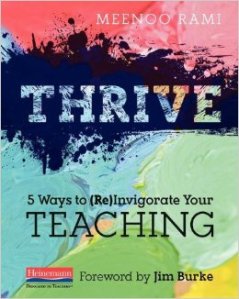
How to Thrive as a Teacher: A Book Review

thriveThrive : 5 Ways to (Re)Invigorate Your Teaching  by Meenoo Rami

by Janice Ewing and Rita Sorrentino

During the winter months, teachers and students have more to cope with than just cold weather and icy roads. Deadlines, data-driven decisions, and daily demands of classroom life loom larger as testing schedules, teacher evaluations, and interim assessments fill up the calendar.   Finding time to accomplish all that is required of a teacher, while keeping students’ best interests at heart, can zap the energy of the best-intentioned educators. Read more

Moving Students Forward: Be Generous with Time and Space

By Janice Ewing

Time and SpaceWe all know that a teacher’s new year starts in late August or early September, but still, during the months of December and January, as the rest of the world closes out one year and starts the next, it seems appropriate to focus on the theme of moving students forward as readers, writers, and thinkers, and that’s what we’ve been doing on our blog. Moving students forward is what we’re all about, even if that movement is inconsistent or even imperceptible at times.

Lately I’ve been thinking about what it means to “see” growth in our students – whether in test scores, conferences, writing pieces, or observation. What’s happening when growth is not evident, and how should we respond? Read more