Skip to content

Posts tagged ‘language’

Moving Beyond the Worksheet: A Writing Workshop Approach to Grammar Instruction

In our writing workshop class, grammar doesn’t live on worksheets—it lives inside stories, poems, conversations, and the students themselves. When we review parts of speech, for example, the goal isn’t just for students to identify them, but to use them intentionally in their own writing. For my English language learners especially, that connection between language rules and meaningful writing is essential.

We start our parts of speech review with nouns. Instead of defining them right away, students first notice nouns in a poetic excerpt from Out of the Dust by Karen Hesse. Together, we look closely at the objects Hesse includes and talk about what those items reveal about the speaker. What matters to her? What kind of life does she live? Students quickly see that nouns do more than name things—they reveal character.
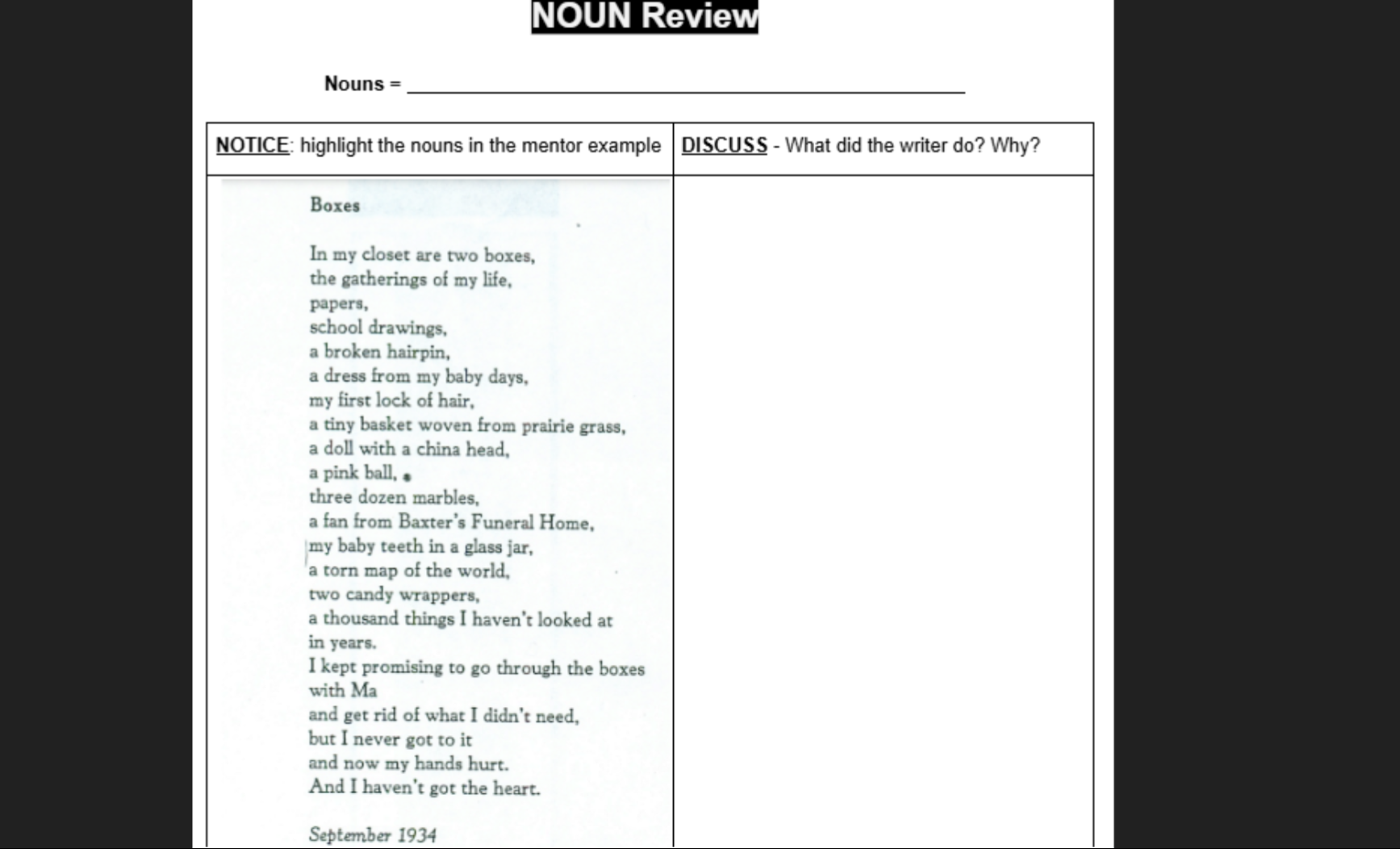
Using those observations, students craft their own personal list poems. They choose specific items from their own lives and begin to see how selecting certain nouns can tell a reader who they are and what’s important to them. This is where the grammar and the writing start to click.

Once we have that foundation, we expand our understanding of nouns by sorting them into types: proper and common, concrete and abstract, singular and plural. Because my students are English language learners, we also pause to notice the language rules that come along with these nouns—capitalizing proper nouns, adding -s to make plurals, and naming the exceptions as we discover them.

To get students moving (and collaborating), we take our learning on the road with a nouns scavenger hunt around the school building. Students work in pairs to complete tasks like introducing themselves to an adult and writing a sentence about who they met, finding the name of our high school and explaining where they are, sitting on something concrete and naming it, or making a facial expression and identifying the emotion they’re showing. It’s active, social, and full of real-world language practice—and it’s always a favorite.
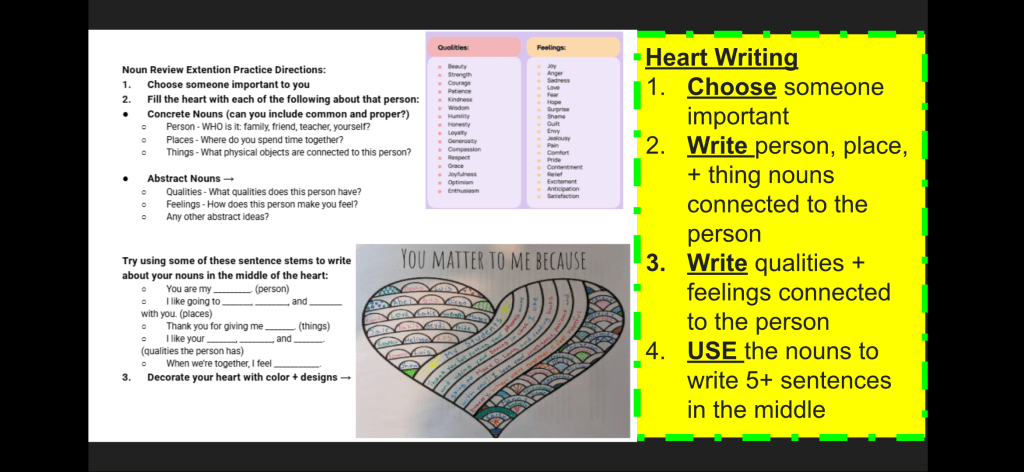
As a culminating project, students create a “noun heart” for someone important to them—a family member, friend, teacher, or mentor. Around the outside of the heart, they brainstorm meaningful nouns connected to that person, thinking again about the different types: people and places, concrete objects, abstract ideas. On the inside, they use that brainstorm to write five or more sentences directly to that person. Sentence frames like You are my ____. I enjoy going to ___ and ___ with you. Thank you for giving me ____. You make me feel ____. support students while still allowing for authentic voice.
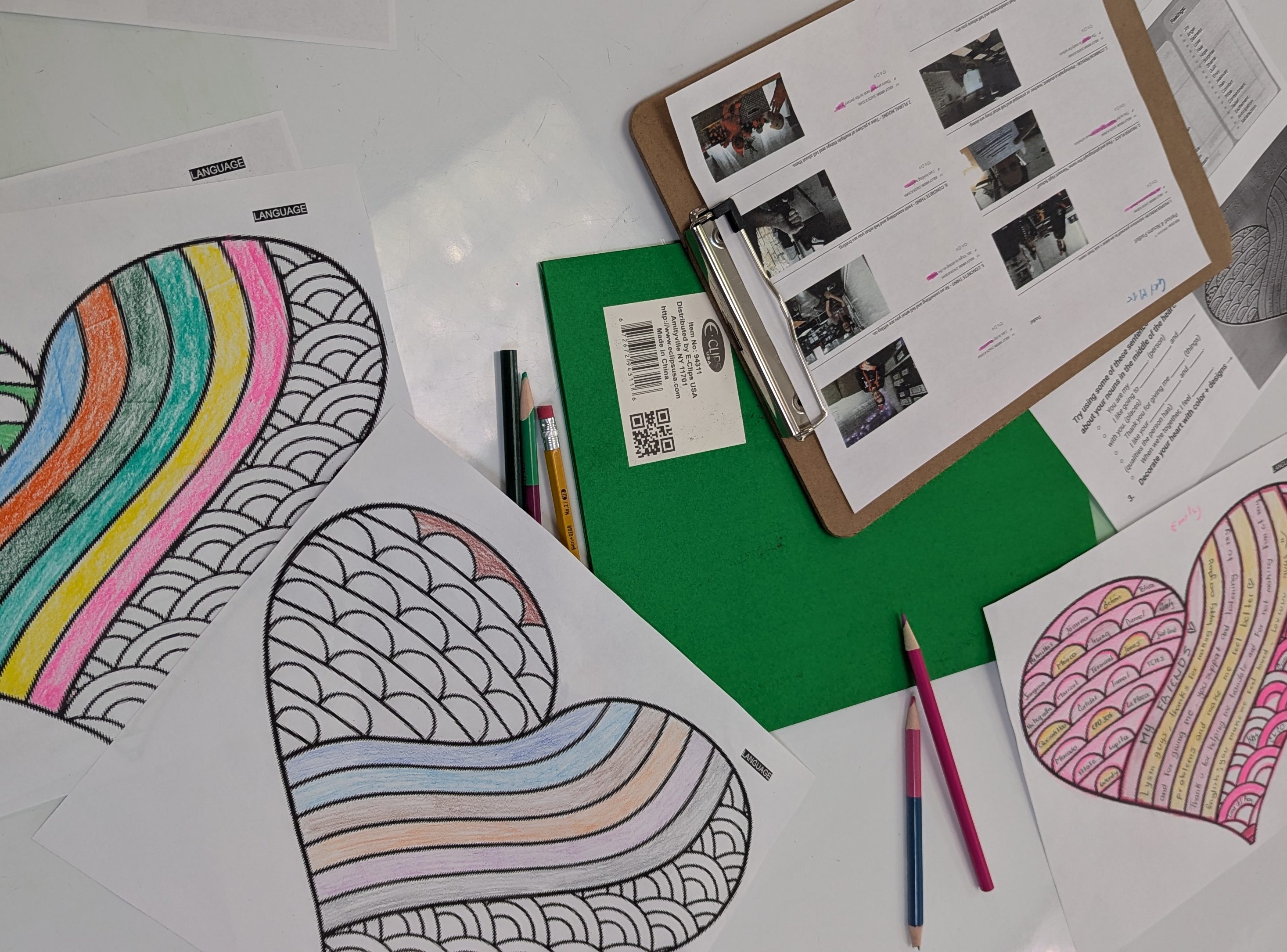
Because this project happens the week before Valentine’s Day, I encourage students to color their hearts and give them to their people as a valentine. It’s a simple addition that adds motivation and joy—providing an authentic audience always enhances any writing task.

In the end, this work solidifies the fact that grammar is not a set of rules to memorize, but a living part of language. When students use grammar to express their identity, relationships, and gratitude, it becomes meaningful and human. Students aren’t practicing grammar in isolation – they’re using it to communicate ideas that matter to them. In this way, it lives in their reading, their writing, and their lives beyond the classroom.


Kelly Virgin is a WCWP teacher leader who teaches high school English for the Kennett Consolidated School District.

From the Classroom: Many Languages in the English Classroom

By Lauren Heimlich Foley

The more I ask questions and learn about my students, the more I can guide them to make reading and writing choices that intrinsically motivate them and support their authentic selves.

Last September, Samantha refused to include dialogue in her micro fiction and Rob rejected internal thoughts in his memoir. After individually speaking with them and asking questions, I learned that language was holding them back. Because Samantha spoke in a language other than English at home and Rob thought in a language other than English, including dialogue and internal thoughts felt impossible. However, after our student-teacher conferences, these students took a writing risk and became mentors within our classroom.

In their final pieces, Samantha included her mom speaking to her in Albanian and Rob included internal thoughts—and his conversation with his mom—in Spanish. Their writerly struggles and accomplishments made me reflect. I reconsidered the way I taught dialogue and internal thoughts because I wanted to honor all of the languages my students spoke. Additionally,  I asked myself how I could further maximize the authenticity of all students’ writing pieces and incorporate a cross-curricular learning opportunity with the eighth grade Spanish and French curricula. To support this risk-taking, my classes explored how writers use language to enrich their writing. All student names are pseudonyms.

With Samantha and Rob’s permission, their pieces became mentor texts for their classmates. I coupled their work with young adult novels that exemplified this technique: The Astonishing Color of After, The Book Thief, Inside Out and Back Again, Salt to the Sea, and The Poet X. Three of the five texts were independent reading books that my students volunteered for the mini-lesson. I would also add Resistance to this list. Samantha and Rob helped lead the mini-lesson in their respective class periods, explaining why they choose this technique. I shared their work with my other classes. Afterwards, students explored the books. They collected a list of how the technique worked in the larger text and how authors helped their readers understand the meaning of new words.

After this initial mini-lesson, other students began employing a second language in their writing. For instance, one student wrote about the Holocaust and asked her neighbor to help her with the German dialogue she included. Another student, who spoke Russian, included authentic dialogue in his personal narrative camping trip. As students continued to refer back to the initial mini-lesson, they taught me and their fellow classmates about their lives and expertise. We learned about one another and were inclusive of one another. Furthermore, students contemplated how to make their writing as accurate as possible.

Fast forward to January 2020 and students are independently reading nonfiction or narrative nonfiction books. Their reading is two-fold; they are learning about something that interests them while simultaneously studying author craft. We are combining the reading unit with a researched, self-selected writing piece. Students are selecting topics, conducting research, picking genres, determining purposes, and choosing audiences. As they read like writers, they are noticing that many authors include languages specific to the topic, culture, and location of the subject matter. Particularly, one student pointed out a page in I am Malala. As writers and researchers, my students are considering how they might include this craft move in their final products.

In the future, I would like to invite students to explore authors such as Christopher Paolini who use made-up languages in their fantasy books. I am curious to see the impact of language creation on my middle schoolers’ fantasy and dystopian writing.