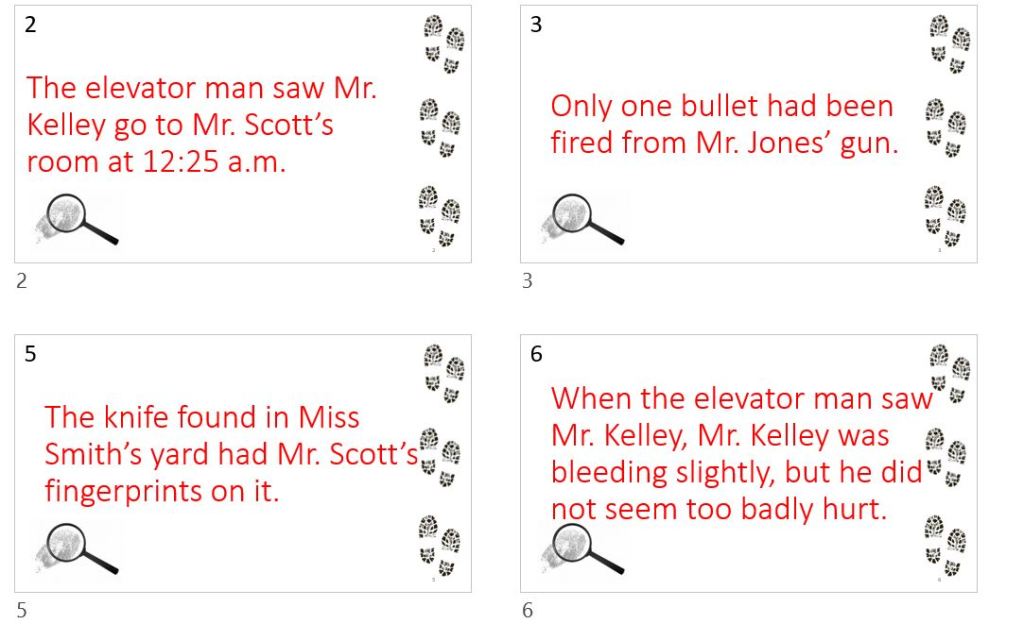
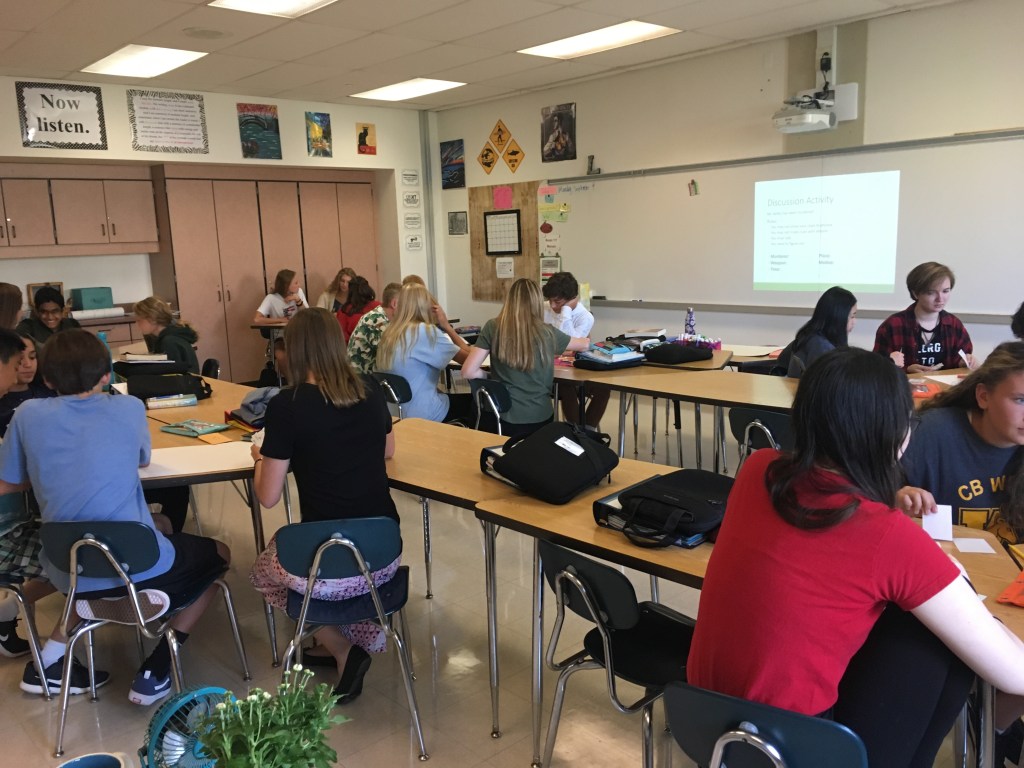
Students are given groups, clues, scratch paper, and twenty-five minutes. They have everything they need to figure out who murdered Mr. Kelley.
I started doing this activity a few years ago when I found that my students either didn’t like to participate in group discussions or struggled to have conversations with peers that weren’t their friends. I started searching around, and I found a murder-mystery discussion activity.
I adapted it to suit my needs, piloted it, and it is now part of my opening week lessons.
When placing the students in their groups for the period, I try to pair them up with people I haven’t seen them interact with as much. I want to build community within our classroom. Students are dealt clues, and they are the only ones allowed to read their clues out loud. This is an easy way to make sure everyone within the group participates and that no person dominates the conversation.
Students work together, organize information, and collaborate and communicate with one another. Once the murder is solved, we discuss the importance of sharing ideas with one another, working together, and thinking critically. The students really enjoy the activity and it does a great job of highlighting the idea that everyone can make valuable contributions to a discussion.
I have used one-pagers before in the context of literature courses, asking students to respond to a book or a reading. But, during the first week of classes, when my first year writing students began thinking about their literacy narratives, I decided to try out something new (for me, at least): to use the one-pager as a brainstorming tool.
Why use a one-pager?
Students are creating narratives, so allowing a visual representation in the brainstorming process can help them think about important details.
They don’t need to write complete sentences. The prompts I gave them asked more about the general aspects of their stories: Who are the characters? What visuals stand out? What are some of the keywords in your narrative? Are there quotes or ideas that could become dialogue? Etc.
Students don’t have to be artists. They just need to convey their ideas in short textual or visual representations.
What did I ask them to do?
I first explained what a one-pager is and why we were using it for further brainstorming. On the previous class meeting, students had produced a list of potential topics for their literacy narrative. On this class meeting, they narrowed it down to the one they would develop.
Before starting their own, I showed students examples of one-pagers from my previous students. I explained that these were a little different because they were responses to a book rather than ideas about their own writing.
I projected on the screen the following list of elements to include in their one-pager:
■A border with key words about your narrative. It can also be a quote you remember.
■Tone. What tone will you take? How will you achieve it?
■An image or set of images that relate to your narrative. Think about what you are including and why. Write about them.
■Key events in your narrative. You can list them, sketch them, or both.
■Characters in your narrative. Who plays a part? How are they part of your story?
■Lines- think about dialogue (this can be “made up”)
What happened?
While including the main components, students created a variety of one-pagers. And each one addressed the individual needs of each writer. One student, for instance, brainstormed ideas learning to use a computer when they were little. In their one-pager, they sketched a keyboard that, instead of letters, was covered in what looked like chicken feet. As the student explained, thinking about their first time trying to use a computer, this is what the keyboard looked like– just indiscernible and confusing characters.
The verdict: The one-pagers worked! My students were able to brainstorm in textual and visual ways, with some structure yet also freedom. Next time, I will consider allow more time in class for this so that their one-pagers can be even more detailed.
How have you used one-pagers with students? What are some brainstorming strategies your students have enjoyed?
Consider seven surprises from the start of the year:
A 6th-grade girl dancing and leaping like Isadora Duncan all by herself. Easily 100 yards away from everyone out in the fields by our school–a happy little pink speck twirling and flickering across the grass.
An 8th-grade boy handed me a knitted blue heart on his way out of class and said “there’s a really interesting project going on with these”: The Peyton Heart Project.
I saw $25 dollars in cash outside. I’m “used to” seeing kids’ smartphones left unattended outdoors, but we’re doing cash now?
The student who said: “I. Am. SO. Going. To. Raid. Your. Bookcase.”
And the boy who wore a full Spiderman costume to Picture Day and the rest of the kids didn’t blink.
And the magic that happens when we provide kids colored chalk, an asphalt surface, and time.
Educator’s curate and plan. Administrators curate and plan. The top-down model of “doing business” is real. Yet, so much of our vocation is steeped in holistic responses–the “intimate and inexplicable connections”–generated within our small communities.
The seven surprises shared above may seem unconnected but that isn’t true. They all have something in common.
Me.
I was there.
And each act of creativity, sincerity, or folly can be impacted by my responsiveness…or silence.
I haven’t shared if or how I may have responded, but I know I can be better. I am reminded that, even after twenty-five years in the classroom, we have so much to learn…and give.
Opportunities to give emerge in unexpected ways every day.
I collaborate with students at Penn State Brandywine’s Writing Studio amid a culture clash. I tutor first-year writers one-on-one weekly; for many students, this is the first time they’re receiving sustained, individual educational attention. This year, Penn State’s professors, drawing from generations of institutional and social power, will expect students to compose using standardized citation, annotation, Standard American English grammar, and critical literacy skills. Meanwhile, our students speak and write a plurality of grammars. They grew up among multiple family and community literacies. Faculty and staff may expect students to navigate college as their primary, if not singular, responsibility. Our students hold themselves personally responsible for much more.
Brandywine’s campus is the second most diverse student community in the Penn State system. My intention this year is to hold space for our differences. When we open intercultural dialogue, my students and I can better acclimate and build a shared community. Previously, I began every semester by reviewing the tutorial’s syllabus: I led with my expectations; I created the terms of a contract for students. I’ve defined students’ success, even delineating their acceptable boundaries for resistance (students are allowed two missed tutorials). My power defined our first communication. This year, I will ask, not tell:
What are your expectations for yourself and for me?
How do you define success as an individual writer and as writing partners, together?
What will we do when we encounter misunderstanding or conflict?
How can we hold each other responsible and accountable for our goals and intentions?
Importantly, we both share our answers to these questions. Exploring difference early and developing shared agreements will hopefully reduce students’ isolation when they encounter different values later on. Hopefully, we’ll begin a conversation that makes visible our intercultural exchange and we’ll return to that conversation throughout the semester. I have the privilege of cultivating individual relationships at the Writing Studio. I want to advance that by respecting students’ unique experiences, histories, and strengths as the foundation for their progress.
As a new school year begins, teachers come armed with new or revised lesson plans and renewed excitement ready to give our students the best of ourselves so that they can be their best selves. Sometimes giving the best of ourselves comes with a price. In our quest to be a great teacher as well as parent, partner, caregiver, or one of the many other titles each of us wear, we often put our own needs last, which is the worst thing we could do to ourselves. In my quest to redefine my work/life balance and reduce school year stress, I read many self-help articles and had several conversations with my daughter and sister, both of whom work in the mental health field, and found many commonalities. Here are a few strategies that stood out to me. I hope at least one will work for you.
Prioritize – Be sure that you differentiate between what “must” and what you would “like” to get accomplished.
Be realistic; you cannot do everything.
Make a schedule to help you use your time more efficiently.
Schedule “Me Time” – If you don’t put yourself on your calendar chances are you will not make or take time for yourself.
Get a massage.
Take in a movie.
Meet up with a friend.
Read for pleasure
Manage Your Mind – The most important voice in your life is your own. Listen to your body and practice positive self-talk. Don’t beat yourself up. When feeling stressed take a mini break.
Close your eyes and take a few deep breaths.
Take a walk.
Listen to music.
Look at cherished pictures – your kids, grandkids, a favorite vacation spot.
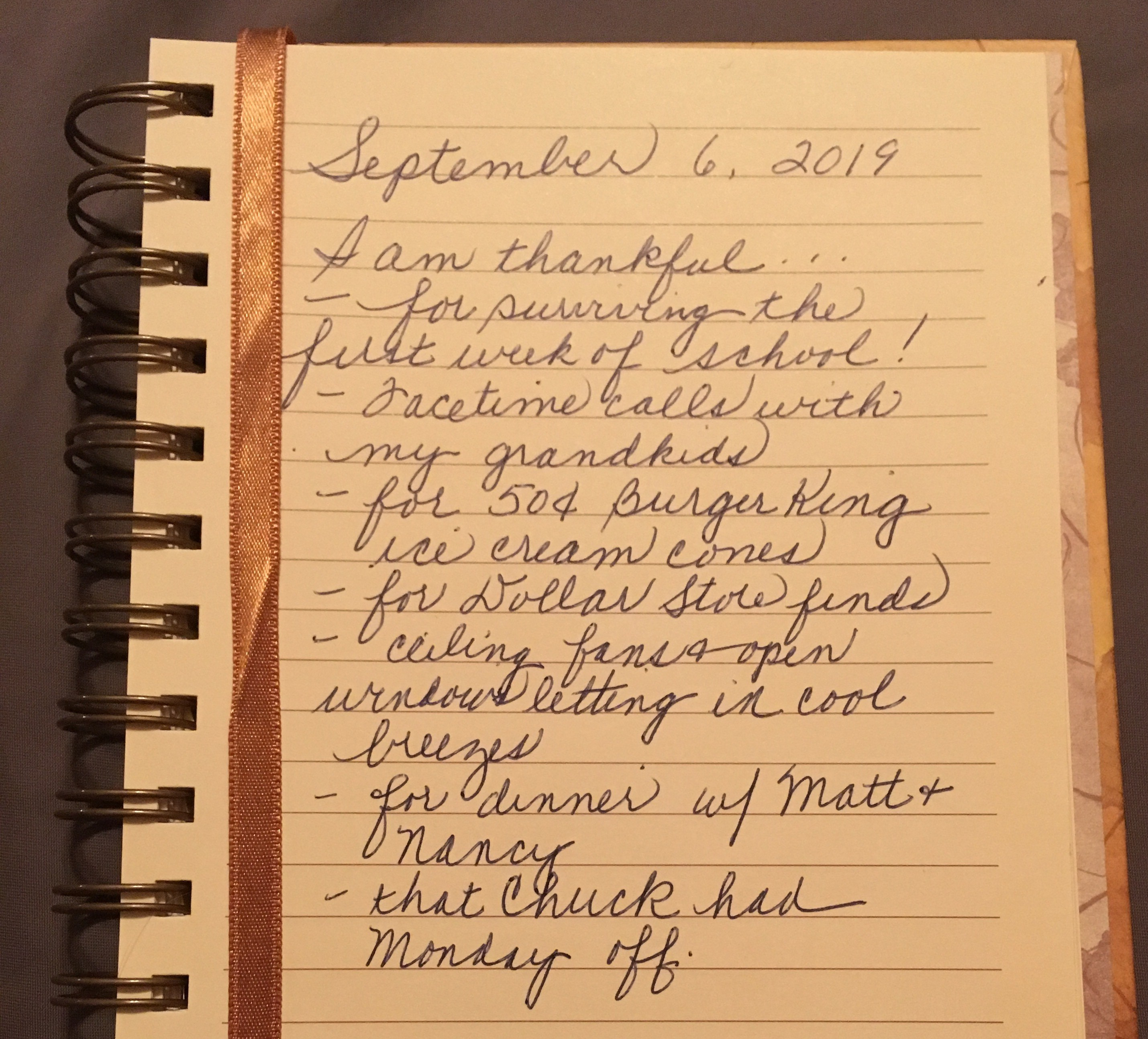
Keep a Gratitude Journal – At the end of the school day or before you go to bed, take a few minutes to reflect on your day and write down a few things for which you are thankful. Not only will this help you to focus on the positive parts of your day, but on a difficult day you can revisit your entries and assure yourself that “this too shall pass.”
A page from my own gratitude journal
Establish Boundaries – While you may not have a “job” that allows you to leave work at work, you do not have to be available 24/7.
Decide on a reasonable time to “unplug” each evening to stop checking your work email.
Establish a time limit for grading or engaging in social media.
Stop saying “Yes,” to every request. Be selective with how you use your precious free time.
These are just a few suggestions and strategies. Obviously, you may not be able to do this right away but choose one and start small. If you have others to add to the list, please share them in the comment section below. Teachers do important work. We can’t make a difference in the lives of our students if we don’t treat ourselves with respect and kindness. We are all in this together!
Rita DiCarne is a 2000 PAWLP Writing Fellow. She teaches 7th grade ELA at Our Lady of Mercy Regional Catholic School in Maple Glen, PA. Rita married her high school sweetheart 39 years ago and with him she shares two wonderful children, their fabulous spouses, and four fantastic grandchildren!
Feedback. The daunting and mystical term prompting students to fill their peer’s pages with “good job” and “nice work.” As teachers, we want more—so we change the word to effective feedback. The result of which garners students to share “really good job!” and “I love it!” This is when teacher frustration ensues, as we pull our hair and turn red trying to explain what effective feedback actually is.
My first time hearing about the idea of effective feedback was during a PAWLP summer institute course. Our guest speaker, Brian Kelley, discussed the idea of teaching students what effective feedback is and how to use it—a simple concept that changed everything for me. In the past, I had some sort of mini-lesson that included what feedback is, with a few brief sentence starters to generate conversation among students. This was fine, but not great.
This month, the students and I will spend a day discussing and practicing effective feedback. My plan for the day begins with a writing prompt. I will show “Paul Delvaux: The Village of the Mermaids” by Lisel Mueller— since it is the beginning of the year and the climate of the room is still forming, it is important to create a prompt that students will readily share with a peer they may not hold a relationship with.
Once students complete their writing, instruction on effective feedback begins. This includes providing a definition of effective feedback and showing examples of comments/feedback from social media posts. Sharing these examples not only attracts student attention, but also provides a platform to discuss what works and does not work in the comments/feedback.
Next, it is time to review the six terms in sharing effective feedback—praise, encourage, resonate, gentle pressure, model, and respectful opposition—along with their sentence starters. This is when the English nerd comes out of me, which happens quite regularly, where the students and I engage in a lively discussion of, “which term is your favorite?” or “how would you use this with partner?” Working with seventh graders, this always turns silly, mimicking a “would you rather…” style conversation.
Finally, we practice. I use a website (http://flippity.net/) to break students up into groups—this site is worth trying in your opening months of school to randomize students into group sizes of your choice as well as generate conversation among those who do not normally engage with one another. In these groups, students will exchange their opening writing passages and begin providing each other with effective feedback. Tip: keep the terms and their meaning projected on the board as well as provide students with an effective feedback handout to complete.
This is the first of many moments in my classroom practicing this skill. Not only will students learn to review each other’s work, but they also learn to accept the feedback and revise. Revision is another lesson for another day.


 Rita DiCarne is a 2000 PAWLP Writing Fellow. She teaches 7th grade ELA at Our Lady of Mercy Regional Catholic School in Maple Glen, PA. Rita married her high school sweetheart 39 years ago and with him she shares two wonderful children, their fabulous spouses, and four fantastic grandchildren!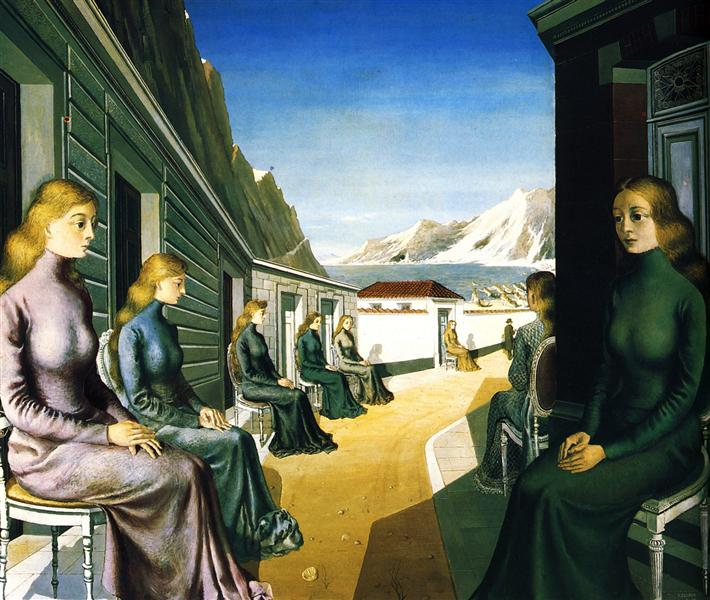






 write.share.connect