Skip to content

Posts from the ‘Book Reviews’ Category

Book Review: The Island of Dr. Libris

island-dr-libris-200

Two weeks ago, we featured some must-read YA titles and last week, we took at a professional title with a review of Tom Newkirk’s latest book. This week, we continue with book recommendations from two more wonderful librarians. First up: a review by Chris Kehan of the Chris Grabenstein’s upcoming book, The Island of Dr. Libris. And tomorrow, don’t forget to come back to check out some middle-school recommendations!

By Chris Kehan

As a librarian I get the privilege of getting the Advanced Reader’s Copy of a book.  I recently had the pleasure of reading The Island of Dr. Libris by Chris Grabenstein.  Chris Grabenstein is the author the New York Times best-seller, Escape from Mr. Lemoncello’s Library.  He is also the co-author of the I Funny, Treasure Hunters, and House of Robots series with James Patterson. Read more

Resolve to Read this Book: A Review of Minds Made for Stories

minds made for stories newkirkBy Judy Jester

It’s not often that I read aloud to my husband from “teacher” books, but I found myself doing so from Tom Newkirk’s latest work as often as I was from Steven Johnson’s How We Got To Now on our recent road trip to Cleveland. The former, Minds Made For Stories: How We Really Read and Write Informational and Persuasive Texts, knocked me out with its treasure trove of facts (not all related to writing) just as much as the latter did. Read more

YA Book Love

This week, we’re thrilled to have librarian Lisa Teixeira with us to share some titles that will no doubt appeal to high school students. Lisa has been leading book discussions with her school book club—Better Than Oprah—playing literacy games with visiting English classes, teaching information literacy to students, and reading lots of wonderful YA literature.

The following 7 books (7 is her lucky birthday number, which she actually shares with her favorite YA author, Sherman Alexie) are her favorites from the past year. Read more

Give Yourself a Gift of Reading

With the holidays here, we hope that amidst the busyness of unwrapping presents and getting together with friends and family, perhaps you’ll find a moment or two to give yourself a gift… the gift of a good book. We asked some of our PAWLP Fellows for book suggestions, and below you’ll find a few of their responses. What could be better than a good book, some hot chocolate, and a warm fire?  Wishing you and yours happy reading this holiday season! Read more

The Writing Conference in Nancie Atwell’s Room (Part 2)

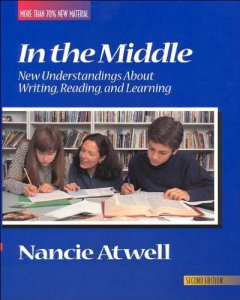
in the middleBy Donald LaBranche

This is a continuation of last week’s review of the two editions of Nancie Atwell’s In the Middle. Click here to read Part 1.

  • In the ’87 edition of In the Middle Atwell explains that there are multiple types of conferences for different purposes. She identified several, but for brevity’s sake, I’ll focus on two of these: the Status of the Class Conference, and the Conference for Content.

Read more

The Writing Conference in Nancie Atwell’s Room (Part 1)

By Donald LaBranche

A summary from two editions of In the Middle

  • I see no reason to spend your life writing poems unless your goal is to write great poems.  –Donald Hall, “Poetry and Ambition”, 1983
  • Here is what I remember: She dismisses her students to go to their seats to write with the benediction “Work hard. Make Literature.” The children—eighteen seventh and eighth graders—move with practiced and confident precision back to their places to pick up with their poems, stories, letters to the local editor, or memoirs about a summer adventure.  After a few minutes of waiting for her writers to find their rhythm, the teacher takes up her clipboard and small bench and starts to move around the classroom. It’s March so she doesn’t have to start each conference with an open ended question any more, the conversations between her and her student-writers are on-going and serious. They are built on a foundation of mutual trust and respect, an understanding of the craft of writing, of the needs and desires of each student as a writer in the moment, and a deep understanding of learning theory and adolescent development. She sits down next to a writer and they talk about the work: what stage it’s in, what’s working and what’s not, where it might go from here. Then she moves on to the next conversation.

Read more