Skip to content

Posts from the ‘PAWLP’ Category

A Writerly Life: Wisdom from Katie Wood Ray
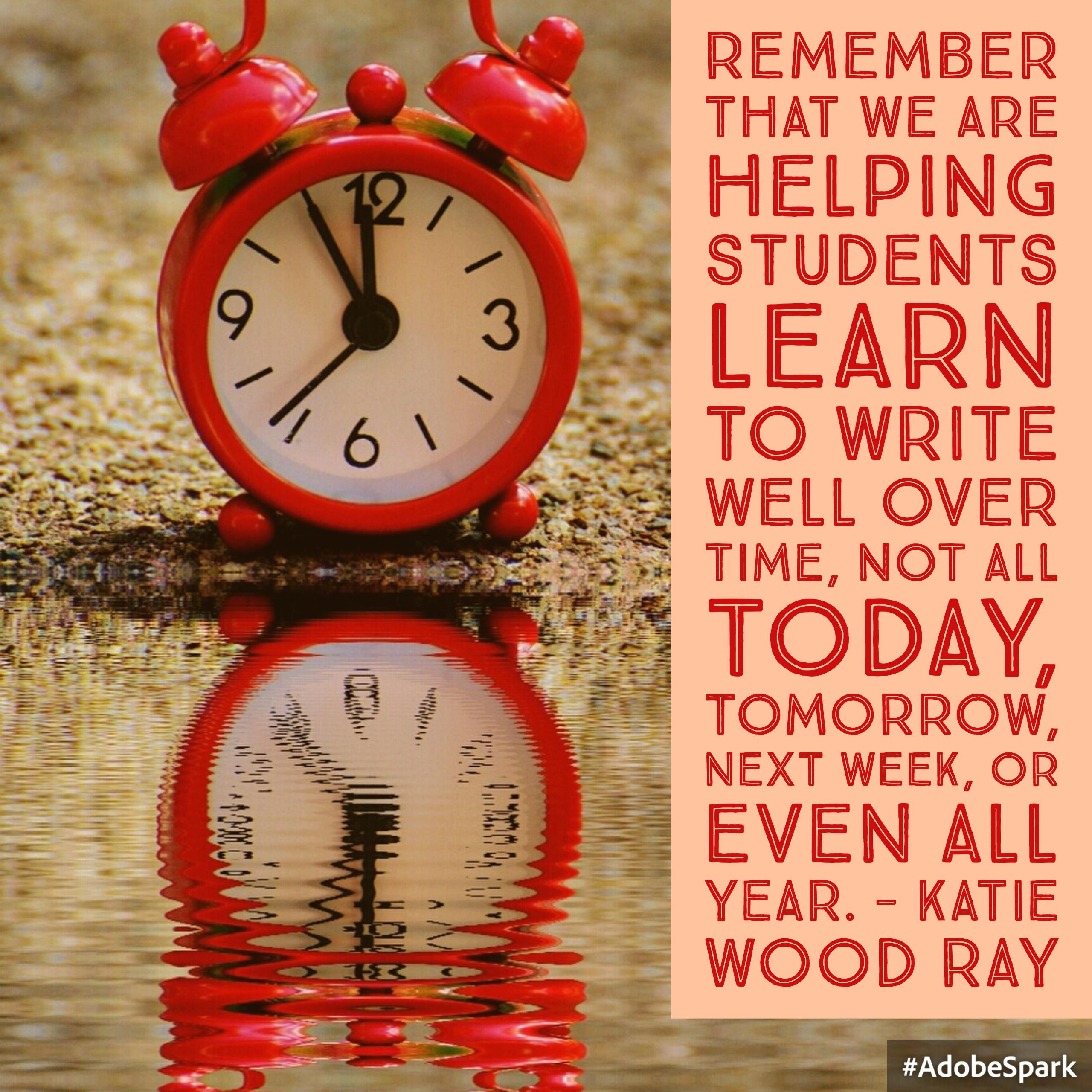
Melissa H Katie Wood Ray quote 1

This quote reminds us all to teach alongside our students, at whatever level that may be.  We are teaching a process, not a product. – W2016 PAWLP Fellow Melissa Hurwitz

A Writerly Life: Wisdom from Ralph Fletcher

This is a quotation that captures how I hope my students will feel about their notebooks next year. Bernadette Langdon  PAWLP Fellow 2016

From the Classroom: The Pressure to Do Versus the Possibilities of Doing

by Tricia Ebarvia

Whenever I blog, especially here for PAWLP, I try to offer fellow teachers some practical strategies to use in the classroom. After all, I know how I much I appreciate picking up ideas that I can try with my own students right away, sometimes even the very next day.

Of course, now that summer is just about here—tomorrow is our last official day with students!—there is no more “very next day.” Instead, as the weather warms and lazy days at the pool run together, the planning for next year begins. Sometimes the planning is purposeful: reading pedagogy texts or writing up lesson ideas. But other times, the planning is a little more serendipitous: stumbling upon the perfect article for class or finding inspiration while on an errand to the store. Summer may be here, but I’ve found that my “teacher brain” never really goes on vacation.

Without the pressure of “the very next day,” the ideas I come across during summer have room to sit, and breathe. There’s no pressure to do—simply the possibilities of doing. The extra time summer offers allows me to think this could work or maybe I’ll try this or what could that look like?

Summer, then, becomes a time to reflect on another year gone by and to gather new ideas for the year ahead. How? Below are just a few of the things I’ll be doing this summer to reflect and re-energize:  Read more

Teacher-to-Teacher: End-of-Year Epiphanies

Adobe Spark (22)

By Janice Ewing

My grad class is small this term, a seminar-like community with lots of conversation and sharing of ideas and experiences. The comfort level among the group is a welcome respite at a time when everyone is striving to fulfill end-of-year requirements and scrambling to reach unmet goals, while keeping up with grad school and family obligations.

Recently, a few of the teachers shared experiences that were unexpectedly positive and rewarding. For example, Anne (names have been changed) teaches in an alternative high school for students who have previously dropped out or taken other detours from the traditional path to graduation. Most, if not all, have had struggles and negative experiences with reading, robbing them of the pleasurable experience of getting caught up in a book. By chance, Anne acquired a large enough collection of Walter Dean Myers’ Monster to accommodate her small class. She had not read the book, but had read reviews and commentaries and it seemed like a great fit for her students. She decided to jump in without reading it ahead, which was not her usual practice. Next issue: a well-meaning colleague pointed out that there were related “packets’ available, which would provide questions, prompts, discussion points, etc. An inner voice told her to forgo the packets, and she listened to it.  Read more

Author’s Corner: Dianne Salerni

We are thrilled to introduce a new series to our blog site—The Author’s Corner. We are so fortunate to have so many PAWLP friends and fellows who are authors willing to share their writing processes with us and our readers. For our first entry in our Author’s Corner, please welcome Dianne Salerni. . . 

Six Stages of Accepting Editorial Feedback

By Dianne Salerni

I’m sure I’m not the only writer who hyperventilates when an email with feedback turns up in my in-box. It might be from a critique partner, a trusted beta reader, or feedback won in a contest from someone you don’t even know. Further down the road, it might be from your agent, or an official revision letter from the editor who acquired your book.
Read more

From the Classroom: Second Draft Reading

by Tricia Ebarvia

As I walk around the room, I notice students talking—generally enthusiastically—about the book we are reading. They have a few discussion questions on a handout to take notes, which they dutifully fill out. What I don’t notice are any books open on their desks. In fact, I see many students with no books out at all, and what books are out are closed on their desks.

“Mrs. Ebarvia, do you know remember what Piggy said to Jack when they went to Castle Rock?”

“Sure, I remember.”

Pause. Expectant looks.

“You know, you could open your book to find out,” I suggest. My students smile and begin searching their books.

Years ago, when I first read Kelly Gallagher’s Deeper Reading during the PAWLP summer institute, one particular section that stood out to me was the chapter on “Deepening Comprehension through Second-Draft Reading.” In this chapter, Gallagher emphasizes the importance of getting students to go back to the text to reread:

Students need to return to the text to help them overcome their initial confusion, to work through the unfamiliarity of the work, to move beyond the literal, and to free up cognitive space for higher-level thinking. They need both a “down” reading draft to comprehend the basics and an “up” reading draft to explore the meaning. (80)

Those who have been teaching English long enough know that getting students to go back to the text can often be a difficult task. Having gotten the “jist” of the story on their first reading, students often see no need to go back to the text unless prompted.

Yet we also know that rereading is one of the first steps towards a deeper understanding of a text. When students reread, they can better appreciate craft—they can see the choices that an author made and question why. When a text is complex and students don’t “get it” the first time, rereading is not only a valuable but necessary move that students can make.

So how do we encourage students to go back to the text—to explore the text a second, or even third time?  Read more