A Writerly Life: Words of Wisdom from Donald Graves
This post is a reminder that conventions and content work together to give words power.
– Melissa Weathers (2017 Grammar Matters Participant)

Aug 12
This post is a reminder that conventions and content work together to give words power.
– Melissa Weathers (2017 Grammar Matters Participant)
Aug 9
by Kelly Virgin
Late this past March I spent two beautiful spring days holed up in a conference room in D.C. feeling both overwhelmed and excited by four letters: CRWP (now known as C3WP). The College, Career, and Community Writers Program is a National Writing Project initiative aimed at providing teachers across the nation with resources needed to help their students critically read and analyze multiple points of view in an attempt to responsibly enter the civic dialogue. As their website explains, the program “answers the contemporary call for respectful argumentative discourse.” In an attempt to reach this lofty, yet vital goal, NWP has gathered and created an impressive stockpile of mini-units complete with suggested text-sets, graphic organizers, audio and visual materials, formative and summative assessments, and suggested extension activities.

In the months following my brief introduction to this program, I spent numerous hours mining the provided resources in an attempt to meaningfully pass the information along to fourteen teacher-leaders through PAWLP’s Advanced Institute. While I still feel slightly overwhelmed by all the possibilities of the program, the three intensive days I spent locked away this summer with a group of thoughtful and inquisitive teachers helped me boil it down to three essential elements: time, access to multiple perspectives, and the freedom to choose. With these three key elements in mind, any teacher can start to meaningfully engage his or her students in thoughtful, thought-provoking, and responsible argument writing. Read more
When writing is meaningful to us, we’ll work at it until it makes us smile (. . . or cry).
-Melissa Radico (2017 Grammar Matters Participant)

Aug 2
By Janice Ewing
My husband and I just got back from the West Coast, and we’re still adjusting to the three-hour time change. Our 10:30 p.m. flight out of Portland, Oregon arrived in Philadelphia at 6:30 a.m., just in time to start a new day, or was it 3:30 a.m., time to go back to sleep? This recent experience got me thinking about the whole concept of time – how we perceive it, yield to it, and/or shape it to meet our needs. Read more
After an amazing week of learning from and listening to many unique voices in Grammar Matters, I am reminded how important it is to keep sharing what we have to say with others. I’m eager to continue to hear what these unique voices have to offer.
-Kelly Virgin (2017 Grammar Matters Co-Facilitator)

Jul 26
by Maria Walther
Today is the first day of my summer break (Woo hoo!) and, like many of you, I’m reflecting on the past year and already rethinking things for fall. What do I want to change, tweak, or keep the same? If you find yourself in the same mindset, I thought I’d offer a few ideas to ponder as you set up your classroom and plan the first days with students.
Take a Peek
Even after 31 years of teaching, I still rearrange my classroom to create the most kid-friendly learning environment. A few years ago, I noticed that the first thing my kids saw when they walked into my classroom was the trash can. Hmmmm! What message does that send? How could I fix that? I did a little rearranging and was able to change the view. Now, the first thing children (and adults) see when they peek into my classroom is an A-frame shelf filled with books—covers facing out. 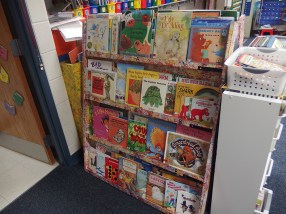
If you know someone handy with a hammer and a saw, my husband drew up the plans for this easy-to-make shelf and you can access them here. http://mariawalther.com/images/AFrameShelfPlansWalther.pdf
I realize that not everyone has enough room in their teaching space for a bookshelf inside the door. If this is the case, here are some other ways to place books up front. Set up an easel or small shelf outside your door, or simply display book covers of your (or your students’ favorite books) on the door. Read more




 write.share.connect